













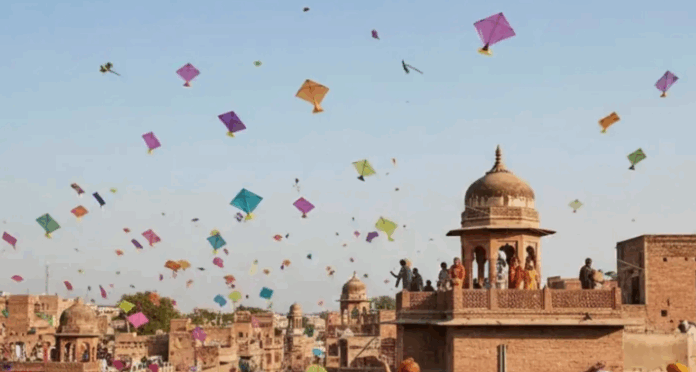
LAHORE: The skyline over Lahore turned into a shifting mosaic of colour as Basant returned, with rooftops crowded, music blaring and chants of “Bo-kata” rising above neighbourhoods across the city.
From the Walled City to newer commercial centres, kites of every shape and shade drifted in the winter sun while families gathered on terraces decorated with buntings and loudspeakers. Children leaned over parapets to track duels in the sky, elders supervised spools of string, and groups broke into bhangra as severed kites fluttered down into streets and courtyards.
The festival’s revival, after years of restrictions linked to safety concerns, came with visible government oversight. Large billboards carrying kite imagery appeared along major roads and intersections, and police patrols were seen moving through busy localities to enforce standard operating procedures.
Officials repeatedly warned against the use of hazardous string and aerial firing, urging citizens to celebrate responsibly.
Chief Minister Maryam Nawaz visited Liberty Chowk and Mochi Gate during the festivities, where she interacted with residents and traders. She said motorcycles would not be banned during Basant but the use of protective safety rods would be strictly enforced to reduce injuries from kite string. In a public message, she called on people to enjoy the festival while observing safety rules.
Traders described an unprecedented rush in kite and string markets. Traditional hubs such as Mochi Gate, Islampura and Samanabad remained packed from morning till late night, while Liberty Chowk emerged as a new focal point for celebrations and sales. Shopkeepers said stocks were replenished repeatedly as demand outpaced supply.
Representatives of the Kite Flying Association estimated that around one million kites were sold in a single day earlier in the week, along with more than 20,000 spools of string. Prices rose sharply amid the surge in demand. A one and a half tawa kite sold for about Rs700, a one tawa for Rs400 and a pauna tawa for Rs300, while premium two-piece spools ranged between Rs12,000 and Rs15,000 depending on length and quality.
According to the association, trade volumes climbed steadily over several days, crossing hundreds of millions of rupees and pushing cumulative sales past Rs1.5 billion by the fifth day of activity.
For many residents, the festival was as much about reclaiming a public tradition as it was about kite flying. From the Walled City to newer neighbourhoods, families gathered on rooftops from morning, flying kites, playing music, dancing bhangra and sharing food. The festival atmosphere extended well into the streets, where vendors, food stalls and temporary setups added to the celebratory mood that many residents said they had not witnessed in years.
Families shared food on rooftops, neighbours visited one another, and entire streets paused to watch intense kite battles unfolding overhead. The return of Basant, they said, restored a familiar rhythm to the city’s social life, blending celebration with renewed attention to safety.




istanbul nakliyat
istanbul nakliyat
istanbul nakliyat