








- PPP chairperson stresses legacy of Benazir Bhutto’s ‘truth and reconciliation’ message
- Warns PTI against extremism, says state will act according to law and Constitution
- Stresses opposition’s role amid security challenges on frontiers and rising terrorism
- Calls for electoral reforms to strengthen trust in Election Commission before polls
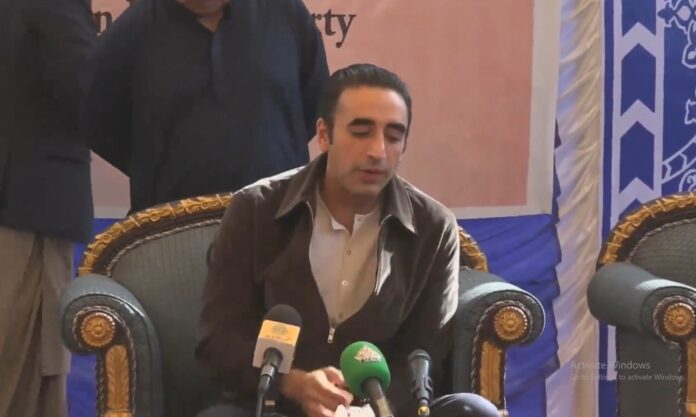
LARKANA: PPP Chairperson Bilawal Bhutto-Zardari on Sunday emphasized the urgent need for political reconciliation in Pakistan, urging both the ruling party and opposition to play responsible roles to ensure political stability, national security, and economic progress. He highlighted that fostering a culture of tolerance and dialogue was critical to reducing political polarization and safeguarding the democratic process.
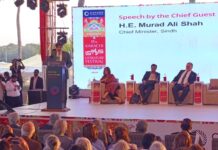
Bilawal made these remarks while speaking to the media at the inauguration of the Sindh Institute of Child Health and Neonatology in Larkana, where he recalled the legacy of his late mother, former Prime Minister Benazir Bhutto, and her enduring message of “truth and reconciliation” in politics. He stressed that both the ruling party and its allies must act proactively, while the opposition is expected to play a “responsible role” to support the country’s political and economic stability.
Chairman PPP @BBhuttoZardari inaugurated today the state-of-the-art, fully equipped intensive care units for children and newborns under the Sindh Institute of Child Health and Neonatology (SICHN) in Larkana.
Read More: https://t.co/VHvruUjECp pic.twitter.com/r7Jfkc4PkB
— PPP (@MediaCellPPP) December 28, 2025
“If stringent measures are taken in response to the politics of extremism, then there should be no complaints,” he remarked, quoting the English idiom, “if you can’t stand the heat, get out of the kitchen.” He added that if the opposition, particularly PTI, resorts to attacking national institutions over minor NAB (National Accountability Bureau) cases or small arrests of its leaders, the state will respond in strict accordance with the law and the Constitution. Bilawal emphasized that had PPP been in a similar position, the consequences would have been even more severe.
He urged PTI to abandon the “politics of extremism,” noting that such tactics would neither benefit the party nor its workers and would harm the political environment of the country. “Political reconciliation is the way forward,” he asserted, adding that creating an environment conducive to dialogue and compromise is vital to prevent further divisions that could adversely impact the nation.
Bilawal also highlighted the pivotal role of President Asif Ali Zardari in advancing Benazir Bhutto’s vision of political reconciliation. He noted that President Zardari, with his experience, track record, and public confidence, was best positioned to play a constructive role in fostering tolerance and dialogue among political forces. “From the first day after the election until yesterday, my stance has been that President Zardari will have to play his role,” Bilawal said.
He further pointed out the “unique dynamics” of the current situation, citing security challenges on the frontiers with India and Afghanistan and the rising threat of terrorism within the country. In this context, the role of opposition parties becomes especially critical. “If they operate like an extremist party, the state’s response will align accordingly. But if they adopt a political attitude, it can create space for reducing political polarization,” he explained.
Addressing recent calls for early elections by JUI-F chief Maulana Fazlur Rehman, Bilawal urged all political parties to focus on electoral reforms to enhance public trust in the Election Commission. He stressed that holding elections without reforms would only undermine credibility and could trigger political instability. He further cautioned against holding by-polls or general elections under flawed conditions, which could exacerbate tensions.
Bilawal also highlighted the need for a functional Parliament as a platform for dialogue, urging politicians and workers to take measures to promote tolerance and political space for constructive engagement. On the economic front, he warned of a “crisis of affordability” in the country, despite claims of improving economic indicators, and reaffirmed PPP’s support for public-private partnership models in privatization.
The PPP chairman emphasized that long-term solutions to Pakistan’s political, economic, and security challenges lie in genuine political stability. He called on all senior political leaders and parties to prioritize reconciliation and constructive engagement, warning that failure to do so would harm both the people and the country.


Really insightful post — Your article is very clearly written, i enjoyed reading it, can i ask you a question? you can also checkout this newbies in classied. iswap24.com. thank you