








— Deal reinforces PM and FM Asim Munir’s leadership in push for export-driven economy
— It also reflects Pakistan’s domestic industrial prowess and FM Asim Munir’s statesmanship
— The ’embargo’ on arms export to Libya is factually non-existent due to multiple reasons
— With this deal, Pakistan has announced its entry into the club of leading exporters of conventional arms and equipment
ISLAMABAD: Pakistan has reached a deal worth over $4 billion to sell military equipment to the Libyan National Army, four Pakistani officials said, despite a U.N. arms embargo on the fractured North African country.
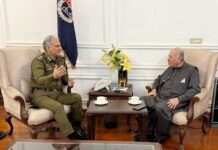
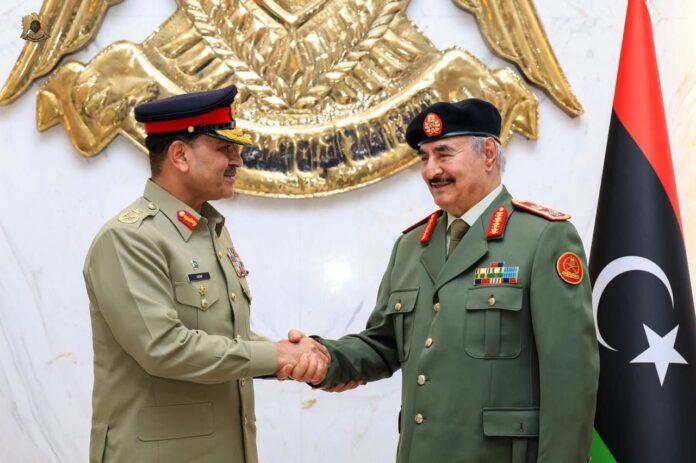
The deal, one of Pakistan’s largest-ever weapons sales, was finalised after a meeting last week between Pakistan military chief Field Marshal Asim Munir and Saddam Khalifa Haftar, deputy commander-in-chief of the LNA, in the eastern Libyan city of Benghazi, said the four officials.
The officials, all involved in defence matters, declined to be identified because of the sensitivity of the deal. Pakistan’s foreign ministry, defence ministry and military did not respond to requests for comment.
The multi-billion-dollar major conventional arms export deal by Pakistan to Libya is reflective of two key aspects.
The deal endorses PM Shahbaz Sharif and Field Marshal Asim Munir’s leadership for an export-driven self-sustained economy. It also reflects Pakistan’s domestic industrial prowess on one hand and FM Asim Munir’s statesmanship as a soldier diplomat on the other.
In recent past, Pakistan has made remarkable progress in developing its indigenous industrial base including mines and minerals, artificial intelligence, Information Technology, Crytpo currency, Large-scale manufacturing, Agriculture and defence technologies, etc.
Pakistan’s indigenous defence products were demonstrated and admired by all in the recent Mark-e-Haq. Pakistan has a long history of being a supplier of conventional arms and equipment to many countries for quite some time now. However, the deal struck with Libya is historic in terms of size and financial impact; a credit to Field Marshal Asim Munir’s extraordinary skills in military diplomacy.
On UN arms embargo on Libya, first it needs to acknowledge that many major Western and Middle East have been supplying weapons and equipment to Libya for many years. So, there is a paper embargo which is factually non-existent due to multiple reasons, not least that all parties are now selling to all since more than a decade.
With this deal, Pakistan has announced its entry into the club of leading exporters of conventional arms and equipment.
However, a Reuters report says the arms agreement with the LNA is likely to face scrutiny given Libya’s long-running instability following a 2011 NATO-backed uprising that toppled Muammar Gaddafi and split the country between rival authorities.
The LNA’s official media channel reported on Sunday that the faction had entered a defence cooperation pact with Pakistan, which included weapons sales, joint training and military manufacturing, without providing details.
“We announce the launch of a new phase of strategic military cooperation with Pakistan,” Haftar said in remarks broadcast on Sunday by Al-Hadath television.
Authorities in Benghazi also did not immediately respond to a request for comment.
The U.N.-recognised Government of National Unity, led by Prime Minister Abdulhamid Dbeibah, controls much of western Libya, while Haftar’s LNA controls the east and south, including major oilfields, and does not recognise the western government’s authority.
ARMS EMBARGO
Libya has been subject to a U.N. arms embargo since 2011, requiring approval from the U.N. for transfers of weapons and related material.
A panel of experts said in a December 2024 report to the U.N. that the arms embargo on Libya remained “ineffective”. The panel said some foreign states had become increasingly open about providing military training and assistance to forces in both eastern and western Libya despite the restrictions.
It was not immediately clear whether Pakistan or Libya had applied for any exemptions to the U.N. embargo.
Three of the Pakistani officials said the deal had not broken any U.N. weapons embargo.
One of the officials said Pakistan is not the only one to make deals with Libya; another said there are no sanctions on Haftar; and a third said Benghazi authorities are witnessing better relations with Western governments, given rising fuel exports.
PAKISTAN EYEING MARKETS
Pakistan has been seeking to expand defence exports, drawing on decades of counterinsurgency experience and a domestic defence industry that spans aircraft production and overhaul, armoured vehicles, munitions and naval construction.
Islamabad has cited its Air Force’s performance in clashes with India in May.
“Our recent war with India demonstrated our advanced capabilities to the world,” military chief Munir said in remarks broadcast by Al-Hadath on Sunday.
Pakistan has also been deepening security ties with Gulf partners, signing a Strategic Mutual Defence Agreement with Saudi Arabia, in September 2025 and holding senior-level defence talks with Qatar.
The Libya deal would expand Pakistan’s footprint in North Africa as regional and international powers compete for influence over Libya’s fragmented security institutions and oil-backed economy.

I was impressed by how the author integrates examples and reasoning to reinforce understanding, ensuring that abstract concepts are both accessible and memorable.