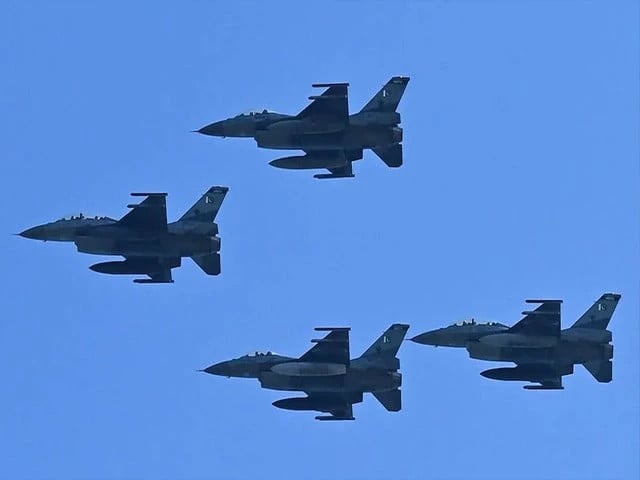
PAF chief hails Pakistan’s role as 'regional stabiliser' following May conflict with India


RISALPUR: Air Chief Marshal Zaheer Ahmed Baber Sidhu on Tuesday said Pakistan has established itself as a regional stabiliser following the May conflict with India, known as Marka-i-Haq.
Speaking at the passing out parade at the Pakistan Air Force Academy Asghar Khan in Risalpur, Khyber Pakhtunkhwa, ACM Sidhu credited the country’s success to coordinated national efforts and robust military capabilities. “As a responsible nuclear power, our ties with key regional and global players have strengthened, reflecting the results of sustained diplomacy and credible defence preparedness,” he said.
The Pakistan Army had named the period from the April 22 Pahalgam attack to the May 10 conclusion of Operation Bunyanum Marsoos as Marka-i-Haq. ACM Sidhu noted that Pakistan’s growing global significance drew attempts by adversaries to malign the country, implicitly referring to India.
“The people of Pakistan, alongside its armed forces, overcame an adversary with greater numbers,” the air chief said. “The success of Marka-i-Haq and Operation Bunyanum Marsoos resulted from a unified approach across national power elements, and above all, Allah’s blessing.”
He credited the national leadership, tri-service coordination, decisive decision-making, and full support from Field Marshal Syed Asim Munir for the outcome. Sidhu stressed that military strength depends on a value system grounded in character and credibility, noting that all PAF claims were supported by evidence and verifiable facts.
Acknowledging a complex regional and global environment, he emphasized Pakistan’s desire to maintain friendly relations with neighbours. “However, any challenge to our sovereignty will be met with a stronger and better-prepared response from our armed forces,” he warned.
ACM Sidhu highlighted that the PAF conducted its first full-spectrum multi-domain operation, integrating space, cyber, and electronic warfare with long-range assets, unmanned aerial systems, killer drones, and loitering munitions. He recalled the downing of multiple Indian jets on May 7, describing the engagement as one of the longest beyond-visual-range aerial battles in modern history.
Regarding the missile exchange on May 10, he said the Pakistan Army and Air Force struck enemy bases and ground assets, neutralising India’s advanced S-400 defence systems and command centres. “Operations were carefully calibrated to ensure peace with honour,” he said. He added that Pakistan’s multi-domain capabilities are now studied internationally by military professionals.
Sidhu underscored that the PAF’s performance was the result of long-term modernisation, indigenisation, and restructuring strategies. The air force adapted its operational doctrine to changing warfare dynamics, incorporating advanced combat and support systems under budget and technological constraints.
He highlighted the National Aerospace Science and Technology Park (NASTP) as central to the PAF’s multi-domain strategy, integrating indigenous unmanned systems, electronic warfare, space, and cyber capabilities. “The range of NASTP projects continues to expand rapidly, with several initiatives in development,” he said.
Addressing the graduating cadets, ACM Sidhu described them as future defenders of Pakistan’s airspace, trained under a paradigm shift that emphasizes technology, leadership, intellectual growth, resilience, and physical readiness. He also noted the participation of Saudi cadets, calling it a symbol of strong bilateral cooperation between the two nations’ armed forces.
Comments
No comments yet. Be the first to join the discussion!