


















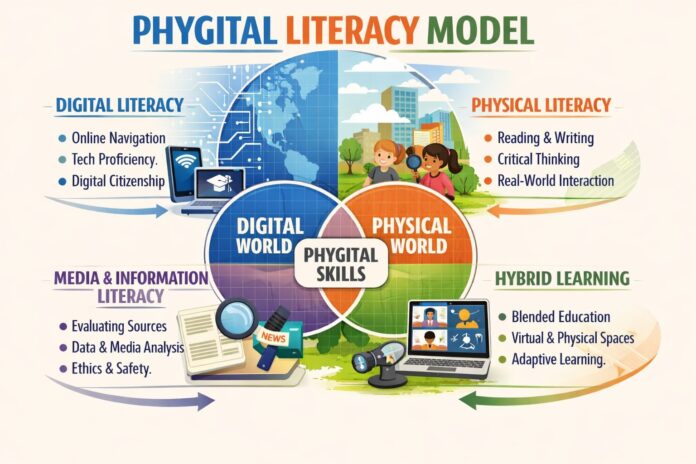
LAHORE: Pakistan has stepped into the global debate on the future of education with the unveiling of what is being described as the first comprehensive phygital literacy framework, following a high-level discussion at the Ministry of Federal Education and Professional Training.
The discussion took place between Wajiha Qamar, Minister of State for Federal Education and Professional Training, and renowned interdisciplinary researcher Prof Dr Aurangzeb Hafi, focusing on the launch of the Deca-archic Phygital Literacy Model.
According to a spokesperson for Asia & Oceania Post-Doctoral Academia (AOPDA), the model provides a structured conceptual framework for integrating ‘In Real Life’ (IRL) education systems with ‘In Virtual Life’ (IVL) education systems, while preserving their distinct operational and cognitive boundaries.
At the core of the model is a clear demarcation between what Prof Hafi terms the Real Life Data (RLD) System and the Cyber-space Data (CSD) system. To explain and manage the interaction between the two, the model introduces a novel analytical concept referred to as ‘Phygital Differential Calculus’, aimed at evaluating how learners process information across physical and digital environments.
The framework seeks to address two major challenges emerging from rapid digitisation:
First, bridging the widening gaps between real-world and cyberspace information-processing mechanisms; and second, enabling learners to critically assess the credibility, intent and purpose of algorithmically generated and integrated digital content.
The model also cautions against an unchecked shift towards cyberspace-dominated data systems, warning that over-reliance on digital platforms may erode foundational educational principles if not properly balanced. In this context, it outlines two distinct literacy patterns within phygital learning: a cognitively perceptual pattern, which relates to deeper understanding and reasoning, and an ostensibly perceptual pattern, which reflects surface-level engagement with information.
One of the model’s defining features is its emphasis on preserving the fundamental fabric of education. The Deca-archic Phygital Literacy Model is structured around ten interlinked ‘archs’, including existential, definitional, circumstantial, experiential, contextual, sequential, longitudinal, latitudinal and cross-sectional dimensions, offering a multi-layered approach to learning design and policy development.
Phygital literacy — an emerging concept combining physical and digital modes of learning — has previously been explored by international scholars such as Santiago Batista-Toledo and Diana Gavilan of the Complutense University of Madrid, who contributed early theoretical frameworks. Institutions such as Columbia University, Stanford University, and Bocconi University are among the few global forums working in related domains, with Bocconi often cited as a pioneering centre.
Within this evolving landscape, AOPDA maintains that Pakistan’s Deca-archic model represents a significant advancement, positioning the country as a meaningful contributor to 21st-century educational transformation.
Prof Hafi is widely regarded as a polymath researcher with interests spanning education theory, digital epistemology and interdisciplinary systems thinking. His work has focused on developing frameworks that reconcile technological advancement with human cognition, ethics and educational fundamentals, particularly in post-digital societies.
Following its formal launch, the Deca-archic Phygital Literacy Model is expected to be presented at national and international academic platforms, including the National Postdoctoral Academia (NPA), AOPDA, the South Asian Interdisciplinary Research Initiative (SAIRI) and UNESCO, among others.
In a felicitation message, Dr. Ekanayake Mudiyanselage Navaratne, Senior Provost of AOPDA and a former adviser to three presidents of Sri Lanka as well as a United Nations adviser during the 2004-05 tsunami response, described the model as “a ground-breaking contribution” and “a monumental breakthrough for emerging educational blends.”
“Congratulations for being so far-sighted by presenting a paramount climax of the 21st century’s transformative approach,” he said in his message.





For the reason that the admin of this site is working, no uncertainty very quickly it will be renowned, due to its quality contents.
Great write-up, I am normal visitor of one?¦s website, maintain up the excellent operate, and It is going to be a regular visitor for a long time.
Hello there! Do you use Twitter? I’d like to follow you if that would be ok. I’m absolutely enjoying your blog and look forward to new updates.
Hi! Do you use Twitter? I’d like to follow you if that would be ok. I’m undoubtedly enjoying your blog and look forward to new updates.
It?¦s truly a great and helpful piece of info. I am glad that you just shared this useful info with us. Please stay us informed like this. Thanks for sharing.
I appreciate, cause I found just what I was looking for. You’ve ended my four day long hunt! God Bless you man. Have a great day. Bye
I like what you guys are up also. Such intelligent work and reporting! Carry on the excellent works guys I have incorporated you guys to my blogroll. I think it’ll improve the value of my web site :).
Aw, this was a very nice post. In idea I wish to put in writing like this moreover – taking time and actual effort to make a very good article… however what can I say… I procrastinate alot and in no way appear to get something done.
I am often to blogging and i really appreciate your content. The article has really peaks my interest. I am going to bookmark your site and keep checking for new information.
Good write-up, I?¦m regular visitor of one?¦s blog, maintain up the excellent operate, and It’s going to be a regular visitor for a lengthy time.
Thanks for another wonderful post. Where else could anybody get that type of information in such a perfect way of writing? I have a presentation next week, and I am on the look for such info.
you have a great blog here! would you like to make some invite posts on my blog?
Some genuinely prize posts on this website , saved to my bookmarks.
You are a very smart individual!
I am not sure where you are getting your info, but great topic. I needs to spend some time learning more or understanding more. Thanks for great info I was looking for this info for my mission.
Wohh exactly what I was searching for, thankyou for posting.
Nice post. I was checking constantly this blog and I am impressed! Extremely useful info specially the last part 🙂 I care for such info a lot. I was looking for this certain info for a very long time. Thank you and good luck.
Hi there are using WordPress for your site platform? I’m new to the blog world but I’m trying to get started and set up my own. Do you need any html coding knowledge to make your own blog? Any help would be greatly appreciated!
Very interesting subject, thanks for posting.
Good post but I was wanting to know if you could write a litte more on this topic? I’d be very grateful if you could elaborate a little bit further. Bless you!
Youre so cool! I dont suppose Ive read anything like this before. So good to find someone with some original ideas on this subject. realy thank you for beginning this up. this web site is one thing that is wanted on the internet, someone with somewhat originality. useful job for bringing something new to the web!
You are a very smart person!
Hello. fantastic job. I did not imagine this. This is a fantastic story. Thanks!
I like what you guys are up too. Such intelligent work and reporting! Keep up the superb works guys I have incorporated you guys to my blogroll. I think it will improve the value of my site :).
This is a topic close to my heart cheers, where are your contact details though?
You have brought up a very great details, regards for the post.
Everything is very open and very clear explanation of issues. was truly information. Your website is very useful. Thanks for sharing.
fantastic publish, very informative. I’m wondering why the opposite specialists of this sector do not notice this. You must proceed your writing. I’m sure, you’ve a great readers’ base already!
I am always searching online for tips that can assist me. Thx!
What¦s Happening i’m new to this, I stumbled upon this I have discovered It positively useful and it has aided me out loads. I am hoping to give a contribution & assist other users like its helped me. Good job.
I’m not sure exactly why but this website is loading extremely slow for me. Is anyone else having this issue or is it a problem on my end? I’ll check back later and see if the problem still exists.
Hello would you mind letting me know which web host you’re using? I’ve loaded your blog in 3 different browsers and I must say this blog loads a lot faster then most. Can you recommend a good hosting provider at a fair price? Kudos, I appreciate it!
Valuable info. Lucky me I discovered your web site by accident, and I’m shocked why this accident didn’t came about in advance! I bookmarked it.
I just could not depart your website prior to suggesting that I extremely loved the standard information a person provide for your visitors? Is going to be back frequently in order to investigate cross-check new posts
I genuinely enjoy looking through on this web site, it contains excellent articles.
My spouse and I absolutely love your blog and find almost all of your post’s to be exactly what I’m looking for. Do you offer guest writers to write content for yourself? I wouldn’t mind writing a post or elaborating on some of the subjects you write about here. Again, awesome weblog!
That is very fascinating, You’re a very professional blogger. I’ve joined your feed and sit up for seeking more of your magnificent post. Additionally, I’ve shared your site in my social networks!
Good write-up, I am regular visitor of one’s website, maintain up the excellent operate, and It’s going to be a regular visitor for a long time.
I really appreciate this post. I?¦ve been looking everywhere for this! Thank goodness I found it on Bing. You’ve made my day! Thank you again
You are my inhalation, I own few web logs and sometimes run out from to brand.
Simply wanna state that this is very helpful, Thanks for taking your time to write this.
But wanna comment on few general things, The website pattern is perfect, the content is rattling superb. “I delight in men over seventy. They always offer one the devotion of a lifetime.” by Oscar Fingall O’Flahertie Wills Wilde.
I do agree with all the ideas you have presented in your post. They’re very convincing and will definitely work. Still, the posts are very short for newbies. Could you please extend them a little from next time? Thanks for the post.
I reckon something really special in this site.
Hello would you mind letting me know which hosting company you’re working with? I’ve loaded your blog in 3 different browsers and I must say this blog loads a lot quicker then most. Can you suggest a good hosting provider at a fair price? Many thanks, I appreciate it!
I would like to thank you for the efforts you have put in writing this site. I’m hoping the same high-grade site post from you in the upcoming also. Actually your creative writing abilities has encouraged me to get my own website now. Really the blogging is spreading its wings fast. Your write up is a great example of it.
I believe other website owners should take this website as an example , very clean and superb user pleasant style and design.
I have learn several just right stuff here. Definitely worth bookmarking for revisiting. I wonder how a lot effort you set to make the sort of wonderful informative web site.
My brother recommended I might like this website. He was totally right. This post truly made my day. You can not imagine just how much time I had spent for this information! Thanks!
Everything is very open and very clear explanation of issues. was truly information. Your website is very useful. Thanks for sharing.
Some really interesting information, well written and broadly user pleasant.
Would you be eager about exchanging links?
I went over this website and I think you have a lot of superb information, saved to my bookmarks (:.
I’ve been surfing online more than 3 hours as of late, but I never found any interesting article like yours. It’s beautiful worth sufficient for me. In my view, if all web owners and bloggers made excellent content as you probably did, the web will likely be a lot more useful than ever before.
You have mentioned very interesting details ! ps nice web site.
I dugg some of you post as I cogitated they were extremely helpful invaluable
excellent post.Never knew this, regards for letting me know.
Hi, Neat post. There is a problem with your site in internet explorer, would test this… IE still is the market leader and a large portion of people will miss your great writing due to this problem.
I wanted to thank you for this great read!! I definitely enjoying every little bit of it I have you bookmarked to check out new stuff you post…
You have noted very interesting details! ps decent internet site.
Thank you for the good writeup. It in fact was a amusement account it. Look advanced to far added agreeable from you! However, how could we communicate?
I simply couldn’t leave your web site prior to suggesting that I extremely loved the standard info an individual supply to your guests? Is going to be back frequently in order to inspect new posts
I regard something really interesting about your weblog so I bookmarked.
you have a great blog here! would you like to make some invite posts on my blog?
I genuinely enjoy reading through on this site, it has good blog posts. “And all the winds go sighing, For sweet things dying.” by Christina Georgina Rossetti.
The next time I read a blog, I hope that it doesnt disappoint me as much as this one. I mean, I know it was my choice to read, but I actually thought youd have something interesting to say. All I hear is a bunch of whining about something that you could fix if you werent too busy looking for attention.
Regards for helping out, superb information. “If you would convince a man that he does wrong, do right. Men will believe what they see.” by Henry David Thoreau.
Thanks a lot for providing individuals with a very marvellous chance to read from this website. It really is very terrific and as well , jam-packed with a great time for me personally and my office fellow workers to visit the blog at the least 3 times in 7 days to study the newest things you have got. And definitely, we are at all times fulfilled with the surprising tricks you give. Certain 3 tips in this posting are honestly the best we’ve ever had.
I really value your work, Great post.
Valuable information. Lucky me I found your website unintentionally, and I’m stunned why this coincidence didn’t came about in advance! I bookmarked it.
I have been absent for some time, but now I remember why I used to love this website. Thanks, I?¦ll try and check back more often. How frequently you update your web site?
Does your site have a contact page? I’m having problems locating it but, I’d like to shoot you an e-mail. I’ve got some recommendations for your blog you might be interested in hearing. Either way, great blog and I look forward to seeing it improve over time.
I haven¦t checked in here for a while as I thought it was getting boring, but the last several posts are great quality so I guess I will add you back to my everyday bloglist. You deserve it my friend 🙂
I am impressed with this web site, very I am a big fan .
I?¦ve read some just right stuff here. Definitely value bookmarking for revisiting. I surprise how much attempt you place to make such a fantastic informative site.
Along with every thing that seems to be developing throughout this particular area, all your opinions happen to be fairly stimulating. Even so, I am sorry, because I can not subscribe to your whole idea, all be it exhilarating none the less. It appears to everybody that your commentary are generally not totally justified and in fact you are generally yourself not thoroughly certain of your argument. In any case I did enjoy reading it.
I got what you mean ,bookmarked, very decent web site.
I went over this web site and I believe you have a lot of fantastic information, saved to bookmarks (:.
Great post and straight to the point. I am not sure if this is really the best place to ask but do you folks have any thoughts on where to hire some professional writers? Thank you 🙂
I do believe all the ideas you’ve offered to your post. They’re very convincing and will certainly work. Still, the posts are too short for newbies. Could you please lengthen them a bit from subsequent time? Thank you for the post.
Wow, fantastic weblog format! How lengthy have you been blogging for? you made blogging glance easy. The total look of your website is excellent, let alone the content material!
I enjoy you because of your whole effort on this web site. Kate takes pleasure in conducting internet research and it’s obvious why. My partner and i notice all regarding the lively mode you deliver helpful guidance on the web blog and attract participation from website visitors on the issue so our favorite daughter is certainly discovering a great deal. Take pleasure in the remaining portion of the year. You have been performing a terrific job.
I got good info from your blog
I couldn’t resist commenting
My spouse and I stumbled over here by a different page and thought I should check things out. I like what I see so now i’m following you. Look forward to looking over your web page for a second time.
I¦ve learn a few just right stuff here. Certainly worth bookmarking for revisiting. I wonder how a lot attempt you put to create any such great informative site.
Wohh just what I was looking for, thanks for posting.
As a Newbie, I am permanently exploring online for articles that can help me. Thank you
It’s actually a cool and helpful piece of info. I’m glad that you shared this useful info with us. Please keep us informed like this. Thanks for sharing.
Aw, this was a very nice post. In thought I would like to put in writing like this additionally – taking time and precise effort to make an excellent article… however what can I say… I procrastinate alot and by no means appear to get one thing done.
Great post, you have pointed out some fantastic points, I likewise believe this s a very excellent website.
Hello.This article was extremely remarkable, particularly since I was browsing for thoughts on this matter last couple of days.
I’m still learning from you, as I’m trying to achieve my goals. I definitely enjoy reading everything that is written on your blog.Keep the posts coming. I enjoyed it!
I gotta favorite this internet site it seems invaluable very helpful
You are a very intelligent person!
I am glad to be one of several visitants on this outstanding internet site (:, regards for putting up.
whoah this blog is great i love reading your posts. Keep up the good paintings! You realize, a lot of people are looking around for this info, you can help them greatly.
Thanks for another wonderful article. Where else could anybody get that type of info in such an ideal way of writing? I’ve a presentation next week, and I’m on the look for such information.
That is very fascinating, You’re an excessively professional blogger. I have joined your feed and look forward to in search of extra of your excellent post. Also, I’ve shared your website in my social networks!
Good – I should definitely pronounce, impressed with your web site. I had no trouble navigating through all the tabs as well as related info ended up being truly simple to do to access. I recently found what I hoped for before you know it at all. Reasonably unusual. Is likely to appreciate it for those who add forums or anything, site theme . a tones way for your client to communicate. Nice task..
The subsequent time I learn a weblog, I hope that it doesnt disappoint me as a lot as this one. I mean, I do know it was my choice to read, however I truly thought youd have something fascinating to say. All I hear is a bunch of whining about something that you would repair should you werent too busy searching for attention.
Very interesting details you have remarked, appreciate it for posting.
naturally like your website but you need to check the spelling on several of your posts. Many of them are rife with spelling problems and I find it very troublesome to tell the truth nevertheless I will surely come back again.
Super-Duper website! I am loving it!! Will come back again. I am taking your feeds also
You got a very superb website, Sword lily I noticed it through yahoo.
I have read some just right stuff here. Certainly worth bookmarking for revisiting. I surprise how much effort you place to create one of these fantastic informative site.
Great post. I am facing a couple of these problems.
Neat blog! Is your theme custom made or did you download it from somewhere? A design like yours with a few simple adjustements would really make my blog shine. Please let me know where you got your design. Bless you
Hey I am so glad I found your web site, I really found you by mistake, while I was looking on Aol for something else, Nonetheless I am here now and would just like to say cheers for a remarkable post and a all round interesting blog (I also love the theme/design), I don’t have time to browse it all at the moment but I have bookmarked it and also added in your RSS feeds, so when I have time I will be back to read much more, Please do keep up the fantastic job.
Very interesting subject , thankyou for putting up.
I’m impressed, I have to say. Really not often do I encounter a blog that’s both educative and entertaining, and let me tell you, you have got hit the nail on the head. Your concept is excellent; the difficulty is one thing that not sufficient persons are talking intelligently about. I am very pleased that I stumbled across this in my seek for something relating to this.
You have observed very interesting details! ps nice internet site.
I enjoy the efforts you have put in this, thank you for all the great content.
Hello! I could have sworn I’ve been to this blog before but after browsing through some of the post I realized it’s new to me. Anyways, I’m definitely happy I found it and I’ll be book-marking and checking back frequently!
You could certainly see your expertise in the paintings you write. The sector hopes for even more passionate writers like you who are not afraid to say how they believe. All the time go after your heart.
Wow, awesome blog format! How long have you ever been running a blog for? you made blogging glance easy. The overall glance of your site is fantastic, let alone the content material!
I am always thought about this, thankyou for posting.
I’m not sure exactly why but this web site is loading incredibly slow for me. Is anyone else having this issue or is it a problem on my end? I’ll check back later and see if the problem still exists.
I found your weblog web site on google and verify a few of your early posts. Continue to keep up the excellent operate. I just extra up your RSS feed to my MSN News Reader. In search of ahead to reading more from you later on!…
Hey very nice blog!! Guy .. Beautiful .. Amazing .. I will bookmark your blog and take the feeds additionally…I’m glad to search out numerous useful info here within the publish, we want develop extra strategies on this regard, thanks for sharing.
Hey there! Do you know if they make any plugins to safeguard against hackers? I’m kinda paranoid about losing everything I’ve worked hard on. Any recommendations?
This internet site is my intake, really excellent style and design and perfect articles.
Thank you for some other wonderful article. Where else may anybody get that kind of info in such an ideal means of writing? I have a presentation next week, and I’m at the look for such information.
I adore reading through and I think this website got some truly utilitarian stuff on it! .
I like what you guys are up also. Such clever work and reporting! Keep up the superb works guys I have incorporated you guys to my blogroll. I think it’ll improve the value of my web site :).
Deference to website author, some superb information .
Hello there, I found your website by the use of Google at the same time as looking for a similar subject, your web site got here up, it seems great. I have bookmarked it in my google bookmarks.
Write more, thats all I have to say. Literally, it seems as though you relied on the video to make your point. You definitely know what youre talking about, why throw away your intelligence on just posting videos to your site when you could be giving us something enlightening to read?
Admiring the time and effort you put into your site and detailed information you offer. It’s good to come across a blog every once in a while that isn’t the same old rehashed information. Wonderful read! I’ve saved your site and I’m adding your RSS feeds to my Google account.
It is actually a great and useful piece of information. I’m satisfied that you just shared this useful info with us. Please stay us informed like this. Thank you for sharing.
Amazing! This blog looks exactly like my old one! It’s on a totally different subject but it has pretty much the same layout and design. Superb choice of colors!
Some truly excellent information, Sword lily I detected this. “Literature … is the rediscovery of childhood.” by Georges Bataille.
Rattling fantastic info can be found on web blog.
Its good as your other content : D, thankyou for posting. “The present is the necessary product of all the past, the necessary cause of all the future.” by Robert Green Ingersoll.
I know this if off topic but I’m looking into starting my own blog and was curious what all is required to get set up? I’m assuming having a blog like yours would cost a pretty penny? I’m not very web savvy so I’m not 100 sure. Any recommendations or advice would be greatly appreciated. Appreciate it
Hello would you mind sharing which blog platform you’re working with? I’m going to start my own blog soon but I’m having a difficult time deciding between BlogEngine/Wordpress/B2evolution and Drupal. The reason I ask is because your layout seems different then most blogs and I’m looking for something completely unique. P.S Sorry for being off-topic but I had to ask!
I really like your writing style, wonderful information, thankyou for putting up : D.
Hello.This post was really motivating, especially because I was searching for thoughts on this issue last Tuesday.
Good – I should definitely pronounce, impressed with your site. I had no trouble navigating through all tabs and related info ended up being truly simple to do to access. I recently found what I hoped for before you know it at all. Reasonably unusual. Is likely to appreciate it for those who add forums or anything, website theme . a tones way for your customer to communicate. Excellent task..
My developer is trying to convince me to move to .net from PHP. I have always disliked the idea because of the costs. But he’s tryiong none the less. I’ve been using Movable-type on a variety of websites for about a year and am nervous about switching to another platform. I have heard very good things about blogengine.net. Is there a way I can import all my wordpress posts into it? Any help would be greatly appreciated!
Hi my friend! I want to say that this post is awesome, nice written and include approximately all important infos. I would like to see more posts like this.
fantastic points altogether, you simply won a logo new reader. What may you suggest in regards to your post that you simply made a few days ago? Any positive?
My brother recommended I might like this blog. He was entirely right. This post truly made my day. You can not imagine just how much time I had spent for this info! Thanks!
Very interesting points you have observed, regards for posting.
Your place is valueble for me. Thanks!…
Having read this I thought it was very informative. I appreciate you taking the time and effort to put this article together. I once again find myself spending way to much time both reading and commenting. But so what, it was still worth it!
Great site. Lots of helpful information here. I’m sending it to several friends ans additionally sharing in delicious. And of course, thank you to your effort!
I have read a few excellent stuff here. Definitely worth bookmarking for revisiting. I wonder how a lot attempt you put to make the sort of excellent informative web site.
Good day! This is kind of off topic but I need some guidance from an established blog. Is it very difficult to set up your own blog? I’m not very techincal but I can figure things out pretty quick. I’m thinking about setting up my own but I’m not sure where to start. Do you have any tips or suggestions? Appreciate it
I really like your blog.. very nice colors & theme. Did you make this website yourself or did you hire someone to do it for you? Plz respond as I’m looking to create my own blog and would like to find out where u got this from. many thanks
Nice post. I used to be checking continuously this weblog and I am impressed! Extremely helpful information specifically the remaining part 🙂 I deal with such info a lot. I used to be looking for this certain information for a very lengthy time. Thank you and good luck.
I’m often to running a blog and i actually appreciate your content. The article has actually peaks my interest. I’m going to bookmark your site and keep checking for brand spanking new information.
I have been exploring for a little for any high-quality articles or blog posts on this kind of area . Exploring in Yahoo I at last stumbled upon this site. Studying this information So i am happy to express that I have an incredibly good uncanny feeling I found out just what I needed. I most indubitably will make sure to do not fail to remember this website and provides it a look on a continuing basis.
NuStar GCash generally refers to the platform’s compatibility with GCash as a digital wallet option. This integration supports convenient transaction handling and reflects the platform’s focus on adapting to commonly used mobile payment solutions.
After study a few of the blog posts on your website now, and I truly like your way of blogging. I bookmarked it to my bookmark website list and will be checking back soon. Pls check out my web site as well and let me know what you think.
Sweet site, super design, very clean and apply pleasant.
Keep up the good work, I read few blog posts on this website and I believe that your web site is rattling interesting and holds bands of superb info .
I used to be recommended this website by way of my cousin. I am no longer certain whether or not this post is written through him as no one else understand such specified approximately my trouble. You’re wonderful! Thanks!
A lot of of what you assert happens to be astonishingly legitimate and that makes me wonder why I hadn’t looked at this in this light before. This piece truly did turn the light on for me as far as this particular topic goes. Nevertheless at this time there is actually 1 point I am not really too cozy with and while I try to reconcile that with the actual core theme of the position, permit me see exactly what the rest of your visitors have to point out.Nicely done.
I truly appreciate this post. I have been looking everywhere for this! Thank goodness I found it on Bing. You’ve made my day! Thank you again
I will immediately grab your rss as I can’t find your e-mail subscription link or newsletter service. Do you have any? Please let me know in order that I could subscribe. Thanks.
F*ckin¦ tremendous things here. I¦m very happy to look your article. Thanks so much and i am taking a look ahead to contact you. Will you please drop me a mail?
hello there and thanks for your information – I’ve definitely picked up anything new from right here. I did alternatively expertise a few technical issues the usage of this website, since I experienced to reload the website lots of occasions prior to I may get it to load correctly. I have been brooding about if your web hosting is OK? Now not that I am complaining, however sluggish loading instances instances will very frequently have an effect on your placement in google and can harm your quality rating if ads and ***********|advertising|advertising|advertising and *********** with Adwords. Well I am including this RSS to my e-mail and could look out for a lot more of your respective interesting content. Make sure you update this again soon..
Great post, I believe people should learn a lot from this site its rattling user genial.
Greetings from Florida! I’m bored at work so I decided to browse your blog on my iphone during lunch break. I love the information you provide here and can’t wait to take a look when I get home. I’m surprised at how quick your blog loaded on my phone .. I’m not even using WIFI, just 3G .. Anyways, fantastic blog!
You have brought up a very great details, thanks for the post.
I went over this internet site and I believe you have a lot of great info, saved to fav (:.
whoah this blog is fantastic i love reading your posts. Keep up the good work! You know, many people are looking around for this information, you can aid them greatly.
I am not rattling good with English but I get hold this rattling easygoing to understand.
Some truly wondrous work on behalf of the owner of this internet site, utterly outstanding written content.
I?¦ve read some good stuff here. Certainly price bookmarking for revisiting. I surprise how much attempt you place to make any such magnificent informative website.
Very interesting details you have observed, thanks for posting.
You are a very intelligent individual!
I like this web site very much, Its a very nice office to read and incur information. “Never contend with a man who has nothing to lose.” by Baltasar Gracian.
I am not sure where you are getting your information, but good topic. I must spend some time finding out more or figuring out more. Thank you for fantastic info I was looking for this information for my mission.
I enjoy you because of every one of your effort on this blog. My mum take interest in doing internet research and it’s really obvious why. Most people know all of the compelling method you give precious techniques through the blog and as well as cause participation from other ones on this concern then our princess is undoubtedly discovering a whole lot. Take pleasure in the remaining portion of the new year. You are conducting a very good job.
I like this web blog so much, saved to fav.
Nice post. I study one thing more difficult on totally different blogs everyday. It should at all times be stimulating to learn content material from different writers and follow just a little one thing from their store. I’d desire to use some with the content material on my blog whether you don’t mind. Natually I’ll give you a hyperlink on your web blog. Thanks for sharing.
You are my aspiration, I have few blogs and sometimes run out from to brand.
Some genuinely nice and useful info on this website , likewise I believe the style and design has got fantastic features.
I am glad to be a visitant of this utter weblog! , appreciate it for this rare info ! .
naturally like your web site but you have to check the spelling on quite a few of your posts. Many of them are rife with spelling problems and I find it very bothersome to tell the truth nevertheless I will certainly come back again.
It’s actually a nice and useful piece of information. I am glad that you shared this helpful information with us. Please keep us informed like this. Thanks for sharing.
I cling on to listening to the news bulletin lecture about receiving free online grant applications so I have been looking around for the best site to get one. Could you advise me please, where could i find some?
I’ve been absent for some time, but now I remember why I used to love this web site. Thank you, I’ll try and check back more frequently. How frequently you update your web site?
Regards for this post, I am a big big fan of this website would like to go on updated.
Hi there, You have done an incredible job. I’ll definitely digg it and personally suggest to my friends. I am confident they’ll be benefited from this web site.
Great blog here! Also your site loads up fast! What host are you using? Can I get your affiliate link to your host? I wish my site loaded up as fast as yours lol
I like the helpful info you provide in your articles. I will bookmark your blog and check again here regularly. I am quite certain I’ll learn lots of new stuff right here! Best of luck for the next!
I’m usually to running a blog and i actually respect your content. The article has actually peaks my interest. I am going to bookmark your website and keep checking for brand new information.
Today, I went to the beach front with my kids. I found a sea shell and gave it to my 4 year old daughter and said “You can hear the ocean if you put this to your ear.” She placed the shell to her ear and screamed. There was a hermit crab inside and it pinched her ear. She never wants to go back! LoL I know this is entirely off topic but I had to tell someone!
Hello! I could have sworn I’ve been to this blog before but after browsing through some of the post I realized it’s new to me. Anyways, I’m definitely happy I found it and I’ll be book-marking and checking back frequently!
This is really attention-grabbing, You’re a very skilled blogger. I have joined your rss feed and look ahead to looking for extra of your magnificent post. Additionally, I’ve shared your website in my social networks!
I am not positive the place you’re getting your info, however good topic. I must spend some time learning much more or figuring out more. Thanks for excellent information I was in search of this info for my mission.
Great post. I am facing a couple of these problems.
Amazing! This blog looks exactly like my old one! It’s on a totally different subject but it has pretty much the same layout and design. Excellent choice of colors!
I used to be very happy to seek out this net-site.I wished to thanks for your time for this glorious read!! I definitely having fun with each little little bit of it and I have you bookmarked to take a look at new stuff you weblog post.
I actually wanted to write a simple message in order to appreciate you for all of the lovely techniques you are showing here. My extended internet research has at the end been compensated with reputable knowledge to exchange with my good friends. I would point out that most of us visitors actually are extremely blessed to dwell in a fine website with very many perfect professionals with interesting strategies. I feel very much grateful to have discovered the webpages and look forward to really more fabulous times reading here. Thanks a lot again for all the details.
Heya i am for the primary time here. I found this board and I in finding It truly useful & it helped me out a lot. I’m hoping to give one thing again and help others such as you helped me.
You made some decent points there. I looked on the internet for the subject matter and found most guys will go along with with your site.
superb post.Ne’er knew this, regards for letting me know.
I went over this internet site and I conceive you have a lot of wonderful information, saved to favorites (:.
You have noted very interesting points! ps nice internet site.
hello!,I like your writing so much! share we communicate more about your post on AOL? I need an expert on this area to solve my problem. May be that’s you! Looking forward to see you.
As a Newbie, I am always searching online for articles that can help me. Thank you
obviously like your website but you need to take a look at the spelling on several of your posts. Several of them are rife with spelling problems and I to find it very bothersome to tell the reality nevertheless I will certainly come again again.
I got what you mean , thankyou for putting up.Woh I am happy to find this website through google. “Those who corrupt the public mind are just as evil as those who steal from the public.” by Theodor Wiesengrund Adorno.
Great post. I was checking continuously this blog and I’m impressed! Very useful information specifically the last part 🙂 I care for such info much. I was looking for this certain information for a very long time. Thank you and good luck.
I am no longer certain the place you are getting your information, but great topic. I needs to spend a while finding out much more or figuring out more. Thank you for wonderful information I was searching for this info for my mission.
Hello my friend! I wish to say that this post is awesome, great written and come with approximately all significant infos. I?¦d like to peer extra posts like this .
Very interesting details you have remarked, regards for posting.
F*ckin’ awesome issues here. I am very satisfied to look your article. Thank you so much and i am having a look ahead to touch you. Will you please drop me a mail?
Hey there, I think your website might be having browser compatibility issues. When I look at your blog in Safari, it looks fine but when opening in Internet Explorer, it has some overlapping. I just wanted to give you a quick heads up! Other then that, superb blog!
Hey there would you mind letting me know which hosting company you’re working with? I’ve loaded your blog in 3 completely different web browsers and I must say this blog loads a lot faster then most. Can you suggest a good web hosting provider at a honest price? Thanks, I appreciate it!
I went over this internet site and I conceive you have a lot of good information, saved to favorites (:.
Bingo Plus is an online bingo gaming platform that provides fast-paced digital bingo games accessible on web and mobile devices.
Please let me know if you’re looking for a writer for your weblog. You have some really great posts and I believe I would be a good asset. If you ever want to take some of the load off, I’d really like to write some material for your blog in exchange for a link back to mine. Please send me an e-mail if interested. Thank you!
Thank you for the auspicious writeup. It in fact was a amusement account it. Look advanced to far added agreeable from you! By the way, how could we communicate?