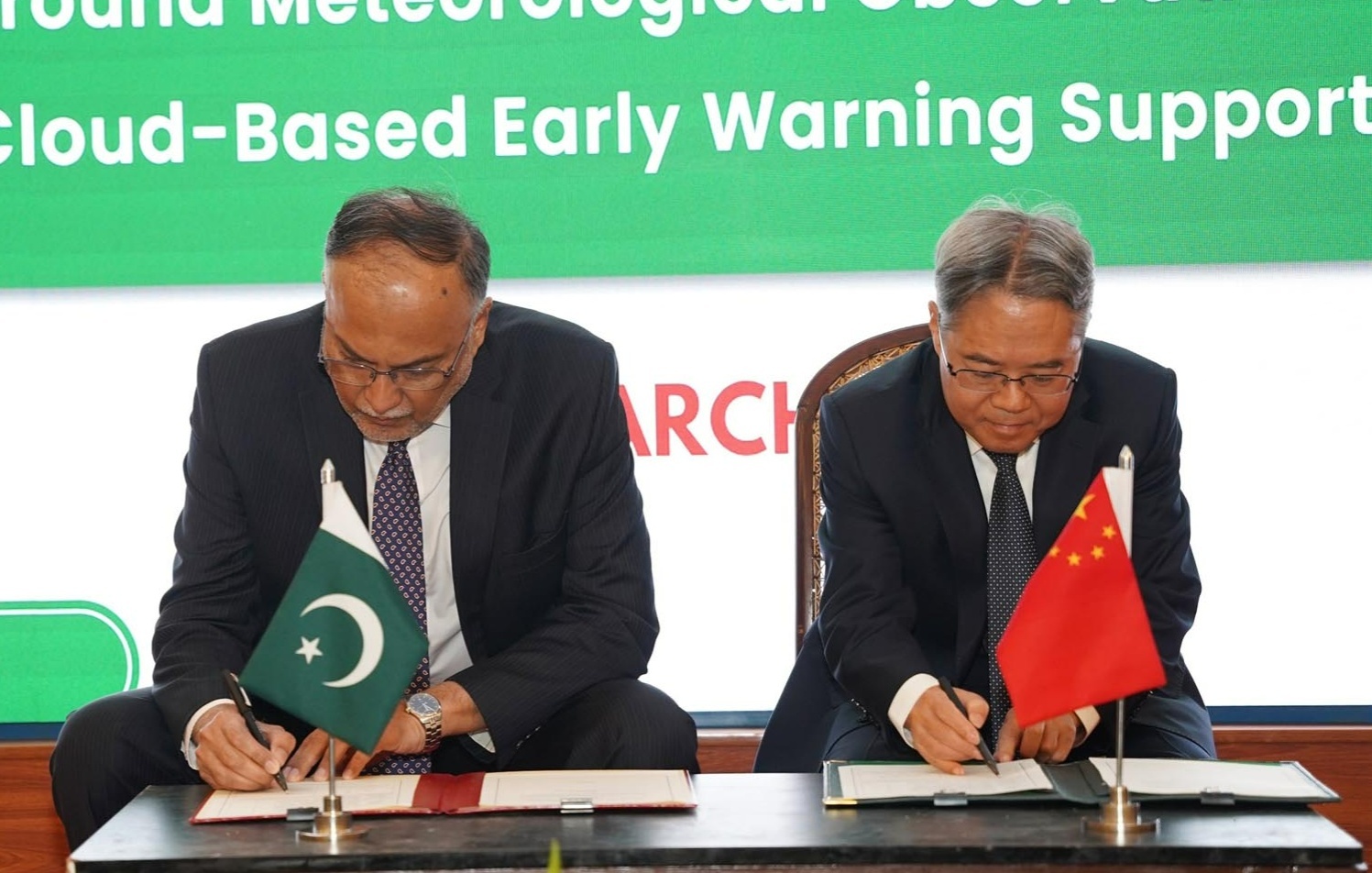
Pakistan, China enter new phase of economic partnership with focus on mineral development: Ahsan Iqbal
Pakistan and China are entering a new phase of economic partnership centered on mineral development, aiming to enhance productivity and exports through CPEC 2.0.

ISLAMABAD: Federal Minister for Planning, Development and Special Initiatives Professor Ahsan Iqbal on Wednesday said Pakistan and China were entering a decisive new phase of economic partnership by placing mineral development at the core of the China-Pakistan Economic Corridor (CPEC) 2.0, aimed at shifting cooperation from connectivity to productivity, exports and sustainable growth.
Addressing the launching ceremony of the China-Pakistan Mineral Cooperation Forum, the minister said the two countries were repositioning their strategic partnership towards minerals-led industrialisation, with Gwadar emerging as a key gateway to connect Pakistan’s mineral-rich regions with regional and global markets.
He said the initiative reflected a deliberate transition from infrastructure-focused cooperation to value-added and export-oriented collaboration as Pakistan and China approach the 75th anniversary of diplomatic relations.
“As we approach 75 years of Pakistan-China relations, our partnership stands as a model of continuity, trust and strategic depth. This relationship has never witnessed a season of autumn; it has always flourished in spring and reached new heights every year,” Ahsan Iqbal remarked.
Highlighting achievements under CPEC Phase-I, the minister said the corridor remained the most visible symbol of bilateral cooperation, adding that completed projects had contributed more than 8,000 megawatts to the national grid, upgraded over 1,000 kilometres of road infrastructure, modernised Gwadar and significantly strengthened national connectivity.
Referring to his recent visit to Gwadar, he said the China-built international airport had positioned the port city for a central role in Pakistan’s next phase of economic growth.
“Gwadar is now ready not only to function as a smart port city but also to serve as a hub for the mining industry by linking Pakistan’s mineral resources with global markets,” he said.
Ahsan Iqbal noted that CPEC Phase-II was focused on addressing Pakistan’s long-standing structural weaknesses, particularly its narrow export base. “Infrastructure for its own sake is not enough. Our goal is to convert connectivity into productivity, productivity into exports, and exports into jobs and sustainable growth,” he added.
Underscoring Pakistan’s untapped mineral potential, the minister said the country possessed around 92 known minerals, with 52 currently being extracted, nearly 5,000 operational mines and annual production of approximately 68.5 million metric tons. Despite this scale, he said mineral exports accounted for only 2–3 per cent of GDP.
“This gap between potential and performance is largely due to the lack of value addition,” he said, noting that more than 90 per cent of mineral exports were raw or semi-processed, while only about 40 per cent of the country’s land had been geologically mapped.
Referring to extensive marble and granite reserves stretching from Turbat to Chitral, Ahsan Iqbal said outdated blasting and extraction techniques were destroying value. He invited Chinese enterprises to invest in modern cutting and processing technologies, saying Pakistan could emerge as a global hub for world-class marble and earn billions of dollars from the sector.

The writer is Head of News at Pakistan Today. He has a special focus on current affairs, regional and global connectivity, and counterterrorism. He tweets as @mian_abrar and also can be reached at [email protected]
View all articles →Comments
No comments yet. Be the first to join the discussion!