Pakistan warns UN of 'unprecedented water security crisis' after India puts Indus Waters Treaty on hold
Pakistan has raised alarms at the UN over a water security crisis triggered by India's suspension of the Indus Waters Treaty, warning of severe regional risks.

ISLAMABAD: Pakistan has warned that India’s unilateral decision to hold the Indus Waters Treaty (IWT) in abeyance has triggered an unprecedented crisis for Pakistan’s water security and poses serious risks to regional stability, calling the move a deliberate “weaponisation of water” in violation of international law.
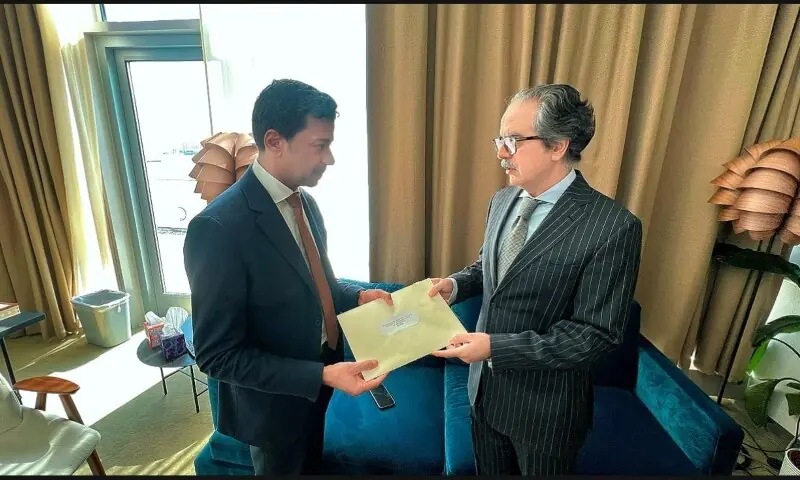
The concerns were raised by Pakistan’s Acting Permanent Representative to the United Nations, Ambassador Usman Jadoon, while addressing the Global Water Bankruptcy Policy Roundtable hosted by the Permanent Mission of Canada and the United Nations University (UNU).
Ambassador Jadoon said India’s decision, taken in April last year, was followed by material breaches of the landmark 1960 treaty, including unannounced disruptions to downstream water flows and the withholding of critical hydrological data. Such actions, he said, undermine trust, predictability and cooperation in one of the world’s most sensitive transboundary river systems.
“Pakistan’s position is unequivocal,” Ambassador Jadoon said. “The Indus Waters Treaty remains legally intact and permits no unilateral suspension or modification.” He stressed that any attempt to hold the treaty in abeyance violates both the letter and spirit of international water law.
Describing the treaty as a rare example of sustained cooperation between two adversarial neighbours, the ambassador said that for more than six decades, the IWT had served as a time-tested framework for equitable and predictable management of the Indus River basin.
He underlined the basin’s critical importance, noting that it sustains one of the world’s largest contiguous irrigation systems, provides more than 80 per cent of Pakistan’s agricultural water needs, and supports the lives and livelihoods of over 240 million people.
Ambassador Jadoon warned that water insecurity has now emerged as a systemic global risk, with far-reaching consequences for food production, energy systems, public health, livelihoods and human security. In South Asia, he said, such risks are magnified by climate change and population pressures.
Referring specifically to Pakistan, he said the country is a semi-arid, climate-vulnerable, lower-riparian state facing multiple, compounding challenges, including devastating floods, prolonged droughts, accelerated glacier melt, groundwater depletion and rapid population growth. Together, these factors are placing immense strain on already stressed water systems.
He said Pakistan is taking concrete steps to enhance water resilience through integrated water planning, flood protection infrastructure, irrigation rehabilitation, groundwater recharge and ecosystem restoration. He cited major initiatives such as Living Indus and Recharge Pakistan as examples of the country’s efforts to adapt to climate change and strengthen water security.
However, Ambassador Jadoon emphasised that systemic water risks, particularly in shared river basins, cannot be managed by any country acting alone. “Predictability, transparency and cooperation in transboundary water governance are not optional — they are matters of survival for downstream populations,” he said.
Calling for stronger global action, he urged that water insecurity be formally recognised as a systemic global risk in the lead-up to the UN Water Conference 2026. He stressed that respect for international water law, cooperative mechanisms and shared governance frameworks must be placed at the centre of global water diplomacy to protect vulnerable downstream communities.
Pakistan’s warning comes amid growing international concern over the impact of climate change on transboundary water systems, as well as fears that the politicisation of shared rivers could deepen regional tensions and undermine long-standing international agreements.
Comments
No comments yet. Be the first to join the discussion!