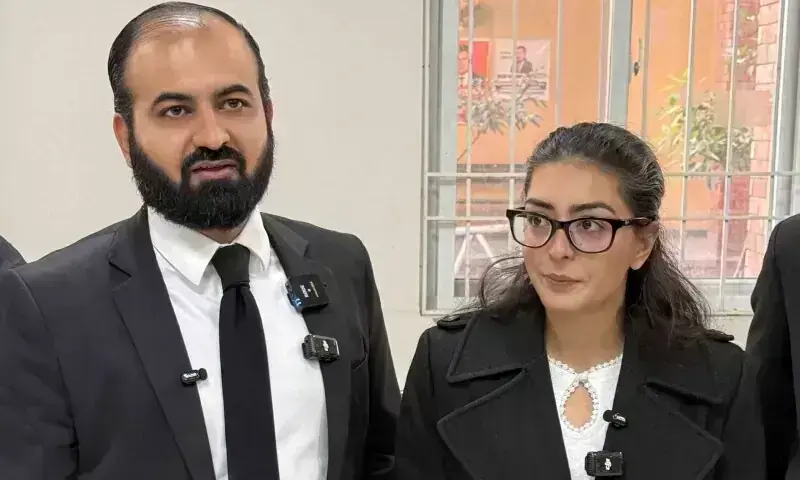
Social media case against Mazari, Chatha turns heated as courtroom confrontation erupts

ISLAMABAD: Tensions ran high during the hearing of the controversial social media posts case against lawyers Imaan Zainab Mazari-Hazir and Hadi Ali Chatha on Tuesday, as sharp exchanges between prosecution and defence lawyers nearly escalated into a physical clash inside the courtroom.
The situation arose during cross-examination of witnesses from the National Cyber Crime Investigation Agency (NCCIA), where defence questioning highlighted alleged procedural flaws and inconsistencies in the prosecution’s case, prompting heated arguments between both sides.
The proceedings were conducted by Additional District and Sessions Judge Muhammad Afzal Majoka at the Islamabad District and Sessions Court, in line with directions issued by the Islamabad High Court (IHC) to record prosecution evidence afresh. The accused appeared in court along with their counsel.
During cross-examination, NCCIA Naib Qasid Afzal admitted that he did not possess copies of his employment contract or service card. He also conceded that official correspondence dated October 16 and 20 lacked any mention of the time of receipt. Defence counsel further pointed out variations in signatures on official documents, casting doubt on the integrity of the record.
Another prosecution witness, Wasim, told the court he had worked as a contract employee with the Federal Investigation Agency (FIA) for five years and had been associated with the NCCIA since its formation. However, he acknowledged that he carried only an FIA service card and not one issued by the NCCIA.
He also admitted that the USB device submitted as evidence was unsealed and that he had no written contract specifying his duties. Wasim further said he was unaware of any FIA directive barring the registration of FIRs without prior notice.
The most intense exchange took place during the questioning of technical expert Anis, who claimed to have prepared more than 5,200 forensic reports and said he was the only technical expert at the NCCIA. He stated that his analysis was limited to surface examination of seven screenshots and 14 social media posts, strictly within the scope outlined by the investigating officer.
Anis acknowledged that neither the complaint nor the scope letter referred to the Pashtun Tahafuz Movement (PTM), Manzoor Pashteen or Ali Wazir. He also confirmed that the social media post under scrutiny dated back to October 31, 2021, whereas the individuals cited were declared proscribed in 2024. Despite this, he maintained that the posts promoted a “state-hostile narrative” due to references to enforced disappearances — a stance strongly challenged by the defence.
Defence counsel questioned whether similar references made by the Supreme Court, high courts, cabinet members or former intelligence officials would also be considered anti-state. The witness declined to respond, saying such determinations were beyond his mandate.
Tempers flared after sharp remarks were exchanged between lawyers from both sides, resulting in an attempt at physical confrontation. Police present in the courtroom intervened, while Judge Majoka directed the prosecution to apologise for using inappropriate language and reminded both sides to address objections through the court.
Following a short break, further cross-examination revealed that numerous other social media accounts had shared the same content but were not investigated. The witness confirmed that the inquiry was confined to the accused only. The court adjourned further proceedings until January 5, when cross-examination of the technical expert will continue.
The case originates from a complaint filed on August 12, 2025, by an assistant director of the NCCIA Islamabad before the FIA’s Cybercrime Reporting Centre under the Prevention of Electronic Crimes Act (PECA), 2016. Mazari was accused of spreading narratives allegedly aligned with hostile and proscribed organisations, while Chatha was booked for reposting some of her content. An FIR was registered on August 22, 2025, under sections 9, 10, 11 and 26-A of PECA, and the couple was indicted on October 30.
Last week, the Supreme Court stayed the trial proceedings until the Islamabad High Court decides the pending appeals. The stay was granted by a three-judge bench headed by Justice Muhammad Hashim Khan Kakar while hearing Mazari’s plea challenging the IHC’s refusal to grant interim relief.
Comments
No comments yet. Be the first to join the discussion!