
















LAHORE: As the Punjab government permits Basant across Lahore under defined safety protocols, DHA Lahore’s decision to prohibit kite flying in most residential blocks while allowing it in select zones has prompted questions about the legal and administrative authority of private housing societies within the city.
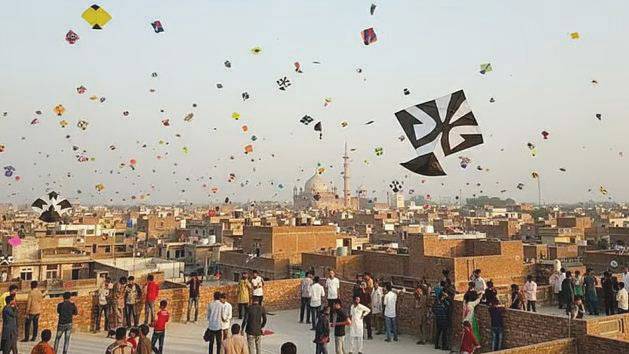
Basant has traditionally been observed as a decentralised cultural practice across Lahore, taking place on rooftops and within neighbourhoods rather than in designated venues. When the provincial government announced a limited restoration of the festival, the permission applied citywide, with an emphasis on safety measures such as banning hazardous kite strings, enforcing penalties, and reducing risk.
Within DHA Lahore, however, the implementation of this permission has differed from the rest of the city.
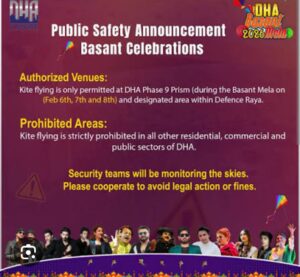
According to notifications and on-ground enforcement, kite flying has been discouraged or effectively disallowed across most DHA residential blocks. At the same time, DHA has permitted Basant-related activities in specific locations, including DHA Phase 9 Prism and the Neon Square area. These locations function as managed spaces rather than residential neighbourhoods.
The selective nature of this permission has raised a core administrative question.
If DHA Lahore falls within the jurisdiction of Lahore and the Punjab government, does a citywide cultural permission apply equally within its boundaries, including privately owned homes? Alternatively, do private housing societies possess the authority to impose independent restrictions on activities that have been permitted at the provincial level?
The issue is not limited to Basant alone. It touches on the broader scope of regulatory power exercised by private housing authorities. While such bodies routinely enforce rules related to security, maintenance, and shared infrastructure, their authority to restrict cultural practices within private residences, particularly when those practices have been permitted by the province, remains unclear.
From a safety perspective, the distinction is also being questioned.
Kite flying permitted within designated DHA venues involves the same environmental conditions as kite flying in nearby residential areas. Wind patterns and physical risks do not change across administrative boundaries. As a result, critics argue that safety concerns should be addressed through enforcement against prohibited materials and unsafe practices, rather than through location-based restrictions.
DHA officials and supporters of the policy maintain that limiting celebrations to specific zones allows for better monitoring and risk management. However, this approach has also led to concerns about consistency, especially when the same activity is treated differently within the same housing society.
The situation highlights an unresolved tension between provincial authority and private governance.
If private housing societies can reinterpret or narrow the scope of citywide permissions, questions arise about uniform application of law, civic equality, and the extent to which residents retain the same rights and responsibilities as other citizens of Lahore.
As Basant returns after years of prohibition, the debate surrounding its regulation within DHA Lahore underscores a larger issue. Beyond safety and celebration, it raises the question of how far private administrative bodies can go in redefining public life within a city governed by provincial law.
For now, the absence of clear legal clarification has left residents uncertain about where provincial permissions end and private authority begins, an ambiguity likely to persist beyond the festival itself.