










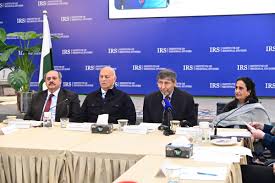
ISLAMABAD: Speakers at a seminar hosted by the Institute of Regional Studies (IRS) on Sunday emphasized that multilateralism is now a strategic necessity for safeguarding global peace and stability amid an increasingly fragmented international order.
The seminar, titled “Protecting Shared Interests through Multilateralism: An Imperative for Global Peace and Stability,” was organized by the IRS China Program to examine the importance of reinforcing multilateral cooperation.
In his welcome remarks, IRS President Ambassador Jauhar Saleem highlighted that unilateral actions, protectionism, conditional diplomacy, and transactional approaches by traditional powers are undermining international law and the UN Charter. He cited India’s military aggression as an example and stressed that protection of shared interests requires global cooperation and multilateral mechanisms. He noted China’s expanding institutional engagements as rooted in shared prosperity and strengthening the UN-based order.
Senator Mushahid Hussain Sayed, delivering the keynote, underscored multilateral engagement as essential for global peace. He praised China’s global initiatives, including the Belt and Road Initiative, as frameworks for protecting shared interests, and noted that Pakistan has long advocated mediation and dialogue in international conflicts.
Ambassador Naela Chohan highlighted unilateral actions, including Indian aggression against Pakistan, the Russia–Ukraine war, U.S. actions in Venezuela, and trade disputes, as destabilizing the current order. She said Chinese-led alternatives are more inclusive and support multilateral diplomacy.
Professor Zafar Nawaz Jaspal warned that intensifying great-power competition increasingly impacts middle powers, highlighting the significance of China’s initiatives in promoting dialogue and cooperation. Professor Qian Feng from Tsinghua University said China’s approach accommodates diverse viewpoints and promotes equity-based global governance.
From the Global South perspective, Dr. Manzoor Khan Afridi highlighted platforms like the Shanghai Cooperation Organization and Chinese development initiatives as contributing to sustainable development. Dr. Noor Fatima noted that China’s initiatives focus on human security, development, and inclusive participation, lending legitimacy to multilateral reforms.
Dr. Talat Shabbir of the China–Pakistan Study Centre described China’s four major global initiatives — Global Development, Security, Civilization, and Governance Initiatives — as grounded in multilateral principles. He stressed the need for inclusive mediation mechanisms in light of eroding trust due to veto politics.
Concluding the seminar, Mr. Wang Shengjie, Counsellor at the Chinese Embassy in Islamabad, presented China’s alternative to unilateralism, emphasizing sovereign equality, inclusiveness, and tangible outcomes. He cited Pakistan–China relations as an example of mutual trust, noting that multilateralism is a collective journey built on equity, shared responsibility, and cooperation.