










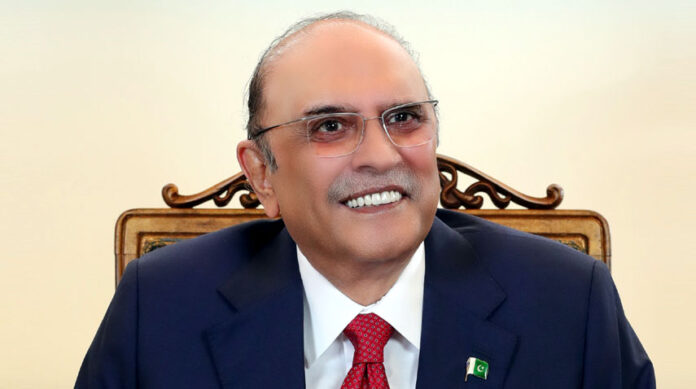
ISLAMABAD: President Asif Ali Zardari has welcomed a report issued by United Nations human rights experts that raises serious concerns over India’s military actions against Pakistan in May this year and their broader implications for regional and global peace and stability.
In a statement, the President said the report reaffirmed Pakistan’s long-held position that the unilateral use of force across international borders constitutes a violation of the United Nations Charter and a serious breach of Pakistan’s sovereignty.
He said the findings related to civilian casualties, damage to populated areas, and the targeting of religious sites in Pakistan during the May incidents were deeply alarming. The President added that the report’s assessment of the heightened risk of escalation resulting from India’s actions was equally troubling.
President Zardari welcomed the report’s observations on India’s unilateral decision to place its obligations under the Indus Waters Treaty “in abeyance”, as well as its aggressive posture and statements, and the significant civilian losses attributed to Indian military actions.
He said the Indus Waters Treaty remained a binding international agreement and a fundamental pillar of regional stability. Any attempt to bypass established dispute resolution mechanisms or take actions affecting water flows, he said, violated Pakistan’s rights and carried serious human rights implications.
The President said the report reflected growing international concern over what he described as India’s conduct as a rogue state, accusing it of increasingly relying on coercion, intimidation, and the normalization of force and violence rather than law and dialogue.
He noted that credible reports of transnational violence and targeted killings allegedly linked to India and raised in multiple countries pointed to a dangerous pattern extending beyond South Asia and undermining global norms.
President Zardari said the report clearly highlighted what he termed India’s irresponsible state behaviour. He added that India had long marginalised its minorities and disregarded its commitments to international forums, including the United Nations, warning that such conduct could not continue unchecked.
The President also drew attention to the report’s conclusion that international law does not recognise any independent right to unilateral military action under the guise of counter-terrorism. He said the affirmation of Pakistan’s inherent right to self-defence under international law underscored the gravity of the violations identified by the UN experts.
He welcomed the scrutiny by UN Special Rapporteurs of India’s regional conduct, including concerns related to alleged support for militant groups and the use of what he described as an illegitimate Afghan government to pursue hostile objectives. He called for transparency and accountability on these issues.
President Zardari also endorsed the UN experts’ call for the provision of credible evidence, compensation for civilian losses, adherence to treaty obligations, and a renewed commitment to peaceful dialogue, including on the issue of Jammu and Kashmir.
Reaffirming Pakistan’s commitment to peace, restraint, and respect for international law, the President said Pakistan would continue to pursue diplomatic and legal avenues to protect its sovereignty, safeguard the rights of its people, and contribute to stability in the region.