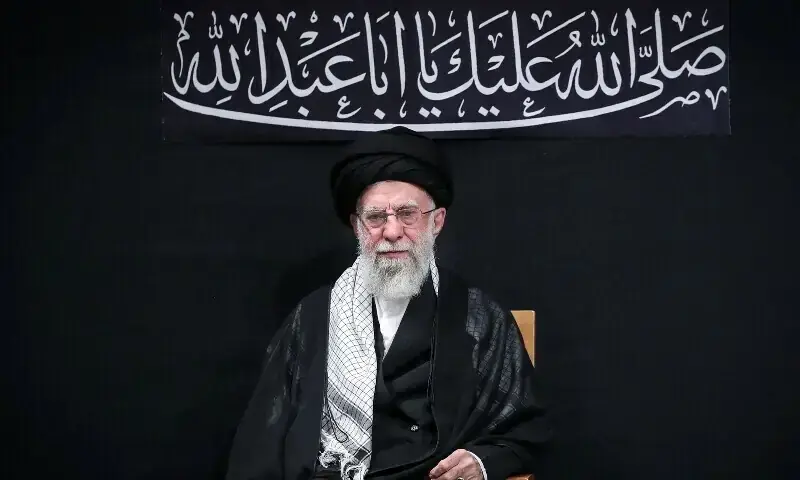
June 10, 2026
More than 100 days unburied: Why Iran has not yet held a state funeral for its former Supreme Leader
More than 100 days after Ayatollah Ali Khamenei was killed in a February strike, Iran has delayed his state funeral.

June 10, 2026

When Ayatollah Ali Khamenei was martyred in a US-Israeli airstrike on his Tehran compound on February 28, 2026, the expectation was that Iran would move quickly — both out of religious obligation and political necessity. Over a hundred days later, his body remains unburied. The reasons are more strategic than they might appear.
What Shi'ite Tradition Requires
Islamic — and specifically Shi'ite — tradition places great weight on burying the dead swiftly. It is understood not merely as custom but as a sacred duty owed to the deceased. The extended delay sits in obvious tension with that principle, and has not gone unnoticed among ordinary Iranians, many of whom have responded with pointed commentary on social media.
The Funeral Iran Has Planned
An autocratic state funeral is never just an act of mourning; it is supreme political theater meant to project total control. Tehran's vision for the burial is not a quiet affair. Officials have outlined a sweeping multi-city procession — beginning in the capital, passing through the holy city of Qom, and concluding in Mashhad, Khamenei's birthplace in northeastern Iran, where he is to be interred. The intent is to draw enormous crowds, projecting national unity and the strength of the Islamic Republic at a moment when both are under scrutiny.
Why It Hasn't Happened
The obstacle is a straightforward security dilemma. Conducting such a ceremony would require gathering virtually the entire senior leadership of the country — political, clerical, and military — into open public spaces at a time when the threat of further strikes remains very much alive. The IRGC, responsible for the protection of that leadership, has concluded the risk is too great. Khamenei's successor, his son Mojtaba, was himself wounded in the February 28 strike and has been recovering since.
There is also a deeper political dimension. The funeral will serve as Mojtaba Khamenei's formal introduction to the Iranian public as Supreme Leader — his first major act of visible authority. For that appearance to go wrong, whether through a security incident or a thin turnout, would be deeply damaging. Tehran wants conditions that guarantee the opposite: a moment that looks, unmistakably, like a consolidation of power.
What Comes Next
Recent reports suggest Iranian officials are eyeing a mid-June window for the funeral, with the timing potentially aligned with the early days of Muharram — the sacred month of mourning in the Shi'ite calendar — in order to maximize religious resonance and public solidarity.
Ceremonies are expected to span several cities before Khamenei's final burial in the religious city of Mashhad.
Until then, Tehran's decision to delay is a calculated act of statecraft — prioritizing the stability of its leadership transition over the religious imperative of prompt burial, and betting that the scale and symbolism of the eventual ceremony will more than compensate for the wait.
0 Comments
No comments yet. Be the first to join the discussion!