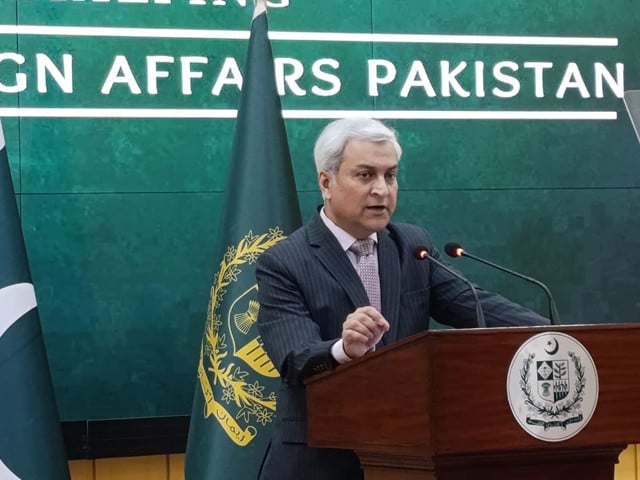
FO rejects claims of Iran nuclear intelligence sharing in Dar–Rubio meeting
Pakistan’s Foreign Office says Ishaq Dar shared no Iran nuclear intelligence with US Secretary of State Marco Rubio, calling media reports baseless. Dar–Rubio talks focused on regional peace, diplomacy, and bilateral cooperation.

Spokesperson Tahir Andrabi terms reports ‘baseless, speculative’ aimed at undermining diplomacy
Says Dar–Rubio talks focused on regional peace and bilateral cooperation, welcoming US role in Middle East ceasefire efforts
Says defensive actions target terror sanctuaries and bases in Afghanistan, citing right to self-defence under necessity and international law principles
Reaffirms Pakistan’s willingness for dialogue with Kabul despite recent border tensions, noting China cooperation on counterterrorism
Slams India’s Chenab diversion plan, saying proposed Chenab–Beas Link project violates Indus Waters Treaty and international law
Claims India plans to divert 1.9m acre feet of water annually via new tunnel project, calling move attempt to ‘weaponise water’ with regional security implications
Reiterates Pakistan retains all options to safeguard treaty rights and national interests, urging international community to ensure full implementation of IWT
ISLAMABAD: The Foreign Office (FO) on Thursday “categorically and unequivocally” rejected media reports claiming that Deputy Prime Minister and Foreign Minister Ishaq Dar shared any intelligence regarding Iran’s nuclear programme during a recent meeting with US Secretary of State Marco Rubio.
Addressing the weekly press briefing, FO Spokesperson Tahir Andrabi said the claims were “entirely baseless and speculative,” adding that they appeared aimed at undermining ongoing diplomatic efforts and the broader process of dialogue and engagement.
He said Deputy Prime Minister and Foreign Minister Dar met US Secretary of State Marco Rubio on May 29 during his brief visit to Washington, where the two sides discussed bilateral cooperation as well as regional security issues. He added that Rubio had also appreciated Islamabad’s role in “advancing peace in the Middle East.”
Weekly Press Briefing by the Spokesperson @TahirAndrabi
On Fake News of Intel-sharing with the US; 🇵🇰 Advocacy for ending violence against Lebanon and US-brokered Lebanon-Israel Ceasefire pic.twitter.com/BPBln1bUq9— Ministry of Foreign Affairs - Pakistan (@ForeignOfficePk) June 4, 2026
The spokesperson firmly stated that “no intelligence was shared during the course of this dialogue,” stressing that the discussions focused on regional peace, stability, and the importance of pursuing diplomatic solutions to ongoing challenges.
He welcomed the continued engagement of the United States in peace efforts and its “positive role” in supporting the ceasefire between Israel and Lebanon, while cautioning the media against publishing “speculative and unwarranted reports.”
The clarification came in response to claims by former Central Intelligence Agency (CIA) analyst Larry Johnson, who, quoting an unnamed source, alleged that Dar had conveyed to Rubio information suggesting what Iran was “prepared to do to preserve its independence,” which reportedly “alarmed” the US Secretary of State.
US Secretary of State Marco Rubio also addressed related questions during a congressional hearing on Wednesday. Responding to US Congressman Scott Perry, who referred to reports suggesting that Dar had delivered a message that Iran was “prepared to demonstrate a nuclear weapon should the current escalation continue,” Rubio said he was not aware of any such communication.
“I have not seen that reporting and I am not aware of any such message,” Rubio said, adding that he would be surprised if such a message had been conveyed.
“I would be aware of it if it was,” he further remarked.
The US-Iran standoff remains in a fragile ceasefire environment established in April, followed by rare direct talks between the two sides, which were hosted by Pakistan.
Although large-scale strikes across Iran and the Gulf have subsided since then, intermittent flare-ups have continued.
Tensions escalated further after exchanges of attacks earlier this week, including reported US strikes near the Strait of Hormuz and a subsequent Iranian missile response, which allegedly caused damage at Kuwait’s airport and resulted in casualties.
Iran has repeatedly targeted areas in the Gulf region hosting US military installations since the conflict began.
‘EU understands Pakistan’s right to defend itself amid Afghanistan tensions’
During the briefing, the FO spokesperson said the European Union (EU) “understands Islamabad’s position, including its right to defend itself,” amid rising concerns over cross-border security incidents and recent tensions involving Afghanistan.
Weekly Press Briefing by the Spokesperson @TahirAndrabi
On Afghanistan related queries pic.twitter.com/8osAlM9Xf5— Ministry of Foreign Affairs - Pakistan (@ForeignOfficePk) June 4, 2026
Tahir Andrabi said that “no responsible state can remain passive when its civilians and security forces are repeatedly targeted,” adding that Pakistan reserves the right to take all necessary measures to safeguard the lives and property of its nationals “based on the principles of necessity and as a measure of last resort.”
He was responding to a question regarding EU foreign policy chief Kaja Kallas, who had earlier referred to the “grave humanitarian consequences” of recent fighting between the two neighbouring countries and urged restraint.
The spokesperson stressed that Pakistan’s actions were guided by the principles of distinction and proportionality, and that any “defensive action” was directed against “legitimate targets under international law, including sanctuaries and bases used for planning terrorism and launching terrorist attacks against Pakistan.”
He further said, “We will continue to take such actions when necessary, and this remains part of our dialogue with our international interlocutors.”
Earlier, Andrabi had stated that the EU understood Islamabad’s position, including “our right to defend ourselves and take action against terrorist incidents, particularly those emanating from Afghanistan.”
He referred to the joint statement issued during Kaja Kallas’s visit, which reaffirmed “the importance of combatting terrorism in all its forms and manifestations,” while both sides expressed “serious concerns over the presence of terrorist entities in Afghanistan” and reiterated that Afghan territory must not be used to threaten or attack other countries.
Responding to another question, the FO spokesperson said there was “no bar on Pakistan pursuing dialogue and diplomacy with Afghanistan.”
“Indeed, this is what we were doing until very recently, when terrorist attacks emanating from Afghanistan, with possible collusion from elements within the authorities there, surpassed a certain threshold of Pakistan’s patience. As a result, there were instances of border closures, and we also took certain actions in our border regions,” he said.
Reiterating Pakistan’s desire for continued diplomatic engagement, Andrabi stressed that Islamabad strongly objects to the killing of civilians and law enforcement personnel, adding: “We have adopted a position whereby we seek an unequivocal commitment from the Afghan side that its territory will not be used for terrorism against Pakistan.”
Weekly Press Briefing by the Spokesperson @TahirAndrabi
On Inadvertent LOC crossing by a National from Azad Kashmir pic.twitter.com/OYwBl8K5iJ— Ministry of Foreign Affairs - Pakistan (@ForeignOfficePk) June 4, 2026
The FO spokesperson also said China’s Special Representative on Afghanistan, Ambassador Yue Xiaoyong, held “productive discussions on regional security” during his visit to Islamabad.
He added that Pakistan and China agreed to strengthen coordination and synchronise counterterrorism efforts “to protect regional peace and security,” while appreciating Beijing’s constructive role on security matters.
On the recent military cooperation agreement between Russia and Afghanistan, Andrabi said the details were still being ascertained, adding: “At this stage, it would be premature to offer any comment on the matter.”
Pakistan slams India’s Chenab diversion plan, warns of grave IWT violation
The FO strongly denounced India’s reported plans to construct a river-linking project to divert Chenab waters into the Beas River, terming it a “grave violation” of the Indus Waters Treaty (IWT) as well as international law.
The Chenab River originates at the confluence of the Chandra and Bhaga rivers in Lahaul and Spiti in Himachal Pradesh. Under the IWT, brokered by the World Bank in 1960, the three western rivers — Indus, Jhelum and Chenab — are allocated to Pakistan, while the three eastern rivers — Ravi, Beas and Sutlej — are allocated to India.
Weekly Press Briefing by the Spokesperson @TahirAndrabi
On Violation of Indus Water Treaty by India pic.twitter.com/UrUPmd4gCX— Ministry of Foreign Affairs - Pakistan (@ForeignOfficePk) June 4, 2026
According to Indian media reports, India is set to begin work on the proposed “Link-3 Project” on the Chenab in Himachal Pradesh on August 1. The project reportedly aims to divert surplus water from the Chenab basin to the Beas system and is estimated to cost 26.2 billion Indian rupees, according to ANI.
Responding to a question, FO Spokesperson Tahir Andrabi said, “Yes, we have seen this report as well as the public tender document issued by the Government of India, which indicates that bids have been invited for the Chenab–Beas Link Tunnel project with the intention of transferring 1.9 million acre feet of water annually from Chenab into the Beas system.”
He said such an inter-basin diversion constitutes a “grave violation” not only of the Indus Waters Treaty but also of international treaty law, particularly the Vienna Convention on the Law of Treaties, as well as broader principles of international water law, including those reflected in the 1977 UN Convention on watercourses.
The FO spokesperson also pointed to India’s reported plans for “silt flushing” operations at the Salal Dam in occupied Kashmir’s Reasi district.
“This is a deeply concerning development. It would provide water control capability that is not permissible under either the Indus Waters Treaty or the 1978 Salal agreement,” he said.
Andrabi noted that India had neither officially communicated nor shared any notification regarding these projects, nor sought consultations in this regard.
“These projects confirm that India seeks to weaponise water,” he said, warning that such actions carry serious implications not only for Pakistan’s economy but also for regional stability and international peace and security.
He reiterated that Pakistan has exercised restraint and remained committed to dialogue, but cautioned that any “illegal measure to endanger Pakistan’s water, food and economic security, as well as the survival and well-being of its 250 million people, is unacceptable.”
Such steps, he added, would amount to further destabilisation of South Asia, with potentially grave consequences for the entire region.
“Under the IWT, Pakistan is entitled to the unrestricted use of the waters of the western rivers, in lieu of the rights of the eastern rivers that were allocated to India,” he noted.
The FO spokesperson asserted that Pakistan “retains all options necessary for safeguarding its rights and entitlements under the treaty and protecting its vital national interests,” adding, “Let me emphasise, we retain all options in this regard.”
The FO urged the international community to call upon India to desist from any form of water coercion, abandon projects aimed at stopping, reducing or diverting flows legally belonging to Pakistan, and ensure full and faithful implementation of the Indus Waters Treaty.
‘Actively engaged’ to secure release of seamen held by Somali pirates
On a separate matter, the FO said Pakistan remains “actively engaged” in efforts to secure the release of 10 Pakistani nationals held aboard an oil tanker seized by Somali pirates.
The MT Honour 25, a Palau-flagged product tanker, was hijacked on April 21, around 30 nautical miles off Somalia’s Puntland region, with 17 crew members on board, including 10 Pakistanis.
“Unfortunately, the situation remains grave,” Andrabi said, referring to the latest developments after a video surfaced showing the captives with limited access to drinking water.
He said Pakistan remains in contact with the ship owner, who is the principal negotiator with the pirates, and noted that the talks are being held with the knowledge of the Somali government.
He explained that the geographical situation, coupled with the presence of highly explosive cargo on board, has made any law-enforcement operation extremely difficult, as authorities do not want to risk the safety of the captives.
The FO urged both the Somali authorities and the ship owner to ensure that hostages are provided with food, drinking water and other basic necessities. Relevant Pakistani institutions, including the interior and maritime affairs ministries, are also engaged in the matter.
“This is a very difficult situation. Our hearts go out to the families of those being held captive,” the spokesperson said, requesting patience from the families.
He further revealed that a team from Pakistan’s Embassy in Djibouti had visited Mogadishu to obtain first-hand information, adding that all channels of communication with both the ship owner and Somali authorities remain open and active.
Andrabi assured that the government is giving the situation its “full attention and concern” as an emergency matter.

Comments
No comments yet. Be the first to join the discussion!