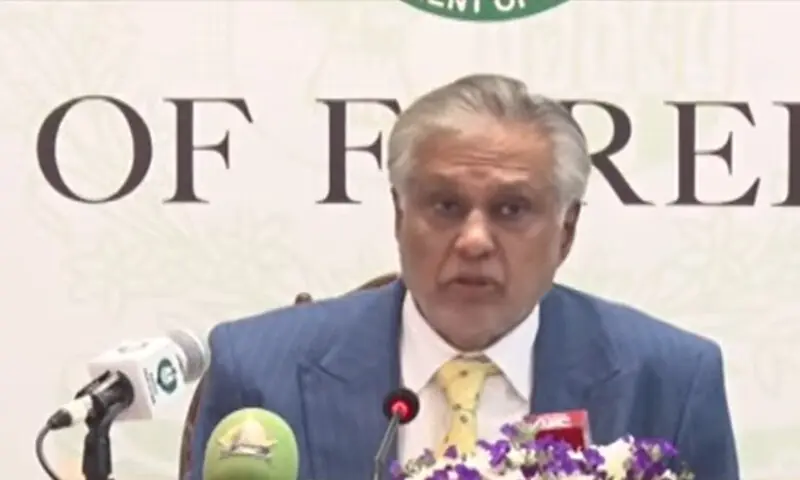
Dar orders urgent coordination to protect Pakistanis as Mideast crisis deepens
Deputy PM Ishaq Dar emphasizes the need for close coordination to ensure the safety of Pakistani nationals in the Middle East amid escalating tensions and recent casualties.

All concerned must remain fully engaged, maintain close coordination, to facilitate and support Pakistanis in region: Deputy PM
Pushes diplomacy in call with Azerbaijan’s FM, discusses latest regional developments
Urges citizens to remain indoors, avoid unnecessary travel after Pakistani killed in Abu Dhabi from missile debris
Pakistan-Iran trade continues smoothly despite regional tensions
ISLAMABAD: Deputy Prime Minister and Foreign Minister Ishaq Dar on Tuesday directed authorities to “maintain close coordination” to “facilitate and support” Pakistani nationals in the Middle East as the regional crisis continues to intensify, according to an official statement.
He issued the directive while chairing a high-level meeting to review the evolving situation in the region, with a particular “focus on the safety and well-being of Pakistani citizens abroad,” said a statement issued by the Foreign Office (FO) on its X account.
Deputy Prime Minister/Foreign Minister Senator Mohammad Ishaq Dar @MIshaqDar50 chaired a meeting today to review evolving regional developments.
DPM/FM took stock of ongoing efforts by Pakistan’s missions in the region and coordination with relevant departments. He directed all… pic.twitter.com/WE79qI6ri2— Ministry of Foreign Affairs - Pakistan (@ForeignOfficePk) March 17, 2026
The statement said the deputy prime minister “took stock of ongoing efforts” by Pakistan’s missions overseas and their coordination with relevant departments. “All concerned must remain fully engaged and maintain close coordination, particularly to facilitate and support Pakistani nationals in the region, while closely monitoring the situation,” he said.
The meeting was attended by Special Assistant to the Prime Minister Tariq Bajwa, Foreign Secretary Ambassador Amna Baloch, the chairman of the National Disaster Management Authority, and other senior officials from the Ministry of Foreign Affairs.
The meeting came hours after a Pakistani national died in Abu Dhabi when debris fell in Bani Yas following the interception of a ballistic missile by air defence systems.
Earlier this month, Pakistan activated a crisis management unit to assist its citizens in the Middle East after another Pakistani national was killed in the United Arab Emirates during the interception of an Iranian missile. The incident followed joint strikes by the United States and Israel on Iran, which triggered retaliatory attacks.
Subsequently, the Foreign Office issued an advisory urging Pakistani nationals residing in the Middle East and the Persian Gulf to exercise utmost caution. They were advised to remain indoors where possible, avoid unnecessary travel, and strictly follow instructions issued by host governments.
As the crisis unfolded, the prime minister directed the Ministry of Foreign Affairs to ensure the safe return of Pakistanis in Iran via Azerbaijan and to immediately engage Azerbaijani authorities in this regard.
Dar, Azerbaijani counterpart discuss regional situation
Earlier in the day, Ishaq Dar discussed the latest regional developments with Azerbaijan’s Foreign Minister Jeyhun Bayramov during a telephonic conversation.
Deputy Prime Minister/Foreign Minister Senator Mohammad Ishaq Dar @MIshaqDar50 spoke with Foreign Minister of Azerbaijan Jeyhun Bayramov @Bayramov_Jeyhun.
They exchanged views on the latest developments in the ongoing regional situation and discussed bilateral matters of mutual… pic.twitter.com/lyFB69PwGK— Ministry of Foreign Affairs - Pakistan (@ForeignOfficePk) March 17, 2026
In a statement, the Ministry of Foreign Affairs said the two leaders exchanged views on the evolving regional situation and discussed bilateral matters of mutual interest.
Separately, the Foreign Office said Dar also held a meeting with Zachary Harkenrider, focusing on bilateral ties and ongoing regional developments. The two sides reviewed the broader regional situation and issues of mutual interest.
“FM emphasised the importance of diplomatic engagement and underscored the urgent need to promote peace and stability in the region,” the statement said.
Pakistan-Iran trade remains uninterrupted
Meanwhile, Pakistan’s Ambassador to Iran Mudassir Tipu said bilateral and transit trade between the two countries remains operational despite heightened regional tensions.
I am extremely grateful to the Government of the Islamic Republic of Iran for extending full facilitation to Pakistan’s trade to Iran- as well as transit trade through Iran- during challenging times . The land borders between Pakistan and Iran are working optimally and Green…
— Ambassador Mudassir (@AmbMudassir) March 17, 2026
In a post on X, the envoy expressed gratitude to the Iranian government for extending “full facilitation” to Pakistan’s trade, including transit trade through Iran during “challenging times”.
He said land border crossings between Pakistan and Iran were functioning optimally, with green channels at multiple routes ensuring smooth and swift movement of goods.
The ambassador added that Pakistan was extending maximum cooperation to Tehran to ensure trade flows remain unaffected, while issues related to congestion at border points were being addressed through joint efforts. He said the embassy remains in close contact with official and private stakeholders in both countries to facilitate trade.
A day earlier, Iran’s Foreign Minister Abbas Araghchi expressed gratitude to Pakistan for its “strong solidarity” amid the ongoing conflict, reaffirming Tehran’s resolve to defend its sovereignty and territorial integrity.
Escalating conflict raises regional concerns
Since the onset of the conflict involving the United States, Israel, and Iran, Pakistan’s leadership has intensified diplomatic engagement to help de-escalate tensions.
A day earlier, Dar stressed the need for peace and stability during his meeting with US Acting Chargé d’Affaires Zachary Harkenrider.
The conflict, which erupted on February 28, has since escalated into a broader regional confrontation, with Iran launching missile and drone strikes on US-linked targets across the Gulf in response to coordinated attacks on its military installations.
The situation has also disrupted key shipping routes, particularly the Strait of Hormuz, raising concerns over global energy supplies and the risk of prolonged economic and security fallout.
Last week, Dar held telephonic conversations with counterparts from several Gulf countries and beyond, stressing the importance of de-escalation and the need to pursue dialogue and diplomacy in line with the principles of the United Nations Charter.

Comments
No comments yet. Be the first to join the discussion!