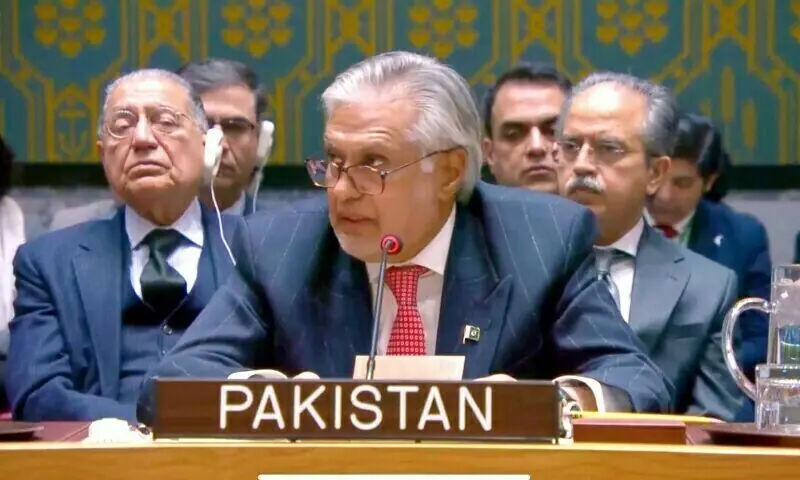
Dar urges ‘swift end’ to Middle East conflict, calls for ‘unity of Muslim Ummah’
Deputy PM Ishaq Dar emphasizes the need for unity among Muslim nations and a swift resolution to the Middle East conflict during a consultative meeting in Riyadh. He advocates for dialogue and condemns attacks on civilians and infrastructure.

DPM/FM Dar stresses dialogue, diplomacy, and de-escalation in Riyadh consultative meeting
Reaffirms full support for sovereignty and territorial integrity of brotherly nations
Condemns attacks on civilians, energy, and critical infrastructure, highlighting need to address root causes of regional crisis
Quadrilateral talks held with Egypt, Saudi Arabia, and Türkiye on sidelines
ISLAMABAD: Deputy Prime Minister and Foreign Minister Ishaq Dar on Thursday underscored the importance of “preserving the unity of the Muslim Ummah” and called for “a swift end” to the ongoing conflict in the region, reaffirming Pakistan’s “commitment to dialogue, diplomacy, and readiness to support de-escalation,” according to the Foreign Office (FO).
Addressing the consultative ministerial meeting of foreign ministers from Arab and Islamic countries in Riyadh, Deputy Prime Minister Dar reiterated Pakistan’s “full support for the territorial integrity, sovereignty, and political independence of all brotherly nations” in the region. He emphasised the urgent need to halt all attacks on their territories, said a statement issued by the Foreign Office (FO).
🔊PR No.7️⃣1️⃣/2️⃣0️⃣2️⃣6️⃣
Visit of Deputy Prime Minister/Foreign Minister to Saudi Arabia to attend Ministerial meeting of Arab and Islamic Countries https://t.co/I0iaqHov1s https://t.co/SHH2WkMZkQ pic.twitter.com/C4gGRmJnzK— Ministry of Foreign Affairs - Pakistan (@ForeignOfficePk) March 19, 2026
Dar highlighted the importance of addressing the “root causes of the ongoing crisis” affecting the wider region and condemned, in the strongest terms, Israel’s continued aggression and provocations against regional countries.
He also strongly denounced attacks on civilians, as well as assaults on energy and critical infrastructure, calling for an immediate cessation of such hostile actions.
Stressing the wider implications, Dar urged all parties to refrain from actions that could undermine regional energy security and further exacerbate global economic challenges.
During his address, the deputy prime minister updated participants on Pakistan’s ongoing diplomatic efforts to resolve the crisis and reaffirmed the country’s desire to continue playing a constructive role in promoting regional security and stability.
On the sidelines of the meeting, Dar conveyed a message of strong solidarity and unwavering support to Saudi Foreign Minister Prince Faisal bin Farhan Al Saud on behalf of the government and people of Pakistan. He also participated in a quadrilateral meeting of the foreign ministers of Egypt, Pakistan, Saudi Arabia, and Türkiye.
#Riyadh | Foreign Minister HH Prince @FaisalbinFarhan held a coordination meeting with the Foreign Ministers of Pakistan, Türkiye, and Egypt, on the sidelines of the consultative meeting of the Foreign Ministers of a group of Arab and Islamic countries. pic.twitter.com/AXs8dP1pv0
— Foreign Ministry 🇸🇦 (@KSAmofaEN) March 19, 2026
In coordination with 11 other Islamic countries, Pakistan issued a joint statement urging Iran to immediately halt attacks on Gulf Cooperation Council (GCC) countries and regional allies. The statement followed a consultative ministerial meeting held in Riyadh a day earlier, which focused on diplomatic efforts to curb the conflict in the Middle East.
The current Middle East conflict erupted on February 28, when US and Israeli forces launched coordinated strikes on Iran. The situation rapidly escalated as Iran retaliated with drone and missile attacks targeting US assets and allied interests across the Gulf.
Since the onset of hostilities, Pakistan has intensified its diplomatic outreach, working to reduce tensions between Gulf countries, the United States, and Iran, and has repeatedly offered to play a mediating role in de-escalating the conflict.
Information Minister Attaullah Tarar, in an interview with Al Jazeera, emphasised that Pakistan is prepared to play a pivotal role in mediating regional tensions following the US-Israeli strikes on Iran.
Last week, Dar also held telephonic conversations with his counterparts from several Gulf states and other countries, underscoring the importance of de-escalation and reiterating the need for dialogue and diplomacy in line with the principles of the United Nations Charter.
Comments
No comments yet. Be the first to join the discussion!