March 3, 2026
Pakistan pushes for US-Iran de-escalation as Dar warns against escalating Middle East conflict
Pakistan's Deputy Prime Minister Ishaq Dar emphasizes the need for dialogue to ease tensions between the US and Iran, amid a recent military escalation. The country offers mediation to prevent regional conflict and has begun evacuating its citizens from Iran.
March 3, 2026

-- Islamabad engages in backchannel diplomacy amid 'sudden' US-Israel strike on Iran
-- Dar says dialogue was progressing before sudden escalation
-- Pakistan offers mediation, seeks to prevent regional spillover
-- Nearly 800 Pakistanis evacuated from Iran as crisis deepens
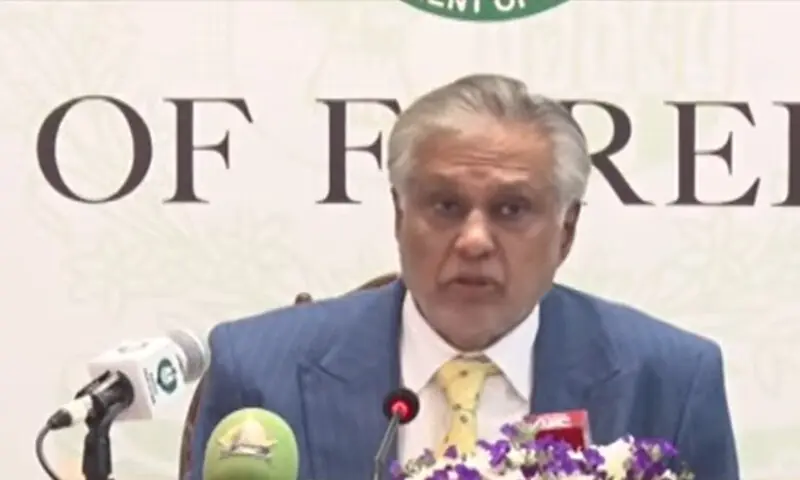
ISLAMABAD: Deputy Prime Minister and Foreign Minister Ishaq Dar told the Senate on Tuesday that Pakistan is actively pursuing diplomatic efforts to reduce tensions between the United States and Iran following what he described as a “sudden” coordinated attack by Washington and Israel on Tehran.
Addressing lawmakers, Dar said Islamabad had remained in close contact with multiple countries over the past three days to encourage a return to dialogue. “Through dialogue, a path of understanding can emerge,” he said, stressing that Pakistan had immediately condemned the strike, calling Iran a neighbouring and brotherly Muslim country.
Dar maintained that diplomatic engagement between Washington and Tehran had been progressing positively before the escalation. He referred to Prime Minister Shehbaz Sharif’s recent visit to Austria, during which Pakistani officials met Rafael Grossi, head of the International Atomic Energy Agency. According to Dar, Grossi had expressed optimism that negotiations were heading in a constructive direction.
He also cited a late-night conversation with Oman’s foreign minister, who informed him that the most recent round of US-Iran talks had concluded “on a positive note”. The Omani envoy later travelled to Washington and conveyed to US leadership that discussions were moving forward constructively, Dar added.
The foreign minister compared the current developments to the June crisis last year, when tensions between Iran and Israel escalated into a 12-day conflict. At that time, Dar and Iran’s Foreign Minister Abbas Araghchi were attending a meeting in Istanbul.
Amid rising hostilities, Pakistan’s Chief of Army Staff, Field Marshal Asim Munir, halted his return journey from the United States to hold consultations in Turkey. Dar said the Pakistani delegation had urged Iran to resolve matters through diplomacy.
Dar further revealed that during an August 2025 meeting with US Secretary of State Marco Rubio, Pakistan opposed Washington’s demand for zero uranium enrichment by Iran. He said Islamabad had maintained that the peaceful use of nuclear energy was Iran’s legitimate right and supported international monitoring mechanisms to address concerns.
According to Dar, Pakistan also helped prevent the conflict from widening. Referring to Islamabad’s Strategic Mutual Defence Agreement with Saudi Arabia, he said Tehran had sought assurances that Saudi territory would not be used against it. “They asked for some assurances… that Saudi soil should not be used. I got them the assurances,” he told senators, adding that Iran’s restrained posture toward Saudi Arabia and Oman reflected those understandings.
Dar reiterated that further escalation would benefit no one and affirmed Pakistan’s commitment to continued diplomatic engagement to reduce tensions.
He informed the Senate that an in-camera briefing on the Middle East situation would be held for parliamentary and opposition leaders on Wednesday morning, with developments in Afghanistan also on the agenda.
On the issue of repatriation, Dar said approximately 35,000 Pakistanis were currently in Iran. So far, 792 citizens, including 46 students, had been evacuated, with most crossing into Pakistan through the Taftan border. Islamabad was also coordinating with Azerbaijan to facilitate potential crossings through Baku if necessary.
The Ministry of Foreign Affairs, he said, remained fully engaged in monitoring the situation and assisting nationals. Dar cautioned against emotional reactions at home, urging responsible leadership to manage public sentiment.
Meanwhile, Senator Sherry Rehman called for a balanced and responsible foreign policy anchored in national unity. Senator Syed Ali Zafar proposed the creation of a regional security framework to promote stability, while Senator Afnanullah Khan and Senator Jam Saifullah Khan condemned the attack on Iran and expressed grief over the killing of Iran’s Supreme Leader Ali Khamenei.
As tensions continue to ripple across the region, Islamabad appears determined to position itself as a mediator rather than a spectator, navigating a geopolitical storm where miscalculation could redraw the strategic map of West Asia.
The writer is Head of News at Pakistan Today. He has a special focus on current affairs, regional and global connectivity, and counterterrorism. He tweets as @mian_abrar and also can be reached at [email protected]
View all articles →0 Comments
No comments yet. Be the first to join the discussion!