
















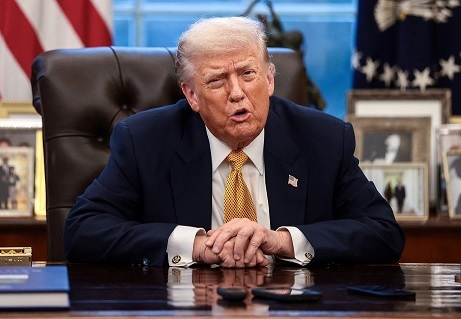
WASHINGTON: President Donald Trump on Thursday revoked a landmark scientific finding underpinning US regulations to curb planet-warming pollution, marking his biggest rollback of climate policy to date.
The repeal of the Environmental Protection Agency’s 2009 “endangerment finding” was paired with the immediate elimination of greenhouse gas standards on automobiles.
But it also places a host of other climate rules in jeopardy, including carbon dioxide emissions from power plants and methane leaks for oil and gas producers.
Legal challenges are expected to follow swiftly.
“This determination had no basis in fact, had none whatsoever, and no basis in law,” Trump said at a White House event.
The president dismissed concerns that the repeal could cost lives by worsening climate change, reiterating his belief that human-caused global warming is a hoax.
“I tell them, don’t worry about it, because it has nothing to do with public health,” Trump said. “This was all a scam, a giant scam.”
The administration also framed the measure as a cost-saving move, claiming it would generate more than $1 trillion in regulatory savings and bring down new car costs by thousands of dollars.
The announcement immediately drew condemnation from Democrats and green groups.
“We’ll be less safe, less healthy and less able to fight climate change — all so the fossil fuel industry can make even more money,” warned former president Barack Obama, under whose government the finding was created.
Manish Bapna, president of the nonprofit Natural Resources Defense Council, told AFP it was the “single biggest attack in history on the United States federal government’s efforts to tackle the climate crisis.”
The 2009 “endangerment finding” was a determination based on overwhelming scientific consensus that six greenhouse gases threaten public health and welfare by fueling climate change.
It came about as a result of a prolonged legal battle ending in a 2007 Supreme Court decision, Massachusetts v. EPA, which ruled that greenhouse gases qualify as pollutants under the Clean Air Act and directed the EPA to determine whether they pose a danger to public health and welfare.