


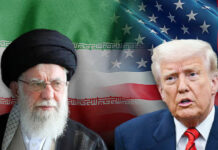








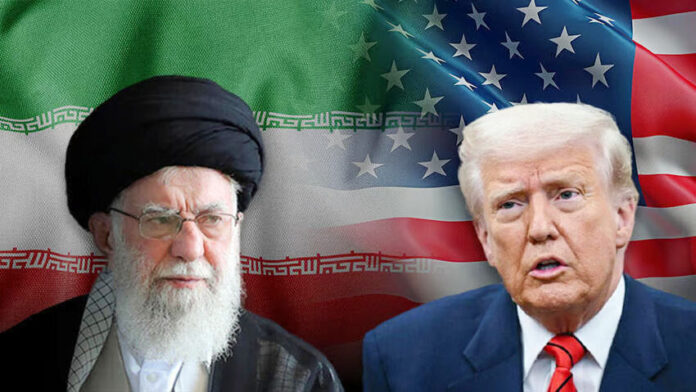
After weeks of attrition, the ultimate clash between the Republican-led Neo-Cons, encapsulated in the POTUS, and the system of government of its own kind, the Wilayat Faqeeh rule in Iran, might have taken place; or there is a possibility that the drumbeating of the war gets louder and louder with the passage of time. As the strike packages assemble at the legendary Muaffaaq Air base in Jordan housing F-15s, KC-135 tankers and other planes, at Crete and Diego Garcia; not to ignore the ‘Armada’ carrying FA-18 Hornets and A-6 EW enabled jets; the arrangement of assets for the attack is almost completely over. There are plans in hand to create a conflict through an economic naval blockade of the Iranian coastline, pressuring it to go for conflict with the US ships; once a triggering situation is created, an all-encompassing assault can be commissioned or might have been already communicated to the formations as and when they decide to hit.
The stalemate in the event of war, where the machinery is brought for quick results and expected not to last long in the area of conflict; any loss of human lives and increasing cost of conflict can bear upon the systems financing the war. The economic fallout during the Afghanistan and Iraq campaigns can revisit the US economy in the form of trillions of dollars of deficit financing. The cascading impact on society and politics cannot be overlooked. The conflict in the Middle East might be kicked off easily, but to sustain it initially in the form of quick results and later in the form of settling the gains is an unpredictable scenario, which can spell greater and adverse aftereffects for the aggressor Western civilization
In such a scenario, a repeat of the June 12-day war between Iran and Israel can be contemplated, where after the initial and partial decimation of the IRGC leadership, the next in line leadership had a free hand to counter and engage the IDF whether in the Iranian air space or through hitting precise targets in the Israeli mainland itself or in the developing scenario US assets across the region. Then in June 2025, the swift action by the Baseej neutralized the local sleeper cells to an extent that another wholesale massacre of the IRGC could be avoided. The missile units were able to create a stalemate where even if the Iranians had no clear victory, they were able to force a stop into the IDF plans; on the basis that the cost benefit analysis of IDF hitting Iranian targets and then being hit by the Iranian warheads the next midnight made it clear to the IDF that the costs of reconstruction of infrastructures hit by the IRGC were going into millions; especially places like the Weizman scientific research institute as well as other such sensitive places in Tel Aviv as well as Haifa. Similarly, the signature USAF strikes in the end also claimed to hit the key nuclear sites in central Iran. However, the war cry of POTUS and a very aggressive war cry at hand, also puts into doubt the claims made by the Americans at that point of time.
Moving forward, if the Iranian missile batteries are saved from the sleeper cells; an apprehension aired by many Iranian political observers that the missile sites identified during the June conflict were the areas of prime unrest; then the conversion of the amount of ordnance in the missile cities if fired can repeat similar destruction to the IDF assets; simply on the plea that the Israeli PM has been the prime instigator for an otherwise reluctant USA to jump into the fray.
Whatever might be the scenarios, remains to be seen and observed on the TV screens and on the Twitter walls, where it might be difficult for a naïve viewer to separate handles-inspired propaganda from pure facts, either way. The prime question is more serious business; why the West led by POTUS is after the annihilation of the Islamic government in Iran.
Is it only the terrorist business at hand? If that is the issue; every elite intelligence agency in the region has its moles all over the world and these moles are activated to wreck chaos in the country which is on adverse terms with the elite agency’s state. The activities of outfits like RAW, Quds Force, ISI and others are simply guided by their national interests, and all are within their mandate to create the best environment for the governments or systems financing their operations.
Given the fact that such activity is the norm of the world, one can ask about the development of weapon systems. During the JCPOA, the halting and roll back of the Iranian missile programme was sought, but was not accepted by the Iranian negotiators. If that issue is taken up, then anytime tomorrow, the West can also lay its hands on the Pakistani missile programme, which like that of the Iranians, is also indigenously developed. In the modern world, where weapon systems sales sometimes interfere with the objectives of the buying state, it has become increasingly the vogue that states like Pakistan, Iran and Turkey go for developing their own systems; like Turkey specializing in drones, Iranians in missiles and Pakistanis in a full-fledged fighter jet. Here it would not be out of context to say that in the May 2025 limited conflict with India, the deployment of the JF-17 was more pronounced than the American cousin, the Block 52 F-16s.
The overt reason for justifying the strikes on Iran, just to appease the Zionist lobby, does not sell well. The lobby has over the years learnt to live with many adversaries and ideologies. The Iranian system might be just a new addition; given the fact that the systems professing the same thought process as Iranians, the Iraqis, were not treated as threat by the West, POTUS or the IDF.
The question invariably settles down at the war of narratives. The unipolar world coming out of World War I was rocked by the 1917 Russian revolution. The Soviet experience went on to develop a parallel narrative, weapon systems, industrial philosophy and industrial processes, to name a few. The West was able to place sleeper cells even in the Politburo to impact a ‘regime change’ in that republic in 1991. In the case of China, it could not cultivate similar moles for quick results; until the recent disclosure of an attempted coup against the Chinese Communist Party leadership.
Iran for that matter is not feared for its religion, caste, or militant profile. Its narrative has the same thought process which has been the case with the USSR in the 1970s in the eyes of the West and in the case of Chinese in the 1990s and 2000s. Its ability to withhold the sanctions, create a parallel lifestyle for its governed population; create an environment where arts and cultures are encouraged to grow within the required parameters, are the issues at hand. Its way of life, its preferences, are in direct conflict with the dominant unipolar narrative. It is no coincidence that the LGBT crowd seems to be visible in many regime change demonstrations in the western capitals.
How the fall of Islamic regime in the event of a US rout of the Iranian system of government will affect the region can be well imagined. Resistance to the US moves can be one of the scenarios; not just within Iran where the support for the Nezam within has not faded entirely, but also in other Middle Eastern countries where revenge attacks against the USA and IDF cannot be ruled out.
Other than that aspect; the spectre of stalemate cannot be ruled out. A section of Iranian society is beholden to the system of the government. Previous experiences in Iran-Iraq War, the Green Movement’s virtual attempt to take over the system and the Israeli attack on Iran; all have been characterized by initial setback, the recuperating of the system and then retaliation to precipitate the response, and then stalemate.
The stalemate in the event of war, where the machinery is brought for quick results and expected not to last long in the area of conflict; any loss of human lives and increasing cost of conflict can bear upon the systems financing the war. The economic fallout during the Afghanistan and Iraq campaigns can revisit the US economy in the form of trillions of dollars of deficit financing. The cascading impact on society and politics cannot be overlooked. The conflict in the Middle East might be kicked off easily, but to sustain it initially in the form of quick results and later in the form of settling the gains is an unpredictable scenario, which can spell greater and adverse aftereffects for the aggressor Western civilization.


5b3ey9