











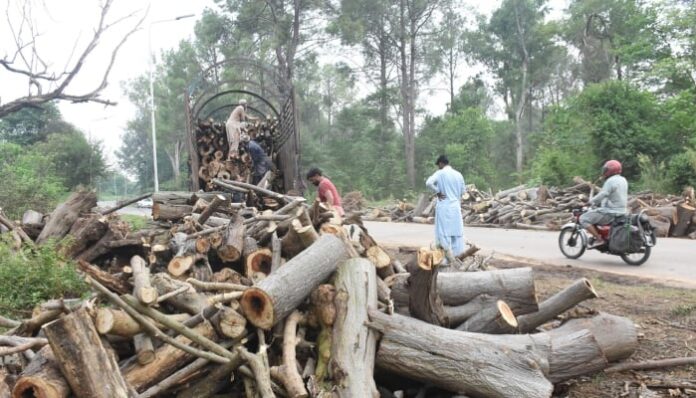
ISLAMABAD: The ongoing tree-cutting drive in the federal capital sparked sharp criticism in the National Assembly on Tuesday, exposing differences within the ruling coalition as key allies questioned the government’s environmental policy.
Raising the issue during the session, Pakistan Peoples Party (PPP) lawmaker Shazia Marri termed the matter “very serious,” citing reports that thousands of trees had been cut across Islamabad, including in Shakarparian. She urged the House to take notice of the scale of the operation.
Muttahida Qaumi Movement-Pakistan (MQM-P) leader Dr Farooq Sattar also questioned the move, expressing concern that decades-old trees had reportedly been removed due to construction activities, which he said should not have happened.
Last week, the Islamabad district administration maintained that the campaign specifically targeted paper mulberry trees, which it said were responsible for widespread pollen allergies in the capital.
Pakistan Tehreek-e-Insaf (PTI) leader Ali Mohammad Khan acknowledged that removing wild mulberry trees during pollination season was understandable but questioned why trees aged 40 to 50 years had allegedly been cut down.
The opposition members and government allies called for the matter to be referred to the National Assembly’s Standing Committee on Environment.
Responding to the criticism, Minister of State for Interior Talal Chaudhry told the House that only allergy-causing paper mulberry trees had been removed. He claimed Islamabad was now “greener than before” and announced that 60,000 additional trees would be planted by the end of March.
While responding to a calling attention notice moved by MNA Muhammad Riaz Fatyana, Chaudhry said the issue had been widely debated on social and electronic media but stressed that facts showed only specific categories of trees were removed.
He explained that tree removal in Islamabad generally occurred under three circumstances: development in brown-area sectors under the city’s original master plan, infrastructure needs such as roads and underpasses, and the elimination of hazardous species, particularly paper mulberry. He added that several areas perceived as green belts were, in fact, designated as brown areas in the master plan.
The minister said no infrastructure project over the past 18 months had removed trees without due process, which included public hearings, Environmental Protection Agency (EPA) review and certification, and verification through SPARCO imagery and NDVI analysis.
“Over 40,000 mature trees, measuring eight to 10 feet, have already been planted, and 60,000 more will be planted by March,” he said, adding that satellite data and NDVI assessments showed an increase in Islamabad’s green cover between 2023 and 2025.
He invited parliamentarians and journalists to attend an on-ground technical briefing to verify the data and emphasised that uprooting paper mulberry generated no revenue but instead required government expenditure to prevent regrowth.
Despite the assurances, the House referred the matter to the relevant standing committee for further scrutiny.
Later, Climate Change Minister Musadiq Malik visited Shakarparian to review the drive, saying he wanted to personally assess which trees had been cut. He warned that action would be taken if local species were removed due to negligence or systematic wrongdoing, and said pollen allergies affected between 30 and 37 per cent of the population.
He also cautioned that show-cause notices would be issued to construction projects found violating Pakistan Environmental Protection Agency guidelines.