















NEW YORK: Pakistan on Wednesday condemned the deadly attack at a Hanukkah gathering in Sydney, which left 11 people dead and several others injured, describing it as a targeted act of terrorism against civilians.
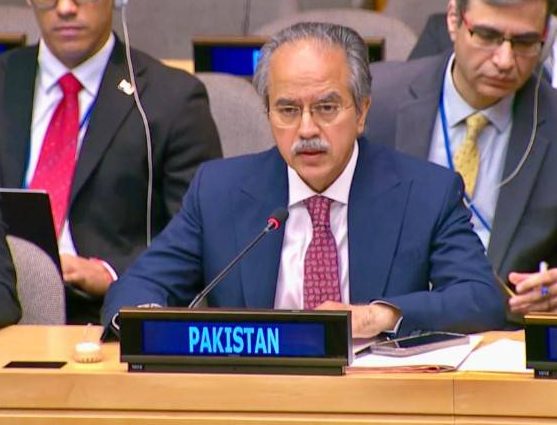
Speaking at the UN Security Council on Tuesday, Ambassador Asim Iftikhar Ahmad reiterated Pakistan’s unequivocal rejection of terrorism in all forms and expressed solidarity with Australia.
The envoy outlined Pakistan’s position on the ongoing Gaza conflict, emphasizing the need for strict enforcement of Security Council Resolution 2803. “Ceasefire agreements must be fully respected. Humanitarian access, prisoner releases, and reconstruction efforts cannot be delayed,” Ahmad said.
He commended the mediation efforts of the United States, Qatar, Egypt, and Türkiye, which culminated in the October 10 ceasefire between Israel and Hamas, noting that over two years of war had claimed more than 67,000 Palestinian lives and devastated Gaza’s infrastructure.
Highlighting UN findings, the ambassador warned of a sharp rise in Israeli settlement activity in the West Bank, including East Jerusalem, stating that more than 6,300 housing units were advanced in 2025 alone.
He stressed that such actions violate international law, undermine the two-state solution, and exacerbate regional instability. Ahmad reiterated Pakistan’s support for a time-bound political process leading to an independent Palestinian state within pre-1967 borders, with Al-Quds Al-Sharif as its capital.
Turning to digital development, Pakistan addressed the WSIS+20 UN General Assembly meeting, marking 20 years since the World Summit on the Information Society. Ahmad highlighted the global digital divide, noting that disparities now extend beyond connectivity to include access to data, artificial intelligence, and technological capacity.
He stressed the importance of international cooperation to bridge these gaps, urging investment, skills development, and technology transfer to developing nations.
Pakistan also showcased its domestic initiatives, including the Digital Nation Pakistan Act, which provides a legal framework for national digital governance and services, and the National AI Policy, which guides the ethical, inclusive, and secure development of artificial intelligence.
“Expanding connectivity, strengthening public digital infrastructure, and promoting e-governance are central to our strategy for inclusive development,” Ahmad said.
The ambassador emphasized that terrorism anywhere threatens global stability, while adherence to ceasefire agreements and international law is critical to ensuring peace. Pakistan called on the Security Council and the international community to support measures that protect civilians, facilitate humanitarian relief, and prevent further escalations.
In conclusion, Ahmad reaffirmed Pakistan’s unwavering solidarity with Palestine and its commitment to multilateral efforts to reduce conflict, restore peace, and advance social and technological development globally.