










BERLIN, Germany: Ukraine has relinquished its aim to join the Nato military alliance in exchange for Western security guarantees as a compromise to end the war with Russia, President Volodymyr Zelensky said on Sunday as peace talks got underway in Berlin.
Zelensky aired the concession as he flew to the German capital, where he began meetings with US President Donald Trump’s envoy Steve Witkoff and son-in-law Jared Kushner in efforts to end Europe’s bloodiest conflict since World War Two.
The move marks a major shift for Ukraine, which has fought to join Nato as a safeguard against Russian attacks and has such an aspiration included in its constitution. It also meets one of Russia’s war aims, although Kyiv has so far held firm against ceding territory to Moscow.
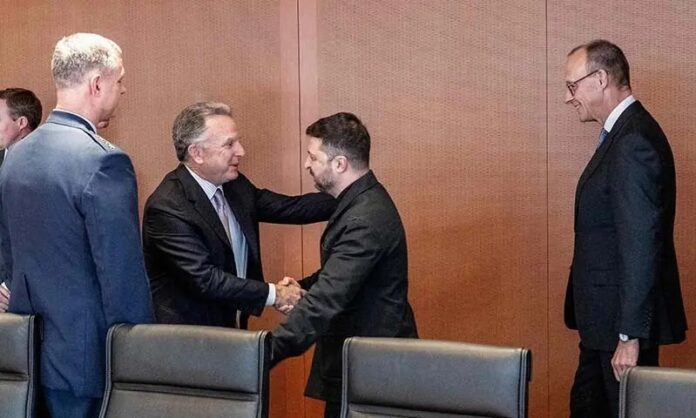
Zelensky met the US envoys at talks hosted by German Chancellor Friedrich Merz, who, a source said, had made brief remarks before leaving the two sides to negotiate. Other European leaders are also due in Germany for talks on Monday.
Security guarantees from the United States, Europe and other partners instead of Nato membership represented a compromise on Ukraine’s side, Zelensky said ahead of Sunday’s discussions.
US President Donald Trump’s son-in-law Jared Kushner, US Special Envoy to the Middle East Steve Witkoff and Nato Supreme Allied Commander Europe, US Air Force General Alexus Grynkewich, meet with Ukraine’s President Volodymyr Zelensky, senior Ukrainian negotiator Rustem Umerov and German Chancellor Friedrich Merz (not pictured) in Berlin, Germany on December 14. — Reuters
“From the very beginning, Ukraine’s desire was to join Nato; these are real security guarantees. Some partners from the US and Europe did not support this direction,” he said in answer to questions from reporters in a WhatsApp chat.
“Thus, today, bilateral security guarantees between Ukraine and the US, Article 5-like guarantees for us from the US and security guarantees from European colleagues, as well as other countries, Canada [and] Japan are an opportunity to prevent another Russian invasion,” Zelensky said.
“And it is already a compromise from our part,” he said, adding that the security guarantees should be legally binding.
Russian President Vladimir Putin has repeatedly demanded that Ukraine officially renounce its Nato ambitions and withdraw troops from about 10 per cent of Donbas, which Kyiv still controls. Moscow has also said that Ukraine must be a neutral country and that no Nato troops can be stationed there.
Russian sources said earlier this year that Putin wants a “written” pledge by major Western powers not to enlarge the US-led Nato alliance eastwards — shorthand for formally ruling out membership to Ukraine, Georgia, Moldova and other former Soviet republics.
Zelensky had earlier called for a “dignified” peace and guarantees that Russia would not attack Ukraine again.
Under pressure from Trump to sign a peace deal that initially backed Moscow’s demands, Zelensky accused Russia of dragging out the war through deadly bombings of cities and Ukraine’s power and water supplies.
Sending Witkoff, who has led negotiations with Ukraine and Russia on a US peace proposal, appeared to be a signal that Washington saw a chance of progress nearly four years after Russia’s 2022 invasion.
Zelensky said Ukraine, the Europeans and the US are looking at a 20-point plan and that at the end of it there is a ceasefire. He said Kyiv has no direct talks with Russia.
A ceasefire along the current front lines would be a fair option, he added.
‘Critical moment’
Britain, France and Germany have been working to refine the US proposals, which in a draft disclosed last month called for Kyiv to cede more territory, abandon its Nato ambitions and accept limits on its armed forces.
European allies have described this as a “critical moment” that could shape Ukraine’s future, and sought to shore up Kyiv’s finances by leveraging frozen Russian central bank assets to fund Kyiv’s military and civilian budget.
Putin hosted Witkoff and Kushner at a meeting earlier in December that the Kremlin praised as “constructive”, although no major breakthroughs were reached.
Zelensky said hundreds of thousands were still without power after Russian strikes on energy, heating and water supplies across Ukraine.
“Russia is dragging out the war and seeks to inflict as much harm as possible on our people,” he said.
Residential buildings during a power blackout after critical civil infrastructure was hit by recent Russian missile and drone attacks, amid the Russia-Ukraine war, in Odessa, Ukraine on December 14. — Reuters
Russia’s full-scale invasion of Ukraine caused relations with the West to plummet and has cranked up warnings from Nato and European leaders that Putin would not stop there.
Nato Secretary General Mark Rutte said in a speech in Berlin on Thursday that Nato should be “prepared for the scale of war our grandparents or great-grandparents endured” and asserted that “we are Russia’s next target”.
The Kremlin has repeatedly dismissed such claims.
“This seems like a statement by a representative of a generation that has managed to forget what World War Two was actually like,” Kremlin spokesman Dmitry Peskov told state television reporter Pavel Zarubin on Sunday.
“They have no understanding, and unfortunately, Mr Rutte, making such irresponsible statements, simply does not understand what he is talking about,” Peskov added.



For the reason that the admin of this site is working, no uncertainty very quickly it will be renowned, due to its quality contents.
Have you ever considered about including a little bit more than just your articles? I mean, what you say is important and everything. Nevertheless imagine if you added some great pictures or video clips to give your posts more, “pop”! Your content is excellent but with pics and videos, this site could certainly be one of the very best in its field. Very good blog!