Pakistan urges US, Iran to revive MoU talks as regional conflict deepens
Pakistan urges the US and Iran to stop hostilities and resume technical-level negotiations under the Islamabad MoU. The FO says the regional peace framework faces challenges amid renewed escalation and Strait of Hormuz risks.

FO spokesperson says implementation of Islamabad-brokered peace framework facing challenges amid renewed hostilities
Calls for restraint, warning Strait of Hormuz crisis threatens global energy, trade and food security
Says UK grooming gang case is Britain's internal matter, rejects any connection with convicted offender
FO reaffirms unwavering commitment to Pakistan-Saudi mutual defence pact following Houthi missile attacks
ISLAMABAD: Pakistan on Thursday renewed its call for “an immediate end to hostilities between the United States and Iran,” urging both sides to return to technical-level negotiations under the Islamabad Memorandum of Understanding (MoU), while acknowledging that implementation of the peace framework brokered by Pakistan and Qatar was facing mounting challenges amid renewed military escalation in the region.
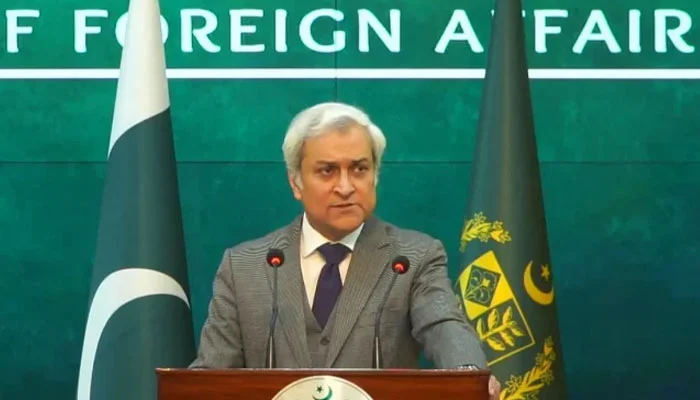
Addressing the weekly media briefing, Foreign Office spokesperson Tahir Andrabi said Pakistan remained committed to encouraging dialogue and diplomacy, stressing that the Islamabad MoU signed between Washington and Tehran last month continued to provide an enduring framework for resolving the conflict peacefully.
🔴LIVE: Spokesperson's Weekly Press Briefing 16-07-2026 at Ministry of Foreign Affairs, Islamabad https://t.co/v76caqFugZ
— Ministry of Foreign Affairs - Pakistan (@ForeignOfficePk) July 16, 2026
"Pakistan will continue to encourage all sides to end violence and resume technical-level talks in accordance with the MoU and the joint statement issued by mediators Pakistan and Qatar on June 20 following the direct talks in Switzerland," Andrabi said.
"We hope all parties will remain committed to the path of dialogue and diplomacy in resolving their outstanding issues," he added.
The spokesperson noted that the implementation of the Islamabad MoU was currently "facing challenges" as hostilities had intensified over the past week.
"As hostilities have continued over the past week, Pakistan reiterates its call on all parties to exercise maximum restraint and refrain from any actions that would further undermine peace and stability," he said.
His remarks came as the United States and Iran continued to exchange attacks on Thursday, with Washington striking Iran's coastal defence and missile sites, while Tehran responded by targeting American military installations in neighbouring Gulf countries.
"Pakistan firmly believes that there is no alternative to sustained engagement, dialogue and diplomacy in pursuit of the shared objectives of lasting peace, stability and progress," Andrabi said.
He stressed that all conflicts and disputes are ultimately resolved through negotiations, describing the Islamabad MoU as an "enduring framework for promoting peace, mutual respect and shared prosperity."
The Foreign Office also underlined the importance of ensuring the continued safety, security and freedom of maritime navigation through the Strait of Hormuz.
"Many countries, particularly those in the Global South, are being adversely affected by the situation in the Strait of Hormuz," Andrabi observed.
"Pakistan recognises the urgent need to address the impact of the current situation on global energy supplies and other economic commodities, including trade and food security," he said, expressing hope for an early normalisation of the situation in the strategically important waterway.
Regional tensions have intensified since Iran announced on Sunday that it had closed the Strait of Hormuz, prompting the United States to reimpose its naval blockade of Iranian ports. Ongoing military operations have also disrupted commercial shipping through the vital maritime corridor, which carried around one-fifth of global oil and gas shipments before the conflict.
The disruption has pushed global oil prices sharply higher and fuelled concerns about rising inflation worldwide. Pakistan increased petrol and high-speed diesel prices by more than Rs13 on July 10, while global crude prices climbed to a four-week high on Tuesday.
Islamabad 'actively engaged' in peace efforts
Highlighting Pakistan's diplomatic outreach, Andrabi said Islamabad had remained "actively engaged with key interlocutors across the region in support of our efforts in de-escalation, dialogue and peaceful resolution of the situation."
He recalled Prime Minister Shehbaz Sharif's telephone conversation with the Emir of Qatar on July 10, during which both leaders agreed on the importance of sustained diplomatic engagement.
The spokesperson also referred to the prime minister's call with Iranian President Masoud Pezeshkian on the same day, during which he urged all parties not to "jeopardise the hard-earned peace gains."
Andrabi further highlighted Deputy Prime Minister and Foreign Minister Ishaq Dar's diplomatic engagements, including his recent conversations with his Saudi and Iranian counterparts aimed at supporting regional peace efforts.
The renewed fighting since July 8 has cast fresh uncertainty over the future of the Islamabad MoU signed on June 18, which sought to reopen the Strait of Hormuz and pave the way for ending the conflict after a further 60 days of negotiations.
Last week, US President Donald Trump declared that he considered the ceasefire over while indicating that the door remained open for renewed negotiations.
The conflict has once again drawn Gulf states into the crisis, with Iran targeting US military facilities in Bahrain, Jordan and Kuwait. Monday witnessed the heaviest exchanges since the initial April 8 ceasefire between Tehran and Washington.
The conflict, which began with US and Israeli strikes on Iran on February 28, has destabilised the Gulf region, while Iran's effective blockade of the Strait of Hormuz has driven up global energy prices and heightened inflationary concerns.
UK grooming gang case 'Britain's internal matter'
Responding to another question, Andrabi said Pakistan had "no connection" with the case of Shabbir Ahmed, identified as the ringleader of a child grooming gang in the United Kingdom.
Ahmed held dual British-Pakistani nationality before being stripped of his British citizenship following his 2012 conviction on multiple child sexual offence charges.
Asked about reports that Britain had approached Pakistan regarding Ahmed's deportation, Andrabi described the matter as "entirely an internal matter" of the United Kingdom.
"The individual concerned is a British national who spent his entire adult life in the UK and was duly convicted by a British court for reprehensible offences committed on British soil," he said.
"Any decisions regarding his release, supervision or future legal status fall exclusively within the jurisdiction of the competent British authorities and must be dealt with in accordance with the laws of the UK."
He stressed that Pakistan "cannot be associated with any decisions relating to the individual's release or subsequent treatment under British law."
Andrabi said Pakistan condemned child sexual abuse in the strongest possible terms.
"Perpetrators of such heinous crimes must be investigated, prosecuted and punished to the fullest extent of the law, irrespective of race, ethnicity or religion," he said.
"Regardless of where he was born, the onus lies on where he grew up, was raised, groomed and unfortunately spoiled. His heinous crimes demand serious introspection rather than a quest to search for extraneous causes."
Pakistan reaffirms commitment to Saudi defence pact
The FO spokesperson also reaffirmed Pakistan's commitment to its Strategic Mutual Defence Agreement (SMDA) with Saudi Arabia following ballistic missile attacks launched by Yemen's Houthi movement against the Kingdom.
The Houthis said they fired missiles at Saudi Arabia in retaliation for what they described as Saudi-backed strikes on an airport under their control, ending a four-year period during which Riyadh had largely remained outside direct confrontation with the Iran-aligned group. Saudi authorities said the missiles targeting the Kingdom's southern region had been intercepted.
Referring to the Strategic Mutual Defence Agreement signed between Pakistan and Saudi Arabia in September last year, Andrabi said Islamabad remained fully committed to implementing all bilateral agreements with the Kingdom.
"Pakistan has expressed its unwavering commitment to support the sovereignty and territorial integrity of our brotherly country, the Kingdom of Saudi Arabia," he said.
"Pakistan remained fully committed to implement all its bilateral agreements with respect to Saudi Arabia, including the mutual defence agreement."
AID TO AFGHANISTAN, BORDER SECURITY
Foreign Office spokesperson Tahir Andrabi on Thursday confirmed that Pakistan continues to facilitate United Nations-led humanitarian assistance to Afghanistan, with approximately 45 aid trucks having already transited through Pakistani land routes.
He noted that while humanitarian assistance was continuing uninterrupted, Pakistan had significantly tightened cross-border movement with Afghanistan since October last year following a deterioration in bilateral relations amid a surge in militant attacks inside Pakistan. As part of those measures, Islamabad had suspended bilateral and transit trade.
Despite facilitating humanitarian aid, Andrabi said relations with the Afghan interim government remained strained because of Pakistan's security concerns.
"No, sir, ice has not broken and ice will not break until Afghanistan renounces the support of terrorism in Pakistan," he said.
"The Afghan Taliban regime must renounce terrorism against Pakistan, give verifiable written assurances that its territory will not be used to foment, engineer, sponsor and execute terrorist attacks against Pakistan."
Pakistan has repeatedly accused Afghanistan of allowing its territory to be used for cross-border militant attacks in the country's western border regions, allegations that Kabul has consistently rejected.
Security for Chinese projects
Responding to reports suggesting that the China-backed Saindak Metals Limited copper mine project in Balochistan could face a shutdown because of security concerns, Andrabi dismissed the claims and reaffirmed Pakistan's commitment to ensuring the safety of its international partners.
"We are not obliged to comment on news stories whose facts remain questionable," the Foreign Office spokesperson said.
China has invested heavily in Balochistan under its Belt and Road Initiative (BRI), including the development of the deep-sea port at Gwadar, despite the province's long-running insurgency.
Andrabi said Pakistan and China remained in close coordination regarding the security of Chinese nationals working on the China-Pakistan Economic Corridor (CPEC) and other strategic infrastructure projects.
"As host to these projects, Pakistan guarantees impeccable security to our Chinese guests who are working on these projects," he added.
Other diplomatic engagements
Highlighting Pakistan's recent diplomatic activities, Andrabi confirmed that Deputy Prime Minister and Foreign Minister Ishaq Dar had departed for Shanghai to sign the founding instrument of the World Artificial Intelligence Cooperation Organisation (WAICO) on Pakistan's behalf.
He said Pakistan would become a founding member of the China-backed organisation. During the visit, Dar will also attend the 2026 World Artificial Intelligence Conference and hold a series of bilateral meetings on its sidelines.
The FO spokesperson also highlighted several recent diplomatic engagements, including the visit of Croatian Foreign Minister Gordan Grlić Radman to Islamabad, annual bilateral consultations with Portugal, and President Asif Ali Zardari's visit to Kyrgyzstan — the first by a Pakistani president to the Central Asian country in more than two decades.
He further noted that Pakistan had successfully hosted the 9th OIC Ministerial Conference on Women, attended by delegates from the organisation's 57 member states, and had submitted its seventh national report under United Nations Security Council Resolution 1540, reflecting the country's continued commitment to international non-proliferation obligations.
During the question-and-answer session, Andrabi rejected India's latest charge sheet against six leaders of the All Parties Hurriyat Conference (APHC), including the late Syed Ali Geelani, describing it as another attempt to employ what he termed "sham legal processes" against the Kashmiri leadership.
He said reopening a case dating back nearly three decades demonstrated how India's legal institutions were being used "to advance a political agenda" and maintained that such actions could not alter "the internationally recognised disputed status of Jammu and Kashmir."
The FO spokesperson also dismissed India's allegations linking Pakistan to the Pahalgam attack, calling them "baseless and politically motivated."
He said Pakistan continued to seek an "independent, transparent and credible investigation," arguing that India had yet to present credible evidence to substantiate its claims.

Comments
No comments yet. Be the first to join the discussion!