GHQ vows tougher response to cross-border terror
Pakistan’s military leadership says intelligence-based operations against militant threats originating from Afghan Taliban-controlled territory will continue. The Corps Commanders’ Conference also reviewed security, hybrid threats, water issues and Kashmir.

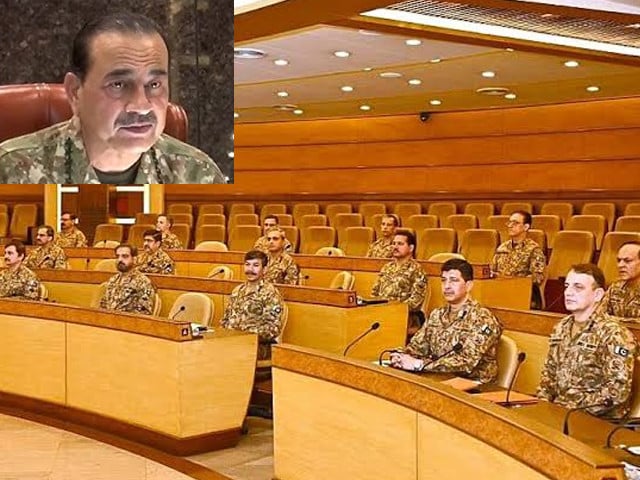
ISLAMABAD: Pakistan’s top military leadership on Monday said intelligence-based operations against militant threats originating from territory under the control of the Afghan Taliban would continue, as the Corps Commanders’ Conference voiced concern over cross-border attacks and the broader security situation.
The statement followed the 276th Corps Commanders’ Conference at General Headquarters in Rawalpindi, chaired by Field Marshal Syed Asim Munir, Chief of Army Staff and Chief of Defence Forces. According to the Inter-Services Public Relations (ISPR), the forum discussed the prevailing security environment and reviewed the operational preparedness, professionalism and combat readiness of the armed forces.
The military’s media wing said the forum expressed serious concern over what it described as the continued use of Afghan Taliban-controlled territory by Indian-sponsored militant groups, including Fitna al Khawarij (FAK) and Fitna al Hindustan (FAH), to plan and launch attacks inside Pakistan. The ISPR said the commanders linked lasting regional peace and stability to preventing the use of that territory by what it called Indian terrorist proxies, and held the Afghan Taliban regime responsible.
In the official statement, the ISPR said Pakistan retained the right to defend its population against terrorism and that the armed forces would continue intelligence-based operations under Operation Ghazab-Lil-Haq against threats emanating from Afghan Taliban-controlled territory.
"The forum affirmed that lasting peace and stability in the region is contingent upon preventing use of Afghan Taliban-controlled territory by Indian terrorist proxies for which the Afghan Taliban regime is directly responsible," the statement added.
Security, governance and hybrid threats
The conference took place amid a recent rise in militant attacks that Pakistani authorities believe were planned from sanctuaries in Afghanistan with external support. The military leadership also said force alone would not be enough to deal with the challenge.
According to the ISPR, the forum called for the urgent establishment of effective governance arrangements in troubled areas, with a focus on public service delivery and welfare, and stressed the need to break what it described as a terror-crime nexus operating under vested political patronage.
The military leadership also said that after what it termed a comprehensive defeat inflicted in Marka-e-Haq, hostile elements had increasingly turned to externally backed hybrid warfare and disinformation efforts aimed at stirring unrest within Pakistan. The conference condemned all forms of state-sponsored financing, facilitation and support for proxies, and warned that any effort to destabilise the country through hybrid means would be met firmly.
Regional issues and Kashmir
The forum said the participants offered Fateha for members of the armed forces, law-enforcement agencies and civilians who had lost their lives, and reiterated that their sacrifices underpin Pakistan’s security, unity and resilience.
Reviewing regional developments, the military leadership appreciated Pakistan’s role in encouraging dialogue, de-escalation and regional stability. It also reaffirmed the country’s stated commitment to peaceful settlement of disputes, adherence to international law and greater regional cooperation to tackle common security challenges.
The conference also took up India’s rhetoric regarding the Indus Waters Treaty and reaffirmed the guidance contained in the National Security Committee’s directive issued on April 24, 2025.
"The forum expressed resolute commitment to undertake all measures necessary to ensure availability of Pakistan's rightful share of water as per the directives of the government and inspirations of the people of Pakistan," the ISPR statement said.
On Kashmir, the forum condemned what it described as continuing human rights abuses and unilateral demographic changes in Indian Illegally Occupied Jammu and Kashmir. It reiterated Pakistan’s diplomatic, political and moral backing for the Kashmiri cause, and said durable regional stability depended on granting the people of Kashmir their right to self-determination in line with United Nations Security Council resolutions.
In his concluding remarks, Field Marshal Asim Munir directed commanders to speed up implementation of the military’s multi-domain transformation plan in view of the changing nature of warfare. He also asked commanders to maintain the highest levels of vigilance, operational readiness and professional standards, with integrated responses to conventional, sub-conventional and hybrid threats while protecting Pakistan’s sovereignty and national interests.
Comments
No comments yet. Be the first to join the discussion!