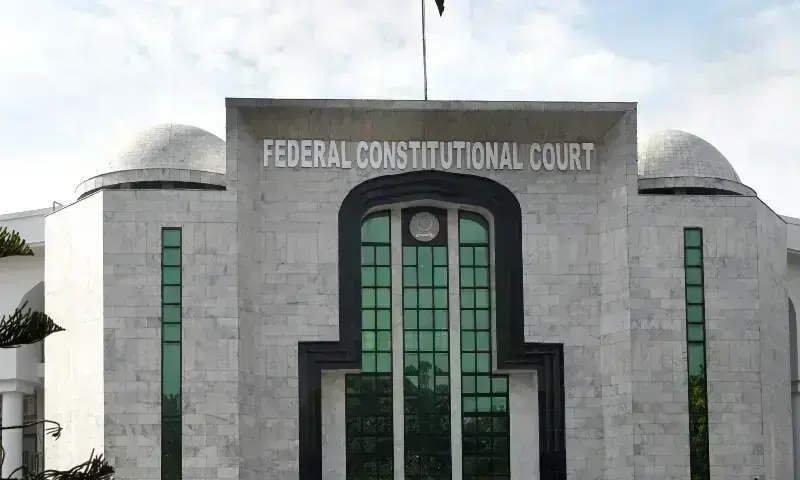
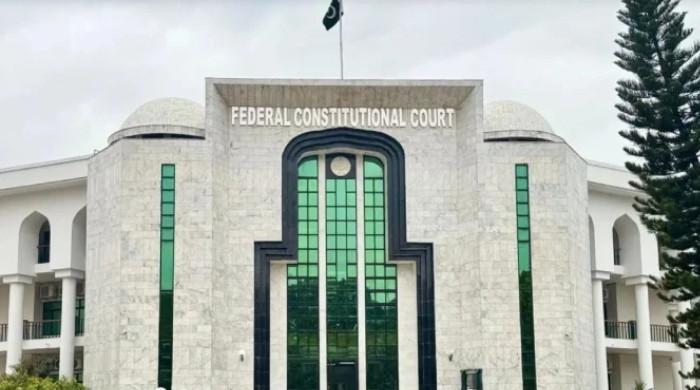
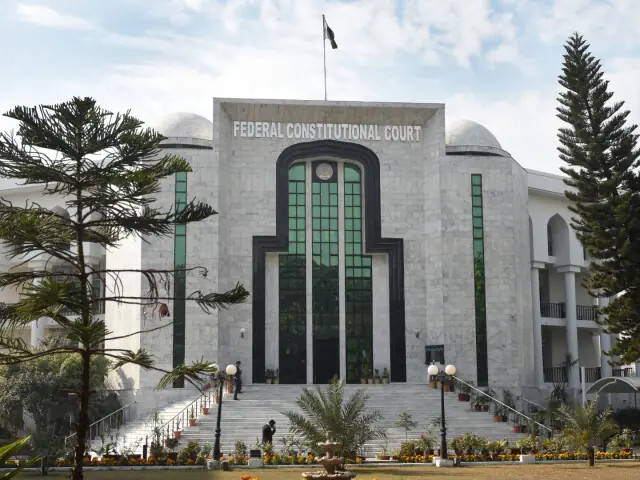
Top court rules bar strikes violate litigants’ right to justice
The Federal Constitutional Court has ruled that strikes called by bar bodies are illegal and violate litigants’ right of access to justice. The court upheld a Peshawar High Court order restoring the licences of two lawyers.

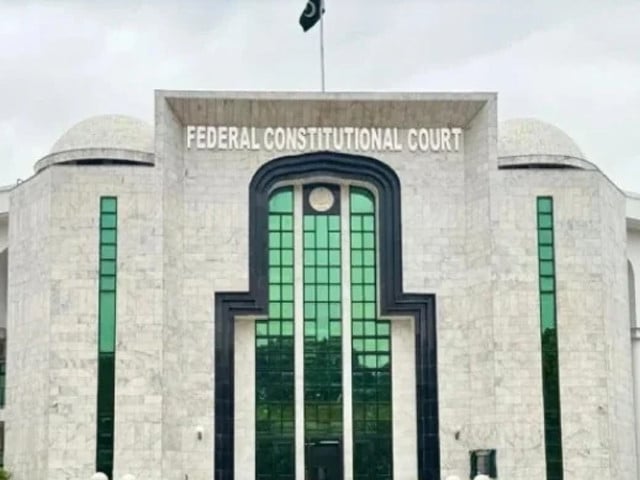
ISLAMABAD: The Federal Constitutional Court (FCC) has held that strikes announced by bar associations and bar councils are unlawful and infringe upon a litigant’s constitutional right of access to justice, ruling that such actions deny citizens legal representation and add to the burden on the judicial system.
In a 20-page judgement authored by Justice Aamer Farooq, the court upheld a Peshawar High Court ruling that had restored the practice licences of two lawyers. The case was heard in proceedings involving the Peshawar High Court Bar Association against a PHC order through which the licences had been reinstated.
Justice Aamer Farooq said the practice of bar-led strikes was common in the subcontinent but could not be sustained in law. He observed that when a strike call is issued, lawyer bodies prevent advocates from appearing before courts, with the result that litigants are left without counsel and their cases are postponed without progress.
The judgement said Pakistan’s legal system was already under heavy strain, with long cause lists and litigants often waiting years for their cases to conclude. In that setting, the court held, strike calls by lawyer bodies only deepen the difficulties faced by those seeking relief through the courts.
Attributing the reasoning to the judgement, the court said even if lawyers consider a cause worthy, strikes are not an acceptable way to press it because the cost is borne by litigants awaiting justice. It further held that denial of access to justice, whether through non-appearance before courts or the closure of judicial or administrative court work, amounts to a violation of the Constitution.
"The practice of calling strikes by Bar Associations or Bar Councils is common in the sub-continent. This practice is not only illegal but also in violation of the right of access to justice of a litigant and his counsel," it said.
The court also stated in the judgement that a litigant is effectively deprived of the right to be represented by a legal practitioner on the day of a strike and that hearings are adjourned without any advancement in the matter. "Our legal system is already over-burdened and cause lists before the courts are hefty and litigant has to wait for years and years for the matter to culminate and in such state of affairs the strike call on part of the lawyer bodies add to the plight of the litigant."
According to the facts recorded in the case, the dispute arose after the murder of a young lawyer in a case in which a station house officer was implicated. An FIR was registered and protests followed, demanding action against the officer. He later surrendered before a court and was taken into custody, after which he engaged advocate Shabbir Hussain Gigyani as his counsel.
The judgement said these developments led the Khyber Pakhtunkhwa Bar Council to pass a resolution barring any advocate from representing the accused officer. Separately, advocate Ali Azim Afridi was subjected to disciplinary proceedings when the executive committee of the Khyber Pakhtunkhwa Bar Council, in an emergency meeting held on October 8, 2025, suspended his licence. The suspension followed a communication from the Peshawar Bar Council, which described his appearance in court during a declared strike as an act of indiscipline.
The affected lawyers challenged the suspension of their licences before the Peshawar High Court, which accepted their writ petitions through a consolidated judgement. The FCC has now upheld that decision and ruled that preventing lawyers from appearing before courts or representing litigants is wholly impermissible.
Comments
No comments yet. Be the first to join the discussion!