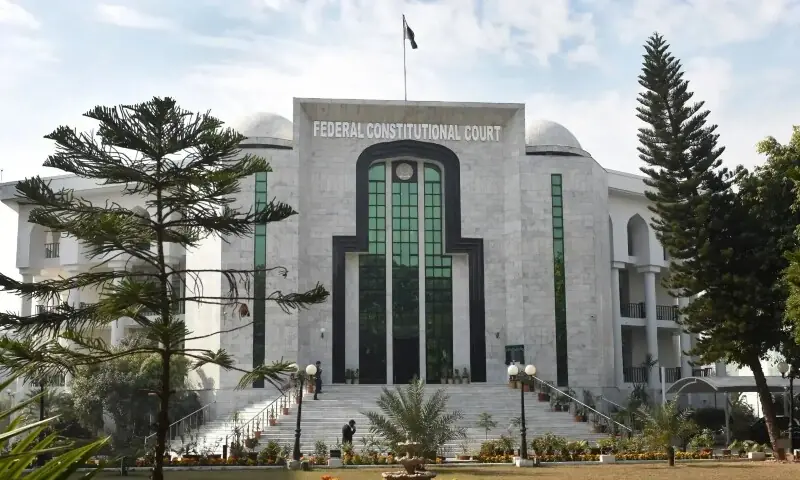
Federal Constitutional Court says verdicts delayed beyond legal limit are unlawful
The Federal Constitutional Court has ruled that reserved judgments delivered after the prescribed legal period are unlawful. The court said high courts must issue such verdicts within 90 days and ordered its ruling circulated to all high courts.

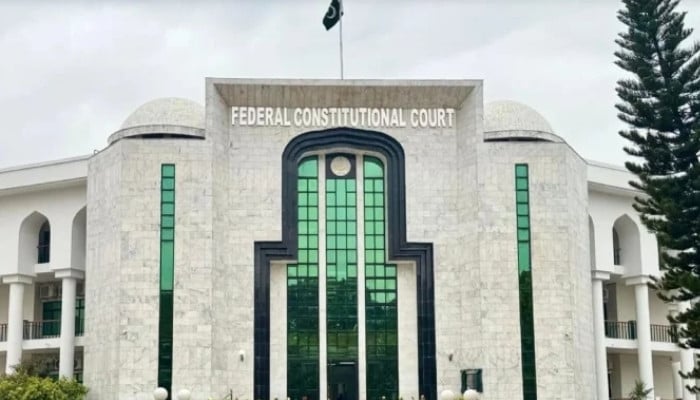
ISLAMABAD: The Federal Constitutional Court (FCC) has held that reserved judgments delivered after the time limit set under the law are unlawful, ruling that superior courts must issue such decisions within the prescribed period.
The seven-page judgment was authored by Justice Aamir Farooq in a case arising from a petition filed by the Pakistan Shipping Corporation against a Sindh High Court (SHC) ruling in a pension dispute.
In the judgment, Justice Farooq said high courts were required to announce reserved judgments within 90 days. He stated that the rules of the Supreme Court and the high courts have the force of law and that breaches of those rules should carry consequences.
The FCC ruled that a judgment announced after the stipulated period could be declared void on that ground alone. It also said judges and court staff were fully bound by procedural rules governing the handling and announcement of decisions.
Leak of judgment before announcement
The court further held that even an unintentional leak by members of a bench before the formal announcement of a judgment would amount to a violation of court rules.
According to the ruling, the head of a bench may order a fresh hearing if a judgment, or its key points, is disclosed before it is officially delivered. The court said such a rehearing may be conducted either by the same bench or by a newly constituted bench.
The FCC also laid down the forum for dealing with such irregularities. It said that in matters concerning high courts, the issue would be referred to the relevant chief justice. In the Supreme Court, such a matter would be placed before the judges’ committee for action.
Court notes growing trend of reserved judgments
The judgment observed that there had been an increasing trend of judgments being reserved, adding that litigants often face long waits for the outcome of their cases.
The court noted that judgments are generally reserved when judges do not reach consensus or when a case involves legal complexities.
The ruling also referred to a case in which the SHC took around 10 months to announce a reserved decision.
against the law
In the same judgment, the FCC disposed of the Pakistan Shipping Corporation’s appeal against the SHC verdict and set aside observations made by the high court.
The court also directed that copies of the judgment be sent to all high courts for implementation.
The ruling addresses the issue of delays in reserved judgments and sets out the consequences for decisions announced beyond the legally prescribed period, while also outlining the procedure to be followed in cases involving premature disclosure of judgments.
Comments
No comments yet. Be the first to join the discussion!