Parting is such sweet sorrow
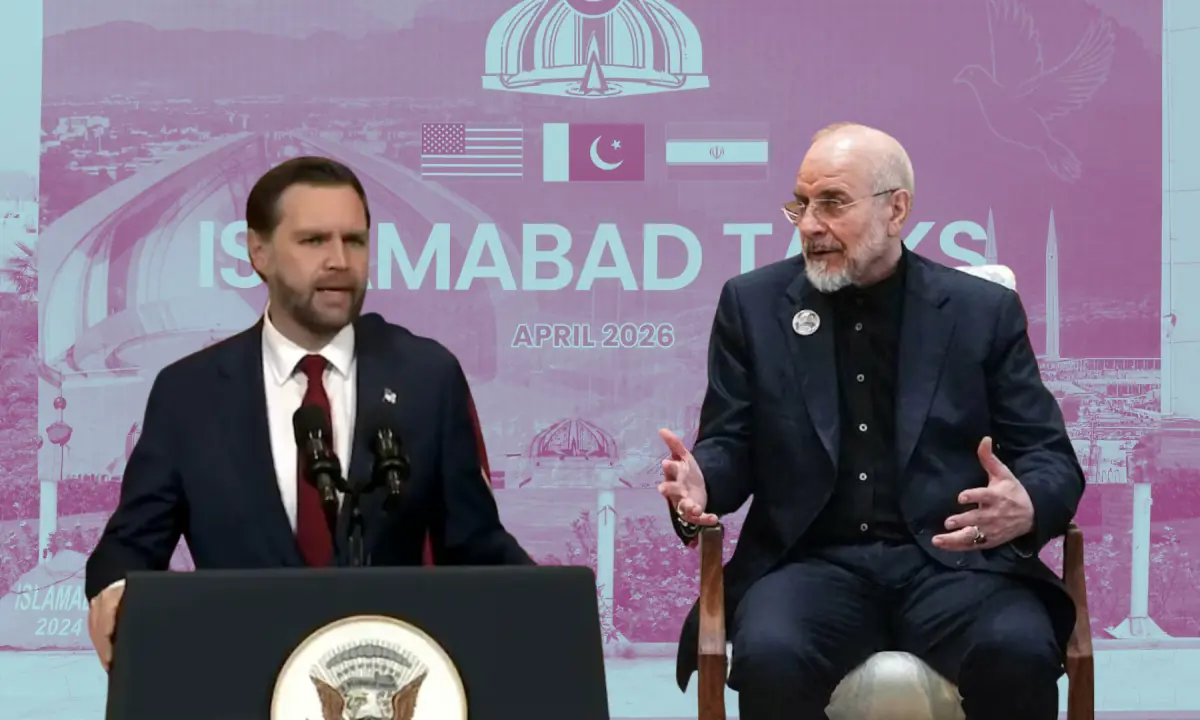
The Islamabad talks between the US and Iran end without resolution. With Hormuz Strait tensions and the nuclear dispute still unresolved, the ceasefire’s future remains uncertain.

Neither side is exhausted militarily
AT PENPOINT
In hindsight, the Islamabad round was bound to fail. The USA historically has not been much good at negotiating beyond the initial ceasefire in any conflict, and ever since the Vietnam War, as had tough negotiations mainly because the ground separating the two sides has been such that covering it has been difficult.
One difference between the Islamabad talks and either the Paris talks which ended the Vietnam War, or the Doha talks which ended the Afghan conflict, is that they started without a definite victory in the field for either side. Indeed, the Doha talks never saw even an informal ceasefire, while the Paris talks were notoriously interrupted by the heaviest US bombing of North Vietnam ever conducted, Operation Linebacker II. That bombing was carried out to ‘persuade’ the North Vietnamese, whom the Americans saw as hanging back from reaching an agreement.
The USA may have already begun the modern equivalent of Linebacker II by its own blockade of the Hormuz Strait. It is of interest to naval historians to see what happens when one strait is blockaded by two different countries at cross-purposes. One point has already been addressed by the USA: it has expressed willingness to shoot at Iranian vessels. Whether the figleaf of the ceasefire can continue beyond that, or whether it involves a resumption of hostilities, is yet to be seen.
Another difference is that the US opponent in the two earlier examples wanted US forces to vacate their own country. Though Iran does demand that the USA vacate the Middle East, the demand is more a desire rather than a core demand.
The principal issue remains Iran’s nuclear programme, according to US Vice-President and delegation leader, J.D. Vance. Iranian unwillingness to commit to not having a weapons programme, followed by its refusal to commit to not obtaining the technological technical capability of making a weapon. Iran continues to refuse to do so. This is despite two attempts by the USA and Israel to bomb the nuclear programme to annihilation.
Matters remained unresolved after the Islamabad talks, not because Iran or the USA were unwilling (or any shortcoming of the mediators), but because neither had yet reached a point where it was too desperate to risk further combat. And that is a problem for the entire world.
Does this imply a third attempt? That is the obvious military solution. It was a possibility when the USA brought in B52 Stratofortress bombers to the theatre, basing them in the UK. There was a visible increase of concern because they can carry air-launched cruise missiles with nuclear payloads, but perhaps more relevant is their ability to deliver ‘bunkerbuster’ bombs, the famous and feared GBU57, a 3000-lb bomb also called the Massive Ordnance Penetrator, They use high-strength steel casings and delayed-detonation fuses to go deep underground, to reach hardened facilities. The newest variant, the 5000-lb GBU 72B, has been used against Iran.
Bunkerbusters have already been used, delivered by B2 Stealth bombers, against nuclear sites, as well as against underground missile sites. The USA has done its best to eliminate Iran’s missile strike capability, but it has so far been unable to. It used bunker busters against anti-ship missile sites targeting the Strait of Hormuz, but either the bombs didn’t work, or the bombs landed in the wrong place because the intelligence was incorrect.
The missiles and the Hormuz Strait are also contentious issues. What emerged in this conflict was how the Strait’s passage is perhaps the biggest single weapon Iran has. While in other respects it is defending what it has (nuclear programme, missiles), with the Strait, it carries the war to the USA. True, the rest of the world is also shattered, but whose fault is that?
The US blockade of the Strait only means that it is not going back to normal. The blockadeis meant to show who controls it. Iran wants to charge a toll, while the USA wants to blockade those ships. It is thus going to be a sort of face-off. Ships which do pay a toll will risk the US Navy boarding them, firing on them or otherwise taking them into custody. Ships which do not, risk being shot at by Iranian anti-ship missiles. Until those are suppressed, the Strait will remain blockaded by Iran. To end the US blockade will also be difficult, for it is not just being done at sea by ships but also in the air, by not k#just missiles but by aeroplanes.
It is the ability to impose a blockade that gives teeth to the Iranian demand for the vacation of US bases in Gulf countries. It would not be impossible for the USA to impose a blockade, which it could do from its carriers and other ships, but it would be much more difficult, and probably more expensive.
One issue, that of the ceasefire, seems as if it is going to follow the Gaza playbook. There, a ceasefire remains in place, but that does not seem to act as a prohibition on Israel from attacking civilian targets. It has also not meant the free entry of food into the Gaza Strip. In the same way, there does not seem to be any restraint on the USA maintaining a blockade, while at the same time proclaiming that the ceasefire remains intact. Iran might choose to play along, as Hamas has done, because it does not wish to face the consequences of the ceasefire having broken down.
One major reason to avoid a ceasefire is to settle the oil markets. Oil is not expected to return to prewar levels, but to remain lower than at present. The new normal has to factor in the possibility of the Hormuz Strait being closed. Unless the matter of the Strait is duly resolved to allow free passage, oil prices are going to go to levels which discourage its use, and cause a world depression in the bargain.
While Trump will not pay much attention to the sufferings of the world, for the crisis of capitalism has led before to Fascism in the 1930s, and to rise of an entire ecosystem of rightwing populists today who would fit very comfortably with Hitler and Mussolini, he is constrained to pay attention to the effects of a depression on the upcoming midterm elections. Though he is blithe about it, the American consumer has already been hurt, and one reason he has not got the support of his European allies is that their voters are taking a beating at the petrol pumps. So far public transport has not been affected, but there is a limit to how long the mass transit entities, like subways and buses, can absorb these massive losses.
The prospect of a resumption of hostilities is nearer, and there is a strong chance that the USA will not be able to keep the Strait open. There is the possibility of the USA allowing negotiations to continue, by constantly renewing the ceasefire, and not coming to any result. This might suit Iran for the time being too, but it is not a permanent solution.
It has become clear that Iran is no cakewalk. This represents a dilemma for the USA, as well as all those who have accepted the claims of the USA to be all-powerful. Iran has shown resolution. The USA does not really have anything left to try except the truly frightening option of nuclear weapons. It could possibly try a conventional bombing of one or more Iranian cities, a little like it did to Dresden and Berlin in World War II, but that did not work in the sense that the German leadership did not cave in. There had to be a ground invasion. That is something the USA has yet to do, and which Iran is awaiting.
Matters remained unresolved after the Islamabad talks, not because Iran or the USA were unwilling (or any shortcoming of the mediators), but because neither had yet reached a point where it was too desperate to risk further combat. And that is a problem for the entire world.

Comments
No comments yet. Be the first to join the discussion!