The guerilla state strikes back
The article analyzes Iran's unexpected resilience against external pressures, highlighting the clerical regime's strategies and the ongoing attrition in the conflict with the USA and Israel.

Initial setbacks give way to attrition
As of now the war and attrition between the clerical regime of Iran on one side and practically the rest of the world led by the USA and Israel is raging along various forms and fronts. Both sides are counting on their relative strengths; with the USA and its ally Israel having a clear edge in terms of technology, ground intelligence and logistics support. The headline above however refers to the stalemate and attrition which is being witnessed as this analysis goes to print. What might prompt a state to withhold pressure to surrender, lose central leadership in the opening salvo and yet show no signs of surrender even then; forces one to look for the reasons, the background and the mechanics at work behind the scenes, which prompt the besieged Nezam to resist and count on not just a stalemate but even an honourable settlement called a strategic victory.
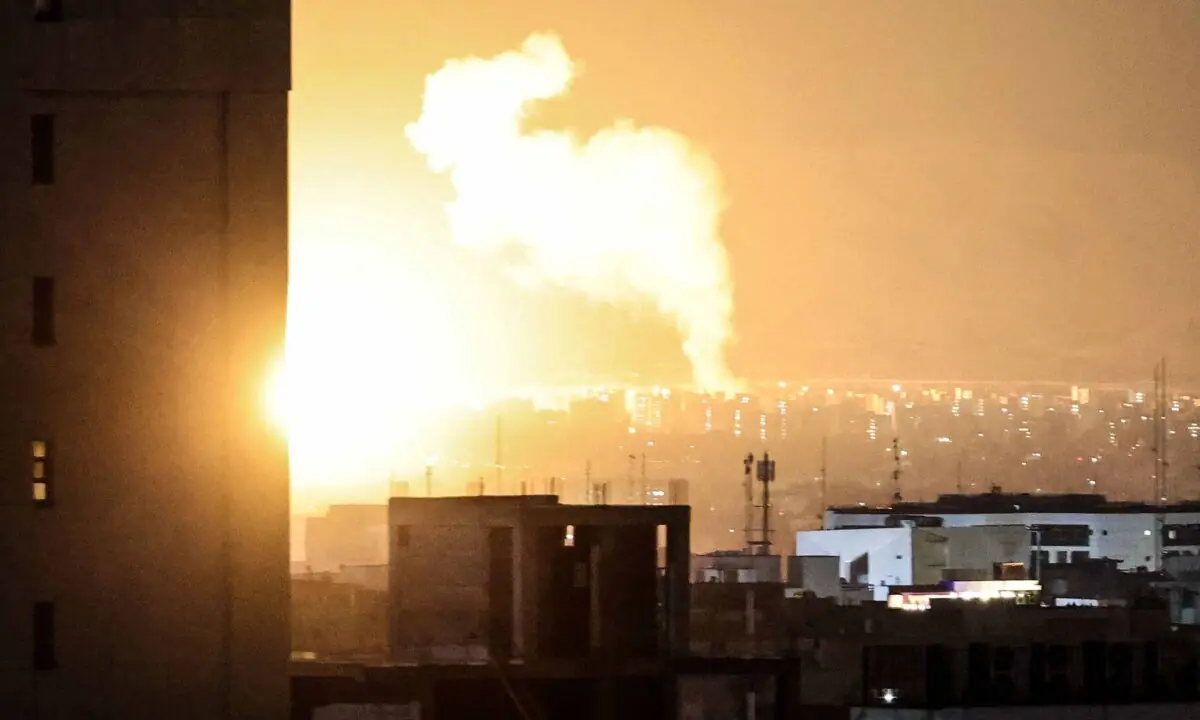
The initial salvo, rather a stab in the back in diplomatic terms, decapitated the regime leadership to the extent that the guiding figure was buried under the rubble of a demolished building after the impact of 30 bunkerbuster bombs and nearly 200 IDF jets participating in the whole operation. While the foreign minister Araqchi was espousing that the deal was round the corner, an assessment even shared by the Omani foreign minister. The strike on Ali Khamenei was itself a bolt from blue, designed to ensure that the beleaguered clerical Nezam would rush to surrender and might even give in more than was decided in the last Geneva meeting.
It was a foregone conclusion, if one keeps the earthly variables in focus. However, what happened is to the contrary. The Nezam struck back, in the streets, through missiles and through drones, which as of now continue to pound, not just the Zionist state, but the US radars, command centres, targets even as insignificant as hotel rooms in Manama, Bahrain, based on whatever intelligence is at hand with the Iranian Revolutionary Guard Corps.
What prompted that? Many can argue that a civilizational upper hand prompted the Iranians to hold their ground. That can be partially responsible. What has been the centre point for the movement called the Islamic revolution is Iran; practically the only Shia replication of the Ikhwan al Muslimeen movement, to hold on despite the odds, rests in their strategic and scientific approach to dealing with the issues and problems faced.
The war rages on, on a daily basis. It has precipitated the migration of affluent Iranians to Turkey and other places. However, the general perception that the revolutionary vanguard has lost touch with the common man proved to be wrong. As we see from the responses, it is now the man on the street who is behind the movement. Even a slightest wish for dialogue can cause a backlash for those looking for that. Conclusively, the movement is here to stay; whatever the price it had to pay in the process.
It is a foregone conclusion that societies all over the world are usually divided along various faultlines. The Muslim societies are usually divided into three parts. Frist are those who feel that Islam has the content to deliver in the post-colonial nation state model. The other group, aligned to the first one, are the people who are apparently trained in post-colonial setups but believe that their own culture and belief can efficiently guide them to solve problems. The last group are the secularists which can include anyone from left of centre to the right of centre. For them religion is little more than Dua Maghfirat, or prayer for forgiveness.
In Iran, the third group ruled whatever was Iran left out after the First World War and the fall of the Qajars. The Pahlavi system belonged to that group. In the particular Iranian and Shia context, the monarch always made it a point that the casket around the graves of the Shia Imams in Iraq or Iran be always financed from the royal exchequer. Yet the same exchequer should be used for that system’s other goals. For obvious reasons, the last group found its adherents grow in size till the upheaval of 1979.
Apparently when viewed from a distance, it is thought that the whole society changed its tracks. In reality it was not so. The 1979 final takeover was possible only when the Shah’s favorite Air Force changed loyalty to Khomeini, followed by the Army and Navy. Yet the revolutionary forces did not waste time to form their paramilitary unit called the IRGC, the details of which can be found in Arash Azizi’s book on Qasem Soleimani.
Experiences of the new government within the first five years of existence validated that decision. The August 1980 pro-Shah Air Force coup was neutralized just in time through the IRGC moles who detected unusual activity at one of the airbases with cluster ammunition being loaded into the Phantoms, when no conflict was on the horizon. The commencement of the war with Iraq in September despite initial setbacks due to the ill coordination of the somewhat demoralized regular army units turned into a stalemate, precisely due to the fact that the revolutionary movement best personified through dedicated units was able to stop and then regain the territory lost to the Baathist regime in Iraq.
What caused that? The movement based its retort back, not just on emotions, rather a very matter of fact approach to not just stop but also hit back. That strategic approach could only stem out of the assumption that the position accrued is not out of a deal with the relevant powers, rather the structure is owned by the movement and obviously its survival is in nobody’s interest, but that of the movement itself.
Here it is pertinent to note that the opposition from the third group was not passive either, a violent armed movement raged side by side along with invasion from Iraq. It is not a closed secret that the slain supreme leader of Iran, lost the use of his right arm on account of the violence caused by the left-wing armed group through the explosion of an IED in the Mosque on June 27, 1981.
That dual onslaught included many moments when the country was without the head of state and the head of the government. On a separate occasion, the most important component of the supervisory council, the Chief Justice, was killed along with key cabinet figures. These experiences were neutralized through the contingency clauses of the Constitution; the will of the movement in the nation state format was also responsible for the continuation of the control of affairs.
The movement treaded a peaceful path much through its transition into the new millennium. It however did not sleep over the fair-weather period and continued its development, whether it was peacetime technology strides or its geopolitical readiness. Faced with a generation which wanted to have a taste of the world, it did not shy away from strides in the creative arts, where it won accolades in the international arena, not just by following the beaten track, but creating its own cultural benchmarks.
It was no coincidence that the unipolar world, priding itself over the notion of ‘Our way of life’, would find pretexts to create confrontation with a system or Nezam, which is willing to offer an alternate narrative. From the accusation of Iran nuclear pursuit to sanctions, JCPOA, pressure for a capitulation-based JCPOA, it has been a stressful scenario for the Nezam to hold on, perform its routine duties and yet put on a brave face when needed.
As things stand, despite the fact that the world media showed the third group cheering the initial setback to the Nezam, the same group providing intel to the unipolar world weapon systems, the movement has not been pushed back in any sense. The guerilla state: faced with the narrative of a disgruntled populace has been able to hit back on the streets, evaporating the chances of any ‘regime change’, to quote the term coined by the US President, or the ‘Coup’, the term used by the slain supreme leader.
The war rages on, on a daily basis. It has precipitated the migration of affluent Iranians to Turkey and other places. However, the general perception that the revolutionary vanguard has lost touch with the common man proved to be wrong. As we see from the responses, it is now the man on the street who is behind the movement. Even a slightest wish for dialogue can cause a backlash for those looking for that. Conclusively, the movement is here to stay; whatever the price it had to pay in the process.
1 Comment
No comments yet. Be the first to join the discussion!