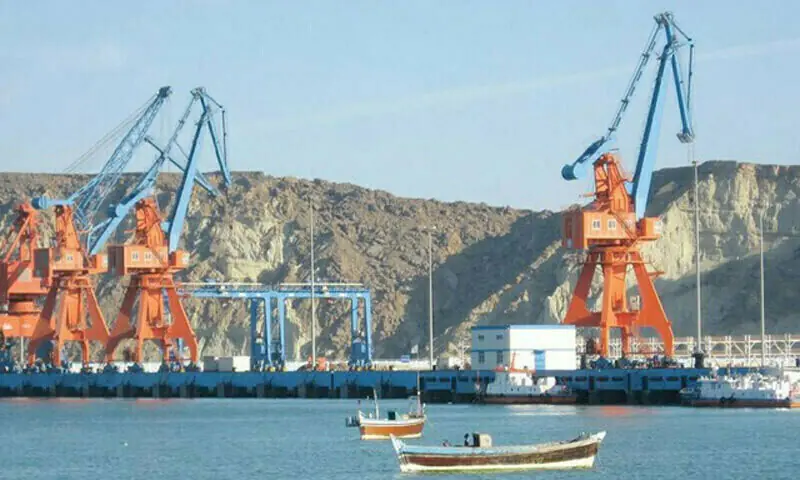
Gwadar: The Port That Can Redraw Asia’s Energy and Trade Map
Gwadar’s deep-sea location could reduce shipping congestion and insurance costs, enabling an energy storage and refining hub. Linked to rail and CPEC corridors, it may accelerate Eurasian trade and boost Balochistan—if security and investment hold.


By Dr Shahzad Latif
The development of the deep-sea port at Gwadar Port represents far more than a regional infrastructure project. It is potentially one of the most consequential economic transformations in South Asia and the broader Eurasian region. Located on Pakistan’s southwestern coast along the Arabian Sea, Gwadar occupies a rare geographic advantage: it sits just outside the narrow and vulnerable maritime chokepoint of the Strait of Hormuz, through which roughly a fifth of the world’s oil supply passes.
If managed wisely, Gwadar could transform Pakistan’s economic landscape, linking Africa, the Middle East, South Asia, Central Asia, and beyond in a powerful network of trade and energy flows. In doing so, it may not only reshape regional commerce but also bring long-awaited prosperity and stability to Balochistan itself. Gwadar’s promise is immense. The challenge now lies in turning that promise into reality.
This location offers enormous strategic and economic benefits. By operating outside the congested waters of the Strait of Hormuz, Gwadar can help reduce shipping congestion, avoid delays, and significantly lower insurance premiums for vessels transporting oil and other critical commodities. In an era where maritime security and shipping reliability are increasingly vital, Gwadar can emerge as a safer and more efficient alternative staging point for global energy trade.
One of the most promising possibilities for Gwadar lies in transforming it into a major global oil storage and refining hub. Gulf energy exporters— including those from the Persian Gulf— could establish large strategic petroleum storage facilities and refineries in Gwadar. Such infrastructure would allow crude oil to be stored, refined, and then distributed to global markets more efficiently.
Oil and refined petroleum products could then be transported from Gwadar to importing countries through multiple channels: shipped onward to Asian and African markets, transported through pipelines into Pakistan and potentially onward into Central Asia, or moved by rail toward European destinations. By integrating storage, refining, and logistics in a single location, Gwadar could become a critical energy redistribution center for three continents.
Gwadar’s potential extends beyond energy. The port could develop into a major manufacturing, logistics, and storage hub for Eurasian trade. Through improved rail and road connectivity, goods produced or assembled in Gwadar could be distributed to:
• Central Asia through overland corridors
• Europe via transcontinental rail links
• Africa and Southeast Asia through maritime routes
This vision aligns closely with the goals of the China–Pakistan Economic Corridor, the flagship economic initiative linking Pakistan with China. By connecting Gwadar to western China and onward to Eurasian trade routes, the port could shorten supply chains and reduce shipping times for countless goods.
Special economic zones, industrial parks, and logistics centers around Gwadar could attract international manufacturers seeking lower production costs and direct access to global markets. If developed correctly, Gwadar could become a regional equivalent of Singapore or Dubai, anchoring a vibrant trade ecosystem across South and Central Asia. However, at a much better location.
Economic transformation, however, cannot occur without stability. The province of Balochistan has long struggled with underdevelopment and sporadic security challenges. Protecting workers, infrastructure, and investments is therefore essential for Gwadar’s success.
A deeper security cooperation between Pakistan and China to protect strategic projects and foreign workers is vital. Such a security framework could discourage external interference from neighboring countries, and provide investors the confidence that both critical infrastructure and personnel will remain secure.
Ultimately, security arrangements must remain under Pakistan’s sovereignty while ensuring that development projects proceed without disruption.
At the same time, lasting stability will depend not only on security measures but also on economic inclusion. Many individuals drawn into insurgent movements do so because of limited opportunities. Offering employment, education, and economic prospects can provide alternatives to conflict and integrate local communities into the region’s prosperity.
For Gwadar to achieve its potential, development must accelerate across several fronts. Expanding the number of port docks, improving container-handling capacity, and establishing regular international shipping lines will be critical. Gwadar must evolve from a promising port into a fully operational maritime hub with frequent global shipping routes.
Equally important is the development of highways, rail networks, and energy infrastructure connecting Gwadar to the rest of Pakistan and beyond. Universities, research institutions, and industrial development centers could help nurture a skilled workforce capable of sustaining long term economic growth.
Balochistan is believed to hold vast mineral resources, including copper, rare earth elements, and lithium—materials essential for modern technologies and renewable energy systems. Pakistan should pursue a balanced strategy in developing these resources, maintaining control over where and how they are exported.
Rather than exporting raw minerals, Pakistan could prioritize value-added industries such as refining, processing, and manufacturing. This approach would create jobs, increase export revenues, and prevent the country from becoming merely a supplier of raw materials.
Ultimately, the development of Gwadar must be guided by cooperation, transparency, and national interest. Partnerships with China and other countries can bring investment and expertise, but Pakistan must retain the final say in decisions affecting its territory and resources.
If managed wisely, Gwadar could transform Pakistan’s economic landscape, linking Africa, the Middle East, South Asia, Central Asia, and beyond in a powerful network of trade and energy flows. In doing so, it may not only reshape regional commerce but also bring long-awaited prosperity and stability to Balochistan itself.
Gwadar’s promise is immense. The challenge now lies in turning that promise into reality.
The writer is a freelance columnist
1 Comment
No comments yet. Be the first to join the discussion!