










AT PENPOINT
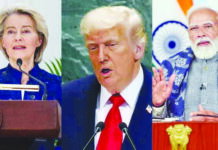
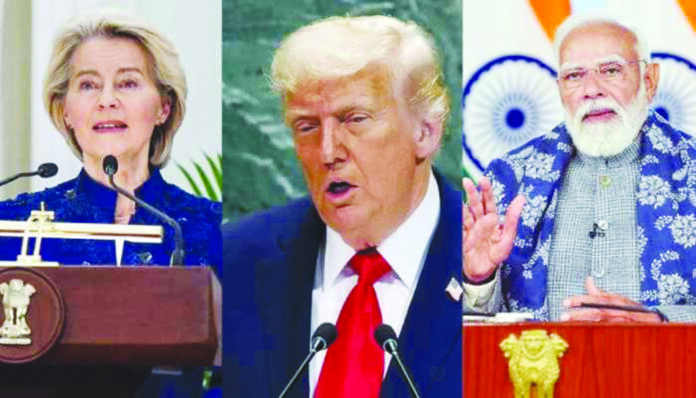
The India-European Union deal is being seen in some quarters as a major development in the world mainly because it seems to establish a separate European pole which was seen as a mere adjunct of the USA since World War II, It is also India’s best reply to the USA, which has apparently shaken it off. Thus the USA’s policy of going it alone seems to have backfired, for it has meant that Europe has coalesced around the need to find greater security, while its erstwhile counterweight to China seems to have found a new friend.
Pakistan has found itself flummoxed. Whereas it had tried to draw closer to the USA, it had excluded itself from the role of counterweight by its relationship with China. That the Chinese relationship is non-negotiable was shown last summer, when Chinese technology as used by Pakistan proved superior to European technology as used by India. Chinese jets, using Chinese missiles, shot down French Rafales and a Russian Su-25.
The deal has left it awkwardly placed, for the EU remains its largest export destination, even after Brexit. As much as 40 percent of its exports go to the EU, with textiles about 76 percent of this, making textiles to the EU 28 percent of its total exports. With a government dedicated to exporting its way out of the debt trap, any threat to exports to the EU becomes a threat to the whole economy.
It is interesting that India is not so reliant on textile exports to the EU, with 2024 exports to the EU of $92.7 billion, which were about 22 percent of its total exports of $441.7 billion. Of the exports to EU, textiles were worth $ 9 billion. Thus it exported less than Pakistan ($9.7 billion). Thus Pakistan sent 42 percent of total exports to the EU, which represented a much higher market concentration. If Pakistani textiles lose a 15 percent share in the EU as a result of this deal, it would lose about $1.5 billion in exports, which would be a complication it does not need.
While of crucial importance to the economies concerned, the implications of the EU-India deal reflect geopolitical realities. It first reflects the renewed emphasis on economics and commerce, which was introduced by US President Donald Trump by his use of the purely economic tool of tariffs for political purposes. The latest example was his threat to impose tariffs on the EU if it resisted his attempt to snatch Greenland from Denmark. He pulled back from that after being given assurances of greater influence over the fate of Greenland.
Pakistan may well be the last of the Cold Warriors, because the Cold War gave it a role to play. It seems lost in the world of today, where it has to produce and sell in order to survive. That does not seem an activity it is used to.
Trump has also expressed dissatisfaction with NATO, and has persistently claimed that Europe was not pulling its weight in defense spending. That made European countries seek alternative economic partners. India had curried up to the USA, but found itself rebuffed after Pakistan made it clear last summer that India was not suited to acting as a counterweight to China, or as a regional proxy. The deal was thus struck by parties which are deeply involved with the USA, but are seeking economic alliances as a sort of alternative to the USA. The EU has been courted by China, but is clearly not willing to be on its side, especially because of China’s ties to Russia, with which its relationship has been spoiled by the latter’s invasion of Ukraine. Therefore finding a partner in India makes a certain sense.
It also implies that India has in a sense arrived. Its inclusion in BRICS implied that it was acknowledged as an emerging power, if not superpower. Until its recent expansion to include countries like Ethiopia and Argentina, which may be future economic powers, but will not necessarily become powers. BRICS has thus become more an economic grouping.
The lowering of tariffs by the USA succeeded the deal with the EU, showing that it was its first fruit. The US lowering of tariffs means there will be further pressure on Pakistan, which has already seen its exports tank everywhere, including to the USA.
The problem for Pakistan is that textiles and textile products both depend on consumer demand. Pakistan is fortunate in not relying on things like durable garments, but on cloth as well as fast fashion, which is the rapid design, production, and marketing of low-cost, trendy clothing to mirror high-fashion trends, often within a 4–6 week cycle. That means that the import cycle never comes to an end (unlike a good suit, which may last decades). However, the flip side is that consumer demand is more closely tied to the health of the economy and consumers’ purchasing power. Softening consumer demand has meant that textiles will have to wait until an economic recovery in Europe for a pick-up in revenue.
That means that Pakistani manufacturers will find themselves crowded out of their main markets. That means there will be further reliance on the export of minerals, especially rare earths. Since Pakistan lacks a mining ecosystem, it will probably find itself sending abroad unprocessed ore, or processed just enough to be exportable. At the moment, the main importer is a US company. The Reko Diq project has got a Canadian investor in Barrick Gold, but Trump has declared intent to take over Canada.
It seems that rare earth ores are being used by a government that still wishes to draw the USA on geopolitical grounds. There seems to be a lack of understanding that the USA has abandoned Cold War considerations and has switched to geoeconomic. Though there is an attempt to attract the USA by exporting rare earths and importing crude oil, there is an absence of the kind of strategy that India is showing. India is putting the economy at the centre of its strategy, even if that strategy is driven by the kind of Nehruvian thinking that desired great-power status that prevailed in the 19th century, exemplified by American thinker and naval officer Wilfred T. Mahan, who postulated that great powers exercise power through their navies, needing coaling-stations. Now, that will mean control over oil.
Neither India nor Pakistan seems to believe that the common man must be the centre of national effort, not just his livelihood and prosperity, but his well-being as well. The state is supposed to exist to improve the lives of a billion and a half people living in the Subcontinent, not so that a couple, at the most seven or eight, individuals may strut the world stage claiming to be important.
The reaction by both the Pakistan government and the trade associations has been similar, but seems a little off the mark. Both seem to want the USA and the EU to take steps which would nullify the Indian advantage. However, neither has expressed any realization that the problem has arisen because of the narrowness of the base of export destinations, as well as of the products exported. Another problem seems to be that the export competitor is India, which means the discussion goes back to a geopolitical mode.
Pakistan may well be the last of the Cold Warriors, because the Cold War gave it a role to play. It seems lost in the world of today, where it has to produce and sell in order to survive. That does not seem an activity it is used to.