











- Defence minister says 12 locations targeted in synchronized strikes, aimed at offseting BLA losses suffered over past year
- Warns women, children being exploited for terrorism, reiterating zero tolerance for BLA, TTP and their facilitators
- Says suicide attempts on FC HQs in Noshki and Dalbandin foiled with over 133 militants killed in two days
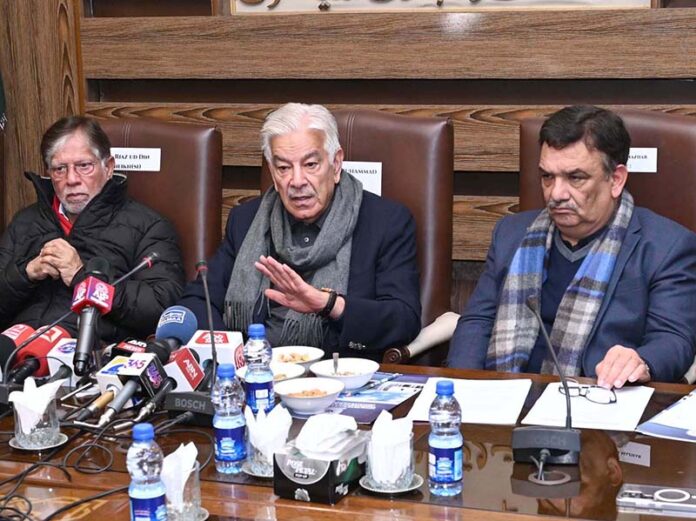
SIALKOT: Federal Minister for Defence Khawaja Muhammad Asif on Sunday said that coordinated terrorist attacks were carried out at 12 different locations across Balochistan, with a clear and deliberate intent to cause widespread bloodshed and instability, reflecting a clear nexus—two sides of the same coin—between India and the Fitna al-Hindustan (BLA).
Addressing a press conference at his residence in Sialkot, the Defence Minister said the attacks were aimed at compensating for the heavy losses suffered over the past year by the Baloch Liberation Army (BLA) and its affiliated organisations.
He said multiple locations across Balochistan were targeted simultaneously, underscoring the highly organised and coordinated nature of the assaults. These incidents, he said, reflected a clear nexus—two sides of the same coin—between India and the BLA, asserting that the outlawed group was operating as an Indian proxy.
Kh Asif said that following the major setback faced by India in May last year, such attacks were now being used to deliberately target civilian populations. The objective, he said, was to destabilise Pakistan at a time when the country, after enduring two years of economic hardship, had begun moving forward again by the grace of God.
He added that India and the BLA were seeking to push Pakistan back into economic darkness and undermine its national integrity. Intelligence reports and confessional statements from arrested militants, he said, clearly indicated that the links of these terrorist activities led back to India. He reiterated that the BLA is a globally designated terrorist organisation, banned both nationally and internationally.
The Defence Minister expressed grave concern over the exploitation of women and children by terrorist networks. He cited the failed child suicide bombing attempt in Karachi and the case of a young girl in Pasni as stark evidence that innocent minds were being systematically radicalised. He said individuals facing poverty, unemployment and economic hardship were being deliberately targeted by extremist elements.
He said suicide attacks were also attempted on the Frontier Corps headquarters in Noshki and Dalbandin, while nearly twelve locations were targeted in total. Due to timely and effective action by security forces, all attempts were foiled. During the operations, eleven security personnel were martyred, while over one hundred militants have been killed in the past two days, a figure he said was expected to rise further.
Kh Asif noted that due to Balochistan’s vast geographical expanse and sparse population, terrorists had at times gained temporary tactical advantages, but assured that these would be eliminated in the coming days. He added that terrorist leadership operating from Afghanistan was exploiting innocent youth to pursue malicious objectives.
He made it clear that Pakistan was engaged in a long and decisive war against the Fitna al-Hindustan (BLA) and Fitna al-Khawarij, the Tehreek-e-Taliban Pakistan (TTP), and that there would be no sympathy or leniency for these groups anywhere in the country. He said strict action would also be taken against facilitators of terrorism, who would meet the same fate as the terrorists themselves.
The Defence Minister said that past counterterrorism measures had significantly reduced attacks in Khyber Pakhtunkhwa and Balochistan, but stressed the need for even more effective and sustained action. Pakistan, he said, would take all necessary measures to defend itself, whether terrorists were operating inside or outside its borders, in accordance with its constitutional mandate and state responsibility.
He further noted that Khyber Pakhtunkhwa remained the most targeted province, adding that the Chief Minister of Khyber Pakhtunkhwa had condemned the attacks earlier in the day, reflecting national unity.
Kh Asif stressed that political differences must be set aside in the national fight against terrorism. The sacrifices of the martyrs, he said, symbolised the devotion of sons and daughters from every province who had laid down their lives for the homeland. This struggle, he emphasized, transcends political affiliations—loyalty is to the nation and the soil alone.