










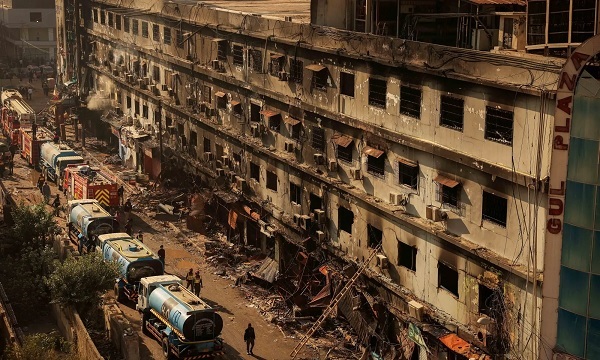
KARACHI: The Sindh government has published the findings of a committee formed to investigate the devastating fire at Gul Plaza, outlining how the incident unfolded and identifying serious shortcomings in fire safety, rescue operations and building management.
The inquiry compiled accounts from the fire brigade, Rescue 1122, the district administration and the police, all of whom submitted formal statements for the record.
According to the report, authorities received the first alert about the blaze at 10:26pm. A fire tender and a water bowser were dispatched three minutes later, followed by a snorkel vehicle at 10:34pm, based on the chief fire officer’s statement.
The Karachi Water and Sewerage Corporation informed the committee that it was notified by the fire brigade between 11:05pm and 11:10pm. Two water tankers, each carrying 3,000 gallons, were sent from the NIPA hydrant between 11:30pm and 11:35pm, while another four tankers with a combined capacity of 6,000 gallons were also dispatched during the same time frame. An additional four tankers were later sent from the Safooran hydrant.
As part of the investigation, the committee recorded statements from 19 witnesses, including shopkeepers, a watchman and injured individuals, and examined available CCTV footage from the premises.
The report concluded that the fire originated in a flower and gift shop, number 193, on the ground floor. The shop owner had reportedly left his 11-year-old son there, while another 11-year-old boy from a neighbouring shop was also present. Investigators said the presence of highly flammable material caused the fire to spread rapidly, quickly engulfing nearby shops. The watchman disconnected the electricity within five minutes to prevent a short circuit.
At the time of the incident, an estimated 2,000 to 2,500 shopkeepers and employees were inside the building. Although three to four gates on the ground floor were open, thick smoke soon filled staircases and corridors, leaving many people trapped inside their shops.
The committee highlighted major delays in supplying water to firefighting units, noting that the first water bowser reached the site at 11:53pm and that uninterrupted water supply only began after midnight.
It also pointed to a severe lack of equipment among rescue teams. Tools needed to cut iron rods and free trapped individuals were unavailable, while firefighters were found to be inadequately equipped, insufficiently trained and lacking proper protective gear.
The report criticised police efforts to manage crowds and secure the area, stating that weak cordoning measures disrupted firefighting operations. It further revealed that multiple fire safety audits had been carried out in the past, but their recommendations were never implemented.
Investigators found that emergency exits within the building were blocked or encroached upon, worsening the situation during evacuation attempts.
In its recommendations, the committee urged immediate safety audits of all high-risk buildings, the enforcement of regular emergency evacuation drills and the modernisation of firefighting and rescue services through upgraded equipment and training.