





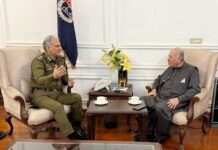









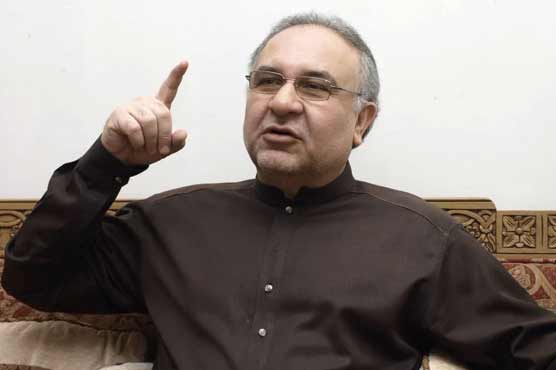
ISLAMABAD: Senior politician and former Federal Minister for Information Muhammad Ali Durrani on Tuesday offered to visit former Prime Minister Imran Khan in Adiala Jail—if granted permission—to help initiate political dialogue and contribute to national reconciliation.
Recalling his earlier role in easing political tensions, Durrani noted that he had previously met Pakistan Muslim League-Nawaz (PML-N) leader Shehbaz Sharif during his incarceration, a move that helped reduce political polarization at that time. He expressed confidence that a similar engagement with Imran Khan could now help address unresolved political issues.
In an interview, Durrani strongly criticized the current leadership of Pakistan Tehreek-e-Insaf (PTI), both inside and outside parliament, accusing it of lacking strategic direction. He said that the PTI’s political weakness has allowed the government to exploit PTI’s popular support while simultaneously running its own political narrative. He observed that while Imran Khan’s popularity continues to rise during his incarceration, the ruling coalition remains focused on maintaining power.
Durrani dismissed the effectiveness of repeated, inconclusive political meetings, remarking that involving opposition leader Mahmood Khan Achakzai would likely result in an endless cycle of talks without tangible outcomes.
Highlighting historical precedents of the hybrid system, he recalled that former Prime Minister Zulfikar Ali Bhutto had engaged in dialogue with jailed leaders of the Pakistan National Alliance (PNA), who were facing serious charges, emphasizing that dialogue without concrete measures cannot deliver meaningful political progress.
Addressing broader political reforms, Durrani proposed barring individuals holding foreign assets from active politics. He also warned that Pakistan’s history of hybrid political arrangements has repeatedly sidelined those who facilitated them, citing examples from the Bhutto–Yahya period, the Zia-ul-Haq–Nawaz Sharif era, and later political setups involving Benazir Bhutto and Pervez Musharraf.
According to him, both PPP and PML-N fear that any reconciliation with PTI could lead to the meltdown of their rule.
The former minister accused the ruling parties of enjoying the privileges of office while shifting responsibility for failures onto the establishment. He lamented the deteriorating economic situation, growing frustration within the business community, and increasing public disillusionment with both PPP and PML-N, describing their power-sharing arrangement as politically expedient but nationally damaging.
Commenting on the May 9 cases, Durrani alleged that the government’s handling of the situation caused harm to national institutions and the country at large, while inadvertently benefiting the accused through weakly constructed cases that struggle to withstand judicial scrutiny.
Reiterating his offer, Durrani emphasized his long-standing personal and political association with Imran Khan, noting that he was among those who initially encouraged Khan’s entry into politics. He maintained that a direct meeting with the former prime minister could help move the political process forward—an effort he said is currently hindered by PTI’s leadership and the ruling parties’ reluctance to engage in meaningful dialogue.