













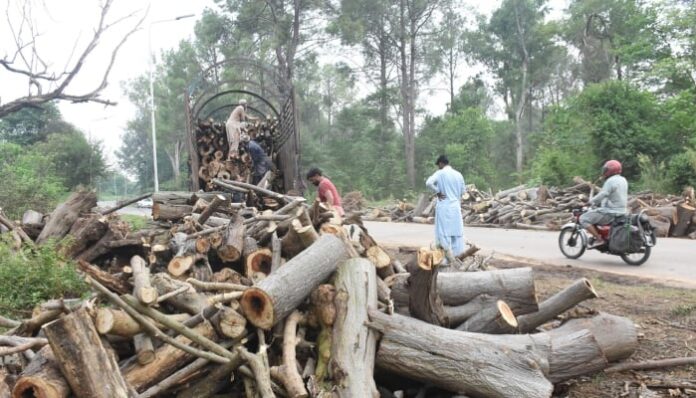
ISLAMABAD: The Islamabad administration on Friday said the ongoing tree-cutting drive in the federal capital is specifically targeting paper mulberry trees, citing their adverse impact on public health.
The clarification came during a meeting chaired by Minister for Climate Change and Environmental Coordination Dr Musadik Malik, where environmental protection measures and the preservation of Islamabad’s green cover were reviewed.
Officials briefed the minister on a campaign aimed at reducing the concentration of paper mulberry trees, a non-native species in the capital. They said the trees are highly allergenic and a major cause of severe allergies and asthma-related health problems among residents.
The meeting followed public concern over reports of large-scale tree cutting across various parts of Islamabad in recent days. However, officials maintained that the drive is limited to areas where paper mulberry accounts for more than 90 per cent of the tree population.
Locations identified under the campaign include Shakarparian, F-9 Park and parts of the H-8 and H-9 sectors.
Officials said the removed trees would be replaced with native, fruit-bearing species and pine trees, adding that the initiative would not reduce the city’s overall tree cover. They assured that more trees would be planted than removed, including the installation of mature native trees to speed up ecological recovery.
Dr Malik stressed the need for timely implementation of protective measures and directed relevant departments to ensure close coordination, particularly ahead of the spring plantation season. He also instructed officials to establish a transparent mechanism to ensure compliance with environmental laws, rules and procedures.
The meeting was attended by Minister of State for Interior Talal Chaudhry, Capital Development Authority (CDA) Chairman Muhammad Ali Randhawa, Secretary of the Ministry of Climate Change and Environmental Coordination Aisha Moriana, and senior CDA officials.
Separately, CDA Deputy Director General Environment Irfan Khan Niazi said the authority has begun removing “harmful paper mulberry trees” to curb pollen-related allergies.
“Pollen levels from these trees rise so sharply that hospitals struggle to handle allergy patients,” he told Geo News, adding that 29,115 trees have been removed so far, with each tree being replaced by three saplings.
Niazi said all tree removal was carried out transparently and in line with standard operating procedures. He added that paper mulberry suppresses surrounding vegetation and that the CDA is planting native species such as Sukh Chayn, Sheesham and Chinar to improve environmental sustainability.