











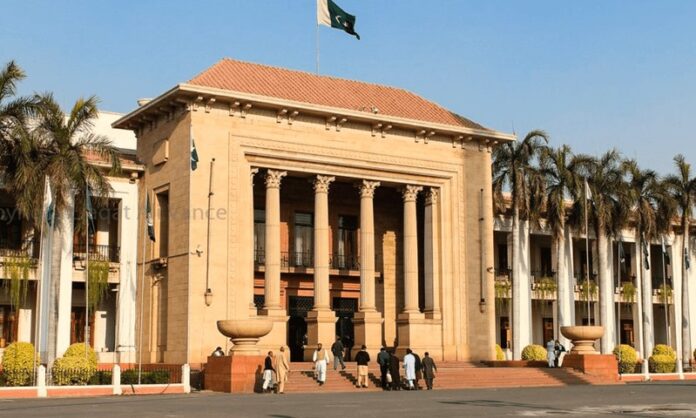
LAHORE: The ruling Pakistan Muslim League-Nawaz (PML-N) in the Punjab Assembly adopted a resolution on Tuesday, calling for a ban on the Pakistan Tehreek-i-Insaf (PTI) and its incarcerated founder and former prime minister Imran Khan, alleging that the party was posing a “threat to the interests of the state.”
The move came amid escalating political tensions following recent remarks by the military’s spokesperson criticising the PTI leadership.
Last week, Inter-Services Public Relations (ISPR) Director General Lt Gen Ahmed Sharif Chaudhry accused Imran Khan of creating and spreading an “anti-army” narrative, dubbing the “PTI founder a mental patient” and asserting that such rhetoric had crossed beyond politics and evolved into a “national security threat.”
His remarks triggered a heated exchange between the government and the opposition.
Defence Minister Khawaja Asif defended the ISPR chief, saying Imran had previously used “harsh language” against political rivals and thus had no grounds to object to the military spokesperson’s comments. The PTI, however, strongly rejected the allegations, terming the DG ISPR’s statements “ridiculous” and insisting that Imran was “not a security threat”.
The resolution, moved by PML-N MPA Tahir Pervaiz, was passed by treasury members amid a boycott by PTI lawmakers. It stated that Pakistan’s security institutions, which had “successfully countered an enemy five times larger”, were vital to national integrity and stability. It further alleged that Imran Khan and his party had “acted as a tool of the enemy state”, made “anti-country” statements, and “spread chaos”.
The resolution urged action under the law against any leader, political or otherwise, found to be acting against the state, and called for “appropriate punishment” for such individuals. It also paid tribute to the armed forces and other security institutions for their role in maintaining stability.
PTI’s ‘recent actions’ ‘pushing’ matters towards a ban: Azma
In a related development, Punjab Information Minister Azma Bokhari on Tuesday said that she was not in favor of a ban on political parties or the imposition of governor’s rule in a province but stressed that the PTI’s “recent actions” were “pushing” authorities in that direction.
Addressing a press conference in Lahore, Bokhari, in response to a two-part question regarding the possibility of a ban on PTI and the imposition of governor’s rule in Khyber-Pakhtunkhwa, said, “As a political worker, I do not support that any party should be banned or that governor’s rule should be imposed.”
But, she continued, “considering the state of affairs, the PTI is pushing us to go in that direction.”
“On the one hand, KP remains most afflicted by terrorism, the police their remain understaffed; they do not yet have a Crimes Control Department (CCD), and police do not have the necessary equipment,” she said.
The minister stressed that the PTI’s rhetoric was putting “Pakistan at stake, and if they do not stop, we will not be left with any other options.”
The minister further added that the incarcerated PTI leader had “become Altaf Hussain part two,” referring to the self-exiled MQM leader. In 2015, the Lahore High Court had banned the broadcast of images and speeches of Hussain across all electronic and print media till further orders for his inflammatory speech against state institutions.
“He has the same policies as Altaf Hussain, which were still quite mild compared to his (Imran),” she said.
At a later point in the press conference, Bokhari remarked about the PTI founder that “I fear that perhaps he will meet the same fate as Altaf Hussain.”
Bokhari alleged that PTI was engaging in maligning the head of an institute — an apparent reference to Chief of Defence Forces and Chief of Army Staff Field Marshal Asim Munir.
The move comes months after the federal government considered imposing a ban on PTI and pursuing Article 6 treason proceedings against Imran Khan, former president Dr Arif Alvi and former National Assembly Deputy Speaker Qasim Suri. That initiative, widely viewed as an attempt to curb PTI’s political resurgence following the Supreme Court’s decision on reserved seats, was ultimately not carried through.
In October, however, the federal cabinet approved a ban on the religio-political party Tehreek-i-Labbaik Pakistan (TLP) under the Anti-Terrorism Act after violent protests. The practice of banning political groups, observers note, has recurred throughout Pakistan’s history — from periods of martial rule to ostensibly democratic governments.