Six contenders enter race to succeed Antonio Guterres as UN chief
Six candidates are vying to become the next UN secretary-general as the world body faces wars, instability and a budget crisis. The race includes four women and two men, with Security Council politics likely to shape the outcome.

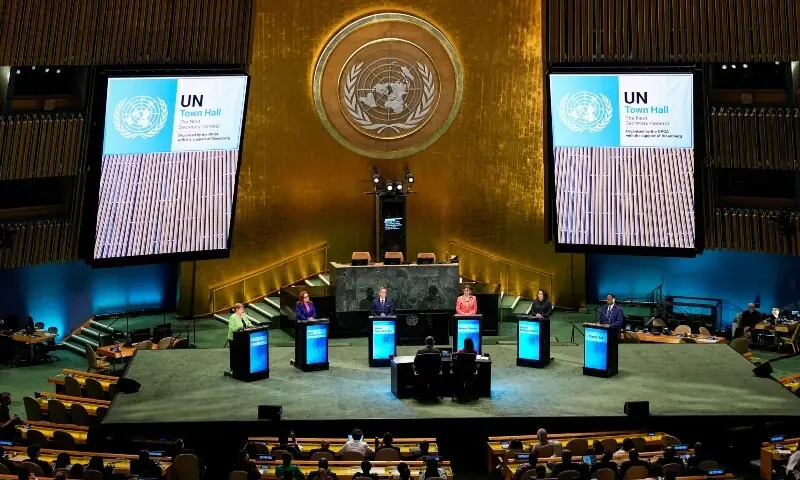
NEW YORK: Six candidates — four women and two men — are in contention to replace Antonio Guterres as secretary-general of the United Nations, as the organisation confronts global instability, ongoing wars and a severe budget strain.
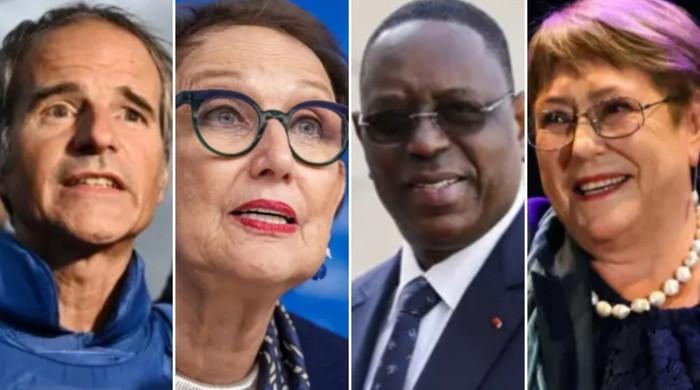
The field includes Argentina’s Rafael Grossi, Chile’s Michelle Bachelet, Ecuador’s Maria Fernanda Espinosa, Costa Rica’s Rebeca Grynspan, Guyana’s Carolyn Rodrigues-Birkett and Senegal’s Macky Sall. Observers say there is no clear frontrunner because major powers are split, though Grossi, who heads the UN nuclear watchdog, has been repeatedly mentioned.
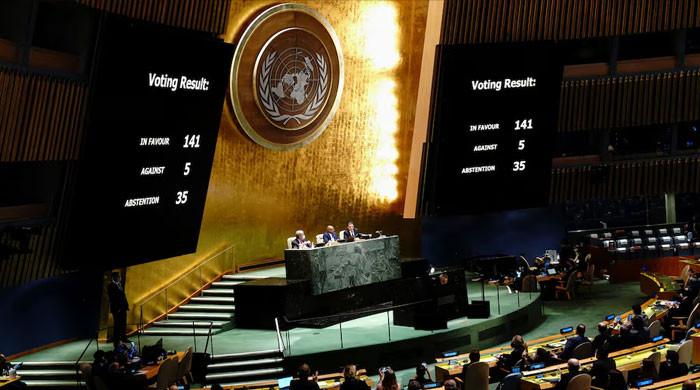
The selection will hinge on the 15-member UN Security Council, where a candidate needs at least nine votes to advance. Any hopeful must also avoid a veto from the five permanent members — the United States, Britain, China, France and Russia — before the name is sent to the General Assembly for approval.
Profiles of the candidates
Bachelet, 74, is a former Chilean president and previously served as the UN high commissioner for human rights. She was tortured under Augusto Pinochet’s rule before later becoming Chile’s first woman president in 2006. In her UN rights role, she drew criticism from some governments, particularly China, over her reporting on alleged abuses involving the Uyghur minority. She has said the secretary-general should have the moral authority to lead even under pressure from major powers. Mexico and Brazil support her bid, while Chile withdrew its backing after President Jose Antonio Kast took office. The United States has also criticised her, especially over her support for abortion rights.
Espinosa, 61, is a former foreign minister of Ecuador and a former president of the UN General Assembly. She has described the United Nations as the only universal forum capable of addressing shared global challenges, while also arguing for deeper institutional reform. Among her proposals is an early warning mechanism aimed at identifying signs of looming conflict. Her candidacy has the support of Antigua and Barbuda, but not Ecuador.
Grossi, 65, has led the International Atomic Energy Agency since 2019. His role has put him at the centre of disputes over Iran’s nuclear programme and the Russian-held Zaporizhzhia nuclear plant in Ukraine. He has stayed in office while seeking the UN’s top job, saying it would be a "dereliction of duty."
Some observers view Grossi as more forceful on UN reform and say he believes the secretary-general should play a more direct role.
Grynspan, 70, is Costa Rica’s former vice president and currently heads the UN trade and development body, UNCTAD, though she has taken leave to campaign. In 2022, she helped broker the Black Sea Grain Initiative between Moscow and Kyiv to enable grain exports after Russia’s invasion. She has also referred to her family history, saying her Jewish parents "barely survived" the Holocaust before moving to Costa Rica. Grynspan has argued that the United Nations has become what she calls a "risk-conservative organisation."
Rodrigues-Birkett, 52, a former foreign minister of Guyana, is now her country’s ambassador to the United Nations. She has said the organisation must rebuild its standing internationally. Speaking about perceptions of the UN’s work, she said:
The UN is judged through the peace and security lens. But the UN is much wider than that and it’s delivering in many, many areas — in development, in human rights.
Sall, 64, the former president of Senegal, is the only candidate not from Latin America, the region from which convention suggests the next UN chief should come. Proposed by Burundi, the current African Union chair, he received his own country’s backing this week. He has underscored the connection between peace and development. Senegalese authorities accuse him of violently suppressing political protests between 2021 and 2024, in unrest that left dozens dead.
Comments
No comments yet. Be the first to join the discussion!