Trump seeks 20% charge on Hormuz cargoes after Iran ceasefire collapses
Donald Trump has said the US will seek a 20% charge on all cargo shipped through the Strait of Hormuz after the ceasefire with Iran collapsed. The move comes amid a broader dispute over control of the strategic waterway and its legal status under international maritime rules.

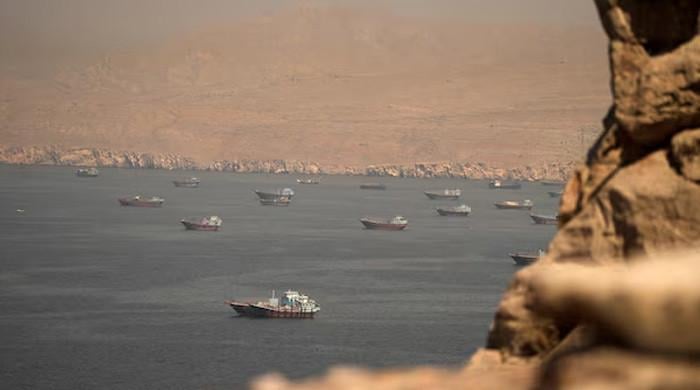
WASHINGTON: United States President Donald Trump has said the US will seek reimbursement of 20% on all cargo shipped through the Strait of Hormuz after a ceasefire with Iran fell apart, amid a wider dispute over Tehran’s bid to retain control over the strategic waterway.
The strait, 34 kilometres wide, had been the main route for around a fifth of global oil supplies as well as other essential goods including fertilisers before Iran shut it after the United States and Israel attacked it on February 28, triggering a shock in energy markets.
US position and Trump’s latest demand
Trump’s latest statement marks a contrast with comments made on June 25 by US Secretary of State Marco Rubio, who said during a meeting with Gulf states, in response to Iran’s demand for fees, that no state had the right to levy charges for use of international waterways and that shipping fees would not form part of any agreement.
Trump had, however, previously raised the possibility of US-imposed tolls if talks with Iran failed. In a social media post on June 20, he wrote “There will be NO TOLLS in the Hormuz Strait for 60 days during the Cease Fire Period, and there will be NO TOLLS after the 60 day period has expired, unless they are imposed by and for the United States of America, should the deal not be completed, for services rendered as the Guardian Angel to the countries of the Middle East for purposes of both past, present, and future reimbursement of costs”.
With the ceasefire now broken, Trump returned to that position on Monday, saying in another social media post “The USA will be, from this point forward, known as 'THE GUARDIAN OF THE HORMUZ STRAIT', but as such, and as a matter of FAIRNESS, will be reimbursed, at the rate of 20% on all cargo shipped”.
He did not set out how such a charge would be collected or under what legal authority Washington could require payment for passage.
How the US and Iran interpret the dispute
Iran has treated lasting control of the strait it shares with Oman as the central issue in negotiations, viewing it as its strongest source of leverage with outside powers and as a key protection against future attacks.
Tehran believes Washington had accepted that position in the wording of last month’s interim agreement, which said Iran will make arrangements using its best efforts for the safe passage of commercial vessels with no charge for 60 days only. The US, however, read that language differently, interpreting it to mean Iran should help ensure safe transit rather than impose restrictions enforced by force.
During the war, Iran created the Persian Gulf Strait Authority and said vessels using the passage must coordinate with it. Tehran has also insisted that ships move only near the Iranian shoreline, and it has targeted vessels attempting to transit along the Omani side without its permission. Iranian authorities have said fees for passage could eventually be introduced, but no details have been announced.
Legal position under maritime rules
The Strait of Hormuz is formed by the territorial waters of Iran and Oman, with the maritime boundary running through the middle. Under the UN Convention on the Law of the Sea, states along straits used for international navigation cannot simply charge ships for permission to pass.
The convention does allow limited charges for particular services such as piloting, tugging or port-related assistance, but those fees cannot discriminate against vessels from specific countries. Although neither Iran nor the United States is a party to UNCLOS, it is widely treated as reflecting international maritime law, and Hormuz is broadly regarded as an international strait.
Iran and Oman agreed with the International Maritime Organisation in 1968 on a traffic system under which large vessels would use lanes running through the middle of the strait. The IMO now considers that route unsafe because of Iranian mine-laying during the war.
Concerns for shipping and energy markets
Shipping industry officials said there is no modern precedent for a unilateral demand for fees to cross a strait. Oman has been in dialogue with Iran on the matter and last month issued guidance for vessels transiting through Omani waters that did not require any payment.
Gulf states are especially sensitive to the issue because the strait is their main outlet to the open seas for crucial energy exports. Major buyers of Gulf energy products and fertilisers could also be unsettled, particularly by Trump’s proposed 20% surcharge, which could significantly raise global oil prices.
Comments
No comments yet. Be the first to join the discussion!