Experts caution against air conditioning surge as UK heatwaves drive demand
As heatwaves intensify in the UK, more households are turning to air conditioning, but sustainability experts say it should not become the default response. They urge building upgrades and passive cooling measures before wider AC adoption.

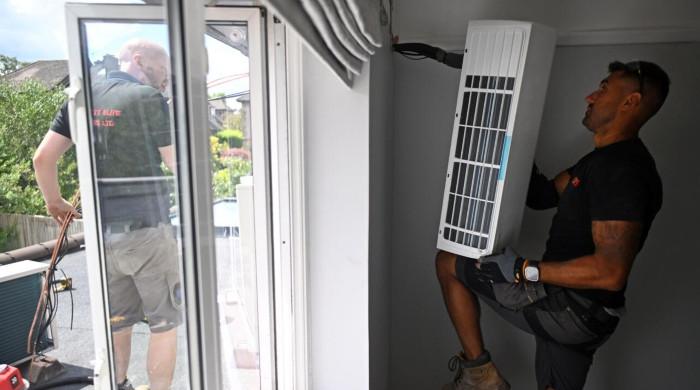
LONDON: Demand for air conditioning is rising in Britain as hotter summers push more households to install cooling systems, but sustainability experts are warning against treating AC as the standard solution.
The shift is reflected in the experience of south London resident Zainab Hussain, 35, who said she once regarded air conditioning as a luxury in the UK but no longer does. After enduring the second heatwave of 2026 last month, she and her husband decided to expand air conditioning from the downstairs area of their semi-detached home in Selsdon to the upper floor as well.
Hussain said the family had already concluded that summers were becoming increasingly difficult to bear and that cooling downstairs had become necessary. After the latest spell of extreme heat, she said, the situation upstairs had also become intolerable. She added that spending more time at home, particularly because of remote working, had made indoor conditions a practical concern rather than just a matter of comfort.
According to a 2025 report by the non-partisan Centre for British Progress think tank, only around 5% of homes in Britain have air conditioning, while half overheat during the summer. The report argued for wider AC use, citing growing risks from heat-related deaths, which it said run into the low thousands each summer, as well as productivity losses.
Hotter summers reshape demand
The increase in interest has come as temperature records continue to be broken. England recorded its warmest June since records began in 1884 for the second year in a row last month. More broadly, Britain’s five hottest summers have all occurred in the 21st century, with last year the hottest. Scientists say climate change caused by human activity is making such episodes more frequent and more severe.
Joe Springett, a 35-year-old air conditioning installer who has worked in the industry for nearly 20 years, told AFP that his business has been gradually shifting from offices and retailers towards homes as temperatures rise. He said domestic demand spikes whenever hot weather arrives and that, following the latest heatwave, his schedule was full for several weeks while stock had also become harder to secure.
For households unable to afford fixed systems or lacking the external space needed for installation, portable units have become another option. These basic systems can cost several thousand pounds when installation is included for larger setups, and retailers are reporting strong interest. B&Q told AFP that searches for portable air conditioners on its website have doubled this year compared with 2025, while some retailer websites are showing the products as out of stock.
Experts urge alternatives first
Rajat Gupta, professor of sustainable architecture and climate change at Oxford Brookes University, said growing reliance on air conditioning risks creating further environmental strain. He told AFP that AC use raises electricity demand, household energy bills and carbon emissions, while also intensifying the urban heat island effect because units expel hot air onto streets.
Gupta said he was concerned by what he described as panic buying and argued that buildings should instead be adapted to remain cool naturally. He called for retrofitting measures such as internal and external shading, better ventilation and other greening steps, alongside stronger heat-resilient design standards for new buildings. He said air conditioning should be prioritised for the most vulnerable, including people in care homes and hospitals, rather than becoming common across households.
John Calautit, a sustainability lecturer at University College London, also told AFP that British buildings are generally designed to retain heat and are poorly suited to heatwave conditions. He said simpler measures, including shading, reflective materials and natural ventilation, should be considered before turning to mechanical cooling systems.
Springett, however, said Britons would have to adapt to a changing climate. For Hussain’s family, whose home has south-facing windows exposed to direct sunlight throughout the day, installing more cooling capacity appeared to be the only workable response to increasingly hot summers.
Comments
No comments yet. Be the first to join the discussion!