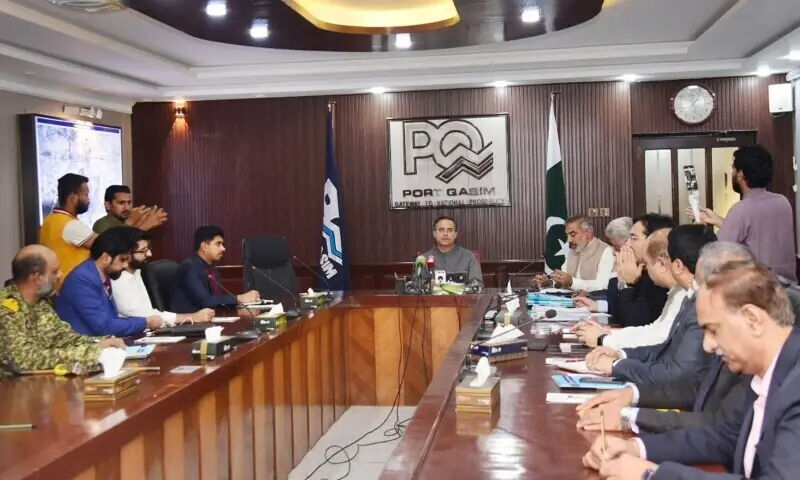
PM maritime reforms drive delivers 85 milestones, reshaping Pakistan's blue economy
Pakistan’s Prime Minister’s Task Force on Maritime Reforms has completed 85 of 99 initiatives in 18 months, advancing port master planning, shipping rules, shipbuilding and fisheries to boost the blue economy.

ISLAMABAD: The Prime Minister’s Task Force on Maritime Reforms has achieved a major breakthrough in transforming Pakistan’s maritime sector, successfully completing 85 of the 99 reform initiatives identified under its comprehensive roadmap within just one and a half years.
The Reform Implementation Committee, constituted in December 2024 under the Prime Minister’s Task Force, has spearheaded wide-ranging structural reforms aimed at modernising ports, boosting shipping and logistics, revitalising shipbuilding and fisheries, and strengthening Pakistan’s maritime economy.
The committee comprises experts from the Ministry of Defence, maritime and logistics sectors—including the National Logistics Corporation (NLC)—along with representatives from other key institutions, ensuring coordinated implementation across the sector.
According to official details, the task force had proposed 99 reforms covering key areas such as port master planning, shipping, shipbuilding, ship recycling, fisheries, and maritime trade. Of these, 85 action points have already been fully implemented, while 11 are in the final stages of completion. The remaining three reforms are being pursued under a long-term strategic framework.
Among the landmark achievements is the preparation of Pakistan’s first comprehensive National Ports Master Plan, the introduction of a uniform port tariff system, and significant improvements in transit trade procedures aimed at enhancing regional connectivity and trade competitiveness.
The reforms have also focused on expanding port capacity, introducing a modern monitoring system for economic zones, and removing illegal encroachments from Karachi Port land to improve operational efficiency and facilitate future expansion.
In the shipping sector, authorities have introduced new customs regulations for transshipment and bunkering services, while simultaneously promoting indigenous shipbuilding and ship repair capabilities to reduce reliance on foreign facilities and strengthen the domestic maritime industry.
The fisheries sector has also witnessed significant progress, with the finalisation of a five-year provincial development plan designed to boost productivity, improve exports, and enhance the livelihoods of coastal communities.
Another notable achievement is the revival of Pakistan’s ship recycling industry after an eight-year hiatus, paving the way for renewed industrial activity and employment generation.
As part of efforts to achieve greater self-reliance in maritime infrastructure, the government has also established the National Dredging and Marine Services, a dedicated institution aimed at strengthening the country's dredging capabilities and reducing dependence on foreign contractors for maintaining navigable waterways.
Officials believe the reforms will enhance Pakistan’s maritime competitiveness, improve port efficiency, attract greater investment, facilitate international trade, and unlock the vast economic potential of the country's blue economy.
Comments
No comments yet. Be the first to join the discussion!