June 28, 2026
South Korea, Japan renew denuclearisation pledge and revive rescue drills
South Korea and Japan have reaffirmed their commitment to denuclearisation of the Korean peninsula and agreed to revive joint search-and-rescue drills. The move follows fresh efforts by Seoul and Tokyo to deepen security ties despite longstanding disputes.

June 28, 2026
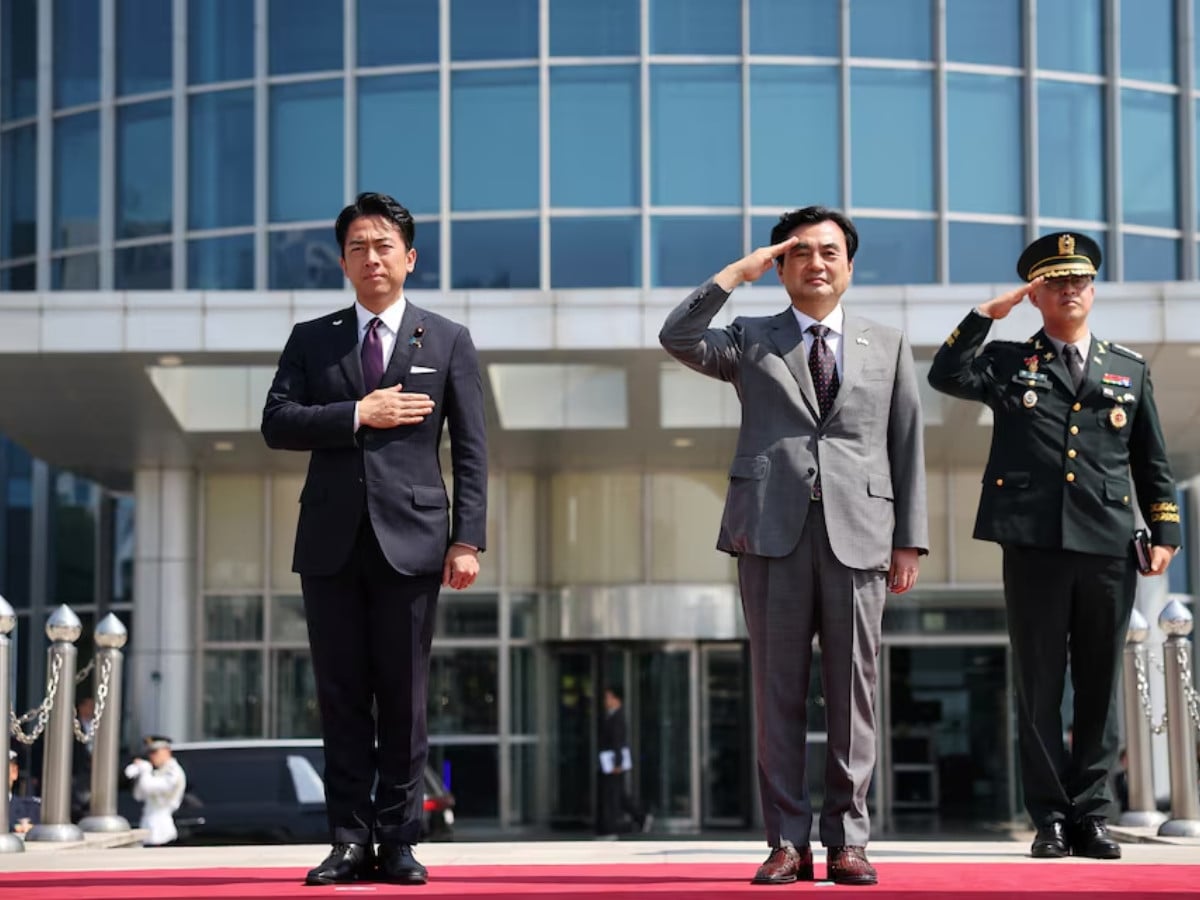
SEOUL: South Korea and Japan on Sunday reaffirmed their commitment to the denuclearisation of the Korean peninsula and agreed to resume joint search-and-rescue exercises, in a further step in expanding security cooperation between the two neighbours.
The agreement came during talks in Seoul between South Korean Defence Minister Ahn Gyu-back and Japanese Defence Minister Shinjiro Koizumi, in what was described as the sixth round of defence discussions between the two countries. The two sides also agreed to pursue regional stability through bilateral coordination as well as cooperation with Washington.
South Korea’s defence ministry said the ministers shared a common view on the need for continued coordination in response to the regional security situation.
South Korea and Japan have been working to improve ties since 2022 with encouragement from the United States, while trying to move past long-running historical tensions. That approach has continued under South Korean President Lee Jae Myung and Japanese Prime Minister Sanae Takaichi.
Security cooperation and past disputes
Relations had come under strain in 2019 when Seoul moved to terminate the GSOMIA intelligence-sharing agreement after Tokyo imposed restrictions on exports of semiconductor materials and removed South Korea from its preferential trade list. Those disputes were linked to unresolved grievances stemming from Japan’s colonial rule of the Korean peninsula.
In 2025, then Japanese prime minister Shigeru Ishiba and President Lee agreed to strengthen security and economic cooperation. Defence ministers from the two countries also committed to working alongside Washington in response to North Korea’s nuclear programme and Pyongyang’s expanding military cooperation with Russia. That cooperation included work related to artificial intelligence, unmanned systems and annual trilateral exercises.
In January 2026, Takaichi and Lee agreed to expand shuttle diplomacy, and in May they broadened cooperation in the energy sector.
Search-and-rescue drills and military exchanges
At Sunday’s meeting, Ahn and Koizumi also agreed to continue exchanges between the two countries’ air force aerobatic teams, South Korea’s Black Eagles and Japan’s Blue Impulse. They said this would support further progress in search-and-rescue exercises intended for a range of maritime accident scenarios.
The two ministers had previously met in Japan in January and again in May during the Shangri-La Dialogue in Singapore. At the Singapore meeting, they discussed a possible military logistics support arrangement covering supplies such as fuel, food and ammunition.
The two sides had also agreed to conduct a joint humanitarian search-and-rescue exercise in June, which would be their first such drill in nearly a decade.
Lingering tensions remain
Despite the recent diplomatic push, differences remain between the two countries. Among the unresolved issues are disputes related to Korean women who were forced to work in Japanese military brothels during World War Two.
More recently, in February, Seoul lodged a protest over a Japanese government event marking a group of disputed islands known as Takeshima in Japan and Dokdo in South Korea. The territory is controlled by South Korea.
0 Comments
No comments yet. Be the first to join the discussion!