Iran's slain leader Khamenei laid in state for week of mass funeral events in Tehran
Iran’s slain Supreme Leader Ayatollah Ali Khamenei lies in state in Tehran as the country holds a week of mass funeral processions, warning the US and Israel against attacks amid deep internal tensions.

TEHRAN: The body of Iran's slain Supreme Leader Ayatollah Ali Khamenei was lying in state in a vast hall in Tehran on Friday as clerics, officials, foreign dignitaries and other mourners paid their respects after his 37-year rule.
Iran is staging a week of mass funeral processions for Khamenei — killed in February by United States and Israeli airstrikes at the start of a four-month war — in a show of public devotion to the Islamic Republic's theocratic state and revolutionary fire.
Khamenei's body was expected to be taken to Qom, Najaf and Kerbala, the great Shi'ite centres of Iran and Iraq, before being laid to rest on Thursday in Mashhad, home to the country's holiest pilgrim shrine.
Critical moment for Islamic Republic
His coffin was unveiled late on Thursday to a throng of sobbing supporters, swaying and beating their heads in time to a sung lament as flowers were thrown from the bier into the crowd. On Friday the coffin — and those of family members killed with him — was laid in state in the great prayer hall built to honour his predecessor, Ayatollah Ruhollah Khomeini.
The funeral comes at a critical moment for Iran, where the clerical rulers backed by the Islamic Revolutionary Guard Corps are riding high from surviving what they saw as an existential war against their greatest and most powerful foes.
But nearly five decades after the 1979 revolution, and for all the official proclamations of national unity in the run-up to Khamenei's funeral, the Islamic Republic has rarely been so internally fractured.
Support for the clerical leadership is paper thin, analysts say, and the new Supreme Leader, Khamenei's son Mojtaba Khamenei, has not been seen in public since being wounded in the strike that killed his father.
Years of crippling sanctions have paralysed the economy as accelerating bouts of mass nationwide protests have been put down by security forces with increasing force — culminating in the killing of thousands of demonstrators in January. Those deep problems have been brushed aside this week, with the authorities mounting a display of state power and mass support, mobilising what they hope will be millions of mourners to take part in the funeral.
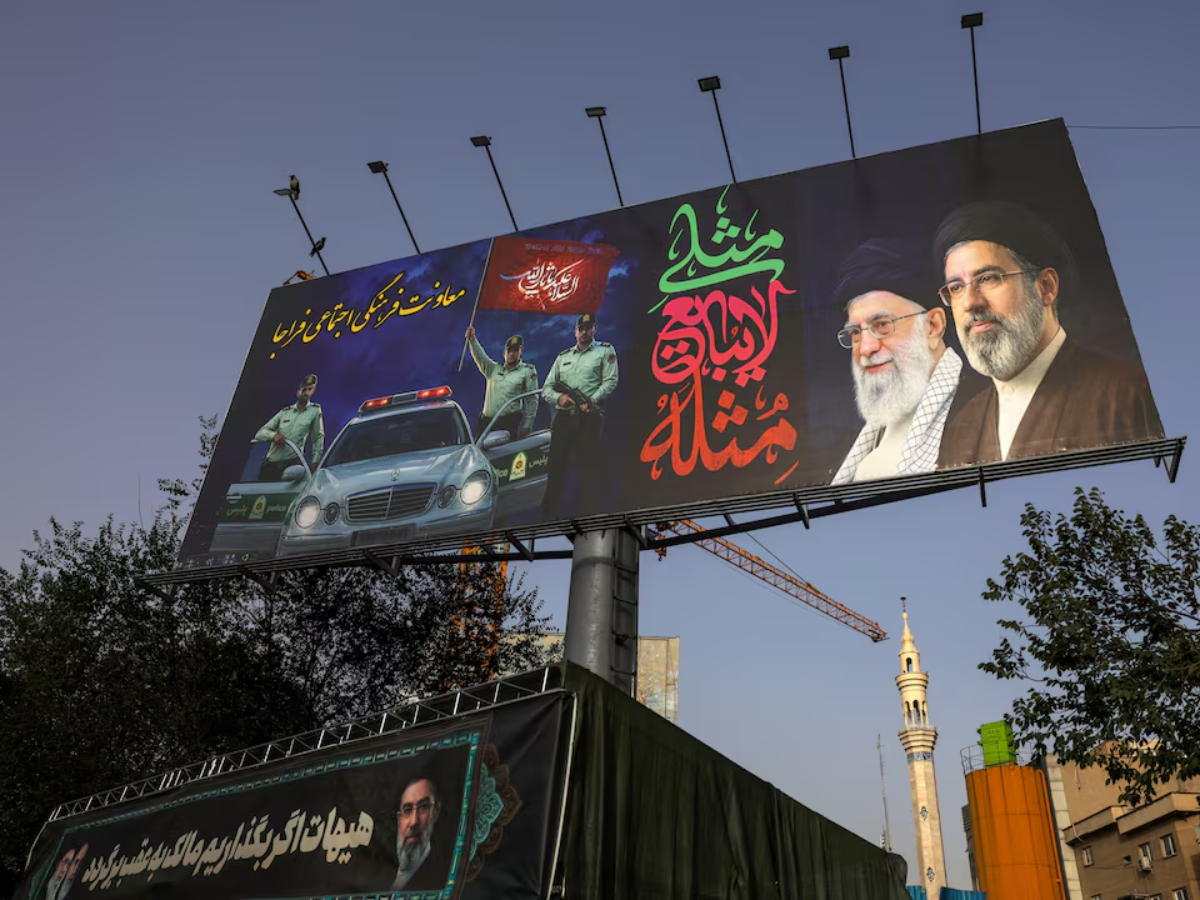
Tehran streets were tightly controlled, with military and police vehicles lining the major roads and police and members of the black-shirted volunteer Basij paramilitary force patrolling on motorbikes. Iran warned the US and Israel against any attacks during the funeral.
After the coffins arrived on Friday, borne high across the upraised hands of a waiting crowd, they were laid in the prayer hall on a white, stepped, dais before a high, intricately tiled, arched recess, flanked by national and black mourning flags. A black turban, worn by clerics claiming descent from Islam's Prophet Muhammad (PBUH), lay on the coffin on a folded chequered scarf, a symbol in Iran of militant revolutionary ideals and solidarity with Palestinians.
Delegations, including from Lebanon, Iraq and Yemen, home to the strongest proxies in Iran's network of regional power, followed each other into the hall to stand before the coffins. Representatives from Russia and China were expected to attend.
Former Iraqi president Abdul Latif Rashid, Armenian Prime Minister Nikol Pashinyan and Pakistani Interior Minister Syed Mohsin Naqvi arrived in Tehran for the funeral. Families of Hezbollah leader Hassan Nasrallah and senior commander Imad Mughniyeh, close Lebanese allies of Iran killed in Israeli strikes, attended the ceremony.
Sobbing crowds, funeral tour of Iran and Iraq
In Iran's theocratic system, Khamenei was not only head of state and leader of a revolutionary movement, but the representative on earth for Shi'ite Islam's 12th imam, who disappeared in the ninth century. His death in an enemy attack plays into a powerful Shi'ite tradition of martyrdom and mourning, in which processions of flagellants beat their chests or backs.
That potent symbolism has been evident in the black funeral flags hanging over city streets since his death referencing the seventh-century martyrdom of Shi'ism's third imam, Hossein.
In central Tehran overnight, a crowd stood sobbing and chanting, led by a Basij member, as others handed out posters of the late Khamenei. "God willing, only by avenging his blood, demanding justice for it, and ensuring that our leader's blood is not left unavenged, can this sorrow of the people be somewhat alleviated," said Mobina Razaaghi, an 18-year-old student from Isfahan, attending the funeral events with classmates.
As Khamenei's coffin was displayed overnight, the crowd chanted "O Hossein" in memory of the third imam, whose killing by a Sunni Muslim ruler at Karbala in Iraq is a wellspring of Shi'ite devotion and a spur to Iranian revolutionary rhetoric.
Killed alongside Khamenei, and displayed in coffins next to his, were his daughter, son-in-law and baby granddaughter, as well as the wife of his son Mojtaba — a conscious echo of the deaths of Hossein's family and companions.
Burial postponed due to war
Burials are meant to be conducted within a day of death in Islam, but because of the risks of holding a big funeral during the war it was postponed until after last month's interim truce deal was agreed.
Hotels are offering 50% discounts, schools, mosques and sports halls have been prepared to house mourners, and bus and rail networks are being diverted to serve the main events.
After what authorities are billing as a massive procession in central Tehran on Monday, the remains will be taken to the seminary city of Qom, the centre of Iran's Shi'ite hierarchy, for ceremonies on Tuesday. Ceremonies will then be held in Iraq's shrine cities of Najaf and Kerbala on Wednesday with prominent attendees from Iran's regional network of Shi'ite proxies.
He will be buried on Thursday, after another procession, in Mashhad near the tomb of the Imam Reza, a figure of great devotion in Iran.
Ghalibaf warns Iran will resume action if US, Israel fail to honour commitments
Iran’s Parliament Speaker Mohammad Bagher Ghalibaf warned on Friday that if the US and Israel do not fulfil their commitments to end the war, then Tehran will respond.
“We strongly demand full implementation of the agreements, and if the US and the Zionist regime fail to fulfil their commitments, Iran will resume proportionate actions,” Ghalibaf said, according to Iran’s ISNA news agency. Ghalibaf, who also heads the country’s negotiating team in talks with the US, added Washington cannot militarily confront Iran and said Israel’s threats are “baseless propaganda”.
“The United States and the Zionist regime did not achieve any of their goals in the Ramadan War, and today everyone has come to the conclusion that the military action against Iran has failed and, ultimately, they requested a ceasefire themselves,” he said.
Separately, speaking to the speaker of the Iraqi parliament, Ghalibaf stated that important matters have been signed in the recent agreement with America regarding the management of the Strait of Hormuz. The matters, according to ISNA, are "based on international laws."
Ghalibaf stated that the administration of the Strait of Hormuz must be carried out between the two coastal countries, Iran and Oman, ISNA reported.
Ghalibaf stated, according to ISNA, "We will not allow any kind of interference by America in the Strait of Hormuz." He added, "In the trip a few days ago to Oman, based on Article Five of the memorandum of understanding, we agreed with each other to organise the manner of regulating traffic in the Strait of Hormuz; we are determined in this regard."
The news agency reported that the speaker stated, "The Israelis are undoubtedly seeking to disrupt the Iran-America memorandum of understanding."
Comments
No comments yet. Be the first to join the discussion!