June 14, 2026
Families of Baldia fire victims demand accountability after SC acquittal
Families of Baldia factory fire victims and labour groups have demanded accountability after the Supreme Court acquitted two men in the case. Speakers at a Karachi press conference called for a fresh investigation into alleged negligence by factory owners and state institutions.

June 14, 2026
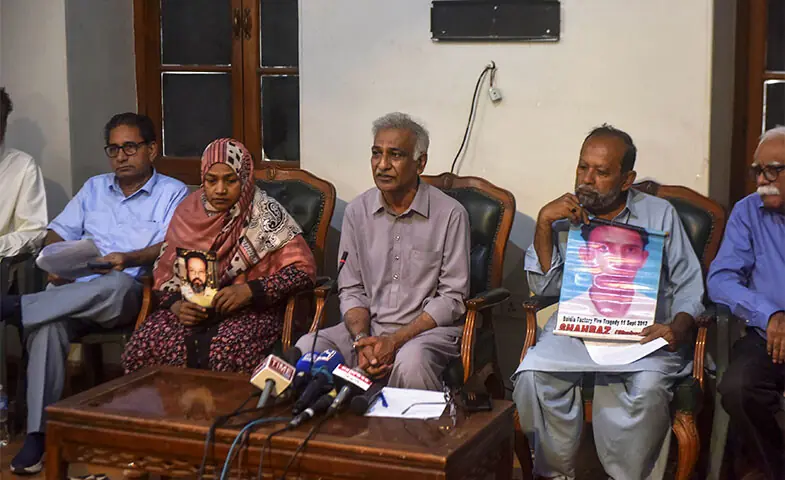
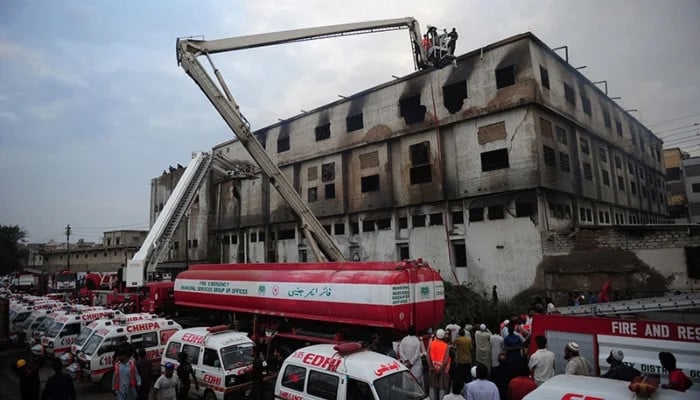
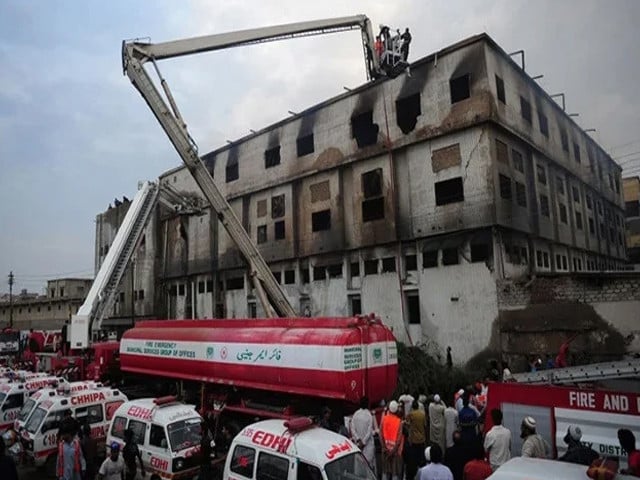
KARACHI: Families of those killed in the Baldia Town factory fire, joined by labour organisations, gathered at the Karachi Press Club on Saturday to demand clarity on who should now be held responsible for the deaths of their relatives after the Supreme Court acquitted two men earlier convicted in the case.
The recent ruling by a three-member Supreme Court bench set aside the case against Muttahida Qaumi Movement activists Abdul Rehman Bhola and Zubair alias Chariya, who had been accused of starting the blaze at the factory on September 11, 2012. According to the judgement cited at the press club, the court gave both men the benefit of the doubt because, out of around 400 witnesses, only one said he had seen one of the accused carrying a chemical bag, while no witness saw the fire being set.
Labour groups seek fresh investigation
National Trade Union Federation General Secretary Nasir Mansoor said the verdict had reinforced what affected families and labour groups had maintained since the beginning: that the disaster stemmed from negligence by the factory owners and failures by state institutions responsible for enforcing safety standards and inspections.
He said several accused had already been acquitted at different stages of the case, including some MQM leaders in the trial court and later factory guards and employees by the Sindh High Court. He said the latest acquittal had created a situation in which no one appeared answerable for the deaths of more than 260 workers.
Mansoor said that by treating the matter as one involving terrorism and extortion, scrutiny of the Labour Department, Fire Brigade, Employees’ Old-Age Benefits Institution, Social Security institutions and other relevant bodies had been pushed aside. He said this diverted the case away from those whose actions or omissions should have been examined, and prevented accountability that could have improved worker safety more broadly.
He also said factory owners did not directly compensate the victims. According to him, the monthly pension arrangement for affected families was secured through the efforts of labour organisations, lawyers and international solidarity groups, including the European Centre for Constitutional and Human Rights, the Clean Clothes Campaign and IndustriALL Global Union. He said compensation was arranged through the German company KIK, with families currently receiving lifelong monthly pensions ranging from about Rs9,000 to Rs35,000.
Speakers say worker safety concerns were sidelined
Academic Dr Tauseef Ahmed Khan said worker safety had not been treated as a central issue in the Baldia case. He argued that had stronger attention been paid then to workplace safety and building maintenance, later tragedies such as the Gul Plaza incident might have been avoided.
Zehra Khan, co-chair of the IndustriALL Global Union textile garments sector and general secretary of the Home-Based Women Workers Federation, said the case had not been tried on its actual merits because it had been framed as one of terrorism and extortion. She called for the matter to be reopened and fully investigated with reference to the roles of the Labour Department, Fire Brigade, Social Security institutions, EOBI and other concerned agencies.
Husna Khatoon, chairperson of the Ali Enterprises Factory Fire Affectees Association and herself a widow of one of the victims, said workers were unable to escape because exits and windows had been locked and sealed to stop theft. She said that many of those inside had effectively been made to work in a closed building and were trapped when the fire broke out.
“Most workers in the factory died because factory exits and windows were locked and sealed to prevent theft. They were effectively forced to work inside a sealed building. They were trapped. It was not an accident. It was murder,” she said.
Pakistan Fisherfolk Forum General Secretary and Pakistan United Workers Federation representative Saeed Baloch said government departments should have taken their responsibilities more seriously after such a major tragedy. Progressive intellectual Dr Asghar Dashti said changing the case narrative toward terrorism and extortion had also served to shield those actually responsible. Ali Enterprises Factory Fire Affectees Association General Secretary Muhammad Siddiq also addressed the press conference.
0 Comments
No comments yet. Be the first to join the discussion!