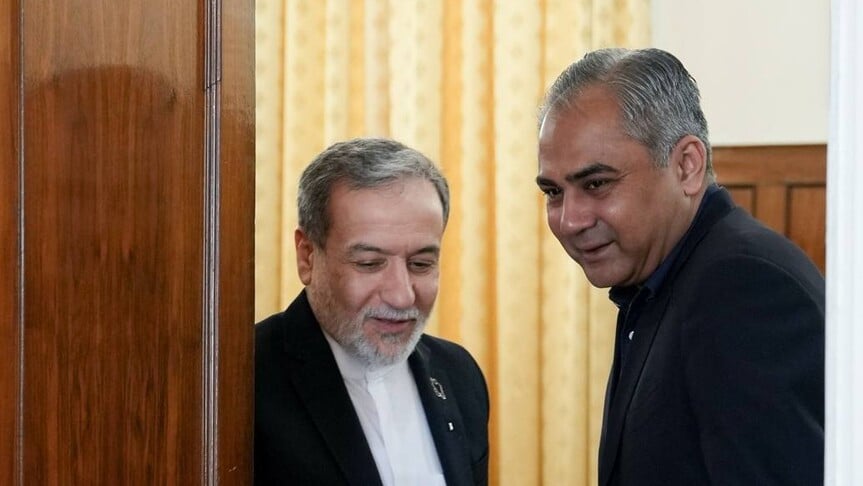
Naqvi holds high-stakes Tehran talks as Pakistan pushes US-Iran peace diplomacy
Interior Minister Mohsin Naqvi visits Tehran again, meeting President Pezeshkian, Iran’s interior minister and IRGC chief Vahidi as Pakistan pushes a critical US-Iran diplomacy phase to strengthen the ceasefire and restart talks.

Interior minister meets Iranian President Pezeshkian during second Tehran visit in five days
He also holds talks with IRGC chief Ahmad Vahidi and Interior Minister Momeni amid fears of renewed US-Iran tensions
Pakistan-led diplomacy enters ‘critical phase’ as fresh US proposal reaches Tehran
Iran confirms negotiations with Washington continuing through Pakistani mediators
Islamabad seeks stronger ceasefire and another round of direct US-Iran talks
ISLAMABAD/TEHRAN: Pakistan’s Interior Minister Mohsin Naqvi on Wednesday held high-level meetings with Iranian President Masoud Pezeshkian and other senior Iranian officials during his second visit to Tehran in less than a week, as Islamabad intensified diplomatic efforts to help broker peace amid fears of renewed tensions between Washington and Tehran.
Iran's President Pezeshkian has met with Pakistan's Interior Minister Syed Mohsin Naqvi in Tehran.
Follow Press TV on Telegram: https://t.co/h0eMpigtxM pic.twitter.com/DNlw0Ub7kR— PressTV Extra (@PresstvExtra) May 20, 2026
Naqvi arrived in Tehran on Wednesday for talks with Iranian leadership, according to Iran’s state news agency Islamic Republic News Agency (IRNA).
Pakistan's interior minister arrived in Tehran
— IRIB (Islamic Republic of Iran Broadcasting) (@iribnews_irib) May 20, 2026
The visit comes days after his previous trip to Iran over the weekend, which was also aimed at facilitating dialogue and reducing tensions in the region.
A brief statement shared on Naqvi’s official WhatsApp channel confirmed the meeting with the Iranian president, while video footage released by IRNA showed the Pakistani minister greeting President Pezeshkian before holding talks in the presence of senior officials.
Pakistan has increasingly positioned itself as a key diplomatic intermediary since the conflict escalated following joint US-Israeli strikes on Tehran on February 28, which triggered Iranian retaliation and caused disruptions in the strategically vital Strait of Hormuz — a critical global energy corridor through which nearly one-fifth of the world’s oil and gas supplies transit.
Although a fragile ceasefire announced on April 8 remains in place, negotiations between Washington and Tehran have largely remained stalled after an initial round of direct talks in Islamabad, with disagreements over Iran’s uranium enrichment programme and the future status of the Strait of Hormuz continuing to hinder progress.
Earlier, IRNA reported that Naqvi also held talks with Iranian Interior Minister Eskandar Momeni shortly after arriving in Tehran.
The two sides discussed the evolving regional security situation, border management and matters relating to internal security cooperation.
Pakistan's Interior Minister Syed Mohsin Naqvi makes his second visit to Tehran within the past ten days and holds talks with Iran's Interior Minister Eskandar Momeni. pic.twitter.com/2KdgzCmzMY
— PressTV Extra (@PresstvExtra) May 20, 2026
“Detailed discussions were held on the latest regional developments during the meeting,” the Iranian news agency said.
Naqvi meets IRGC chief in Tehran
Separately, state broadcaster PTV News reported that Naqvi also met Islamic Revolutionary Guard Corps (IRGC) chief Ahmad Vahidi in Tehran as part of the high-level diplomatic engagement.
وفاقی وزیرداخلہ محسن نقوی اور جنرل احمد وحیدی pic.twitter.com/QYbSq3zqya
— PTV News (@PTVNewsOfficial) May 20, 2026
According to multiple Pakistani government sources cited by Anadolu, Naqvi’s latest visit was linked to discussions surrounding a “fresh” US proposal aimed at ending the lingering Middle East conflict.
The sources said Pakistan-led mediation efforts between Washington and Tehran had entered a “critical phase,” with Islamabad seeking to revive stalled negotiations and pave the way for another round of direct talks.
During his meeting with Gen Vahidi, Naqvi discussed efforts to restart diplomatic engagement between the two sides, according to Pakistan’s interior ministry.
Pakistani officials said the minister was also expected to meet Iranian Foreign Minister Abbas Araghchi and other senior Iranian officials to discuss the latest developments and exchange views on the new US proposal.
Government sources said prospects for a second round of direct negotiations in Islamabad had improved in recent days following several diplomatic developments, including US President Donald Trump’s reported decision to postpone planned strikes on Iran.
“Currently, Pakistan’s top priority is to further strengthen the ceasefire and persuade both sides to hold another round of direct talks,” the sources said.
Tehran receives a fresh US proposal
Meanwhile, Iranian Foreign Ministry spokesperson Esmaeil Baqaei confirmed that Tehran had received a fresh US proposal and was currently reviewing it.
“We received the points of view of the American side and we are currently examining them,” Baqaei told Iranian state media, adding that the presence of Pakistan’s interior minister was aimed at facilitating the exchange of messages between the two sides.
He reiterated Tehran’s key demands in the talks, including the release of frozen Iranian assets abroad and the lifting of US restrictions on Iranian ports.
In separate remarks to Brazilian newspaper Folha de Sao Paulo, Baqaei said negotiations between Tehran and Washington were continuing “through Pakistani mediators,” according to IRNA.
“Basically, what we want is not a demand but our rights,” he said, reiterating Iran’s demand for the lifting of US sanctions.
Delayed renewed military strikes after prospects for ending conflict improving: Trump
US President Donald Trump said on Monday that he had delayed renewed military strikes after several regional countries informed Washington that prospects for a comprehensive agreement to end the conflict were improving.
Speaking about ongoing diplomatic efforts, Trump said leaders from Saudi Arabia, Qatar, the United Arab Emirates and other regional states had urged him to postpone military action because they believed negotiations were moving closer towards a breakthrough.
“They think they are getting very close to making a deal,” Trump said while explaining the decision to delay further strikes.
According to diplomatic sources familiar with the negotiations, the latest US proposal offers “slightly better incentives” to Iran compared to previous proposals, although key disagreements remain unresolved.
The sources said the new proposal includes discussions related to Iran’s frozen overseas assets and international sanctions imposed on Tehran, but noted that Washington had offered “no new concession” regarding Iran’s nuclear programme — the principal stumbling block in efforts to reach a permanent agreement.
Under a previously reported 14-point Iranian proposal, Tehran has sought separate negotiations on its nuclear programme, including issues related to enriched uranium, within 30 days after the implementation of a permanent ceasefire.
Washington, however, maintains that the nuclear issue must be “discussed and resolved” before any final ceasefire arrangement can be concluded.
Diplomatic sources added that the proposal for “third-party monitoring” of any future agreement also remains under discussion, particularly on the Iranian side.
Regional tensions have remained high since the United States and Israel launched strikes against Iran in February, triggering retaliatory attacks by Tehran targeting Israel and US allies in the Gulf region, alongside disruptions in the strategically critical Strait of Hormuz.
A ceasefire brokered through Pakistani mediation came into effect on April 8, temporarily halting hostilities, although subsequent talks in Islamabad failed to produce a lasting settlement. Trump later announced an indefinite extension of the truce.
Since then, both Washington and Tehran have continued exchanging proposals and counter-proposals in an attempt to revive direct negotiations and prevent the conflict from escalating into a wider regional war.
During his recent visit to Tehran, Pakistan’s Interior Minister Mohsin Naqvi held meetings with Iranian President Masoud Pezeshkian, Foreign Minister Abbas Araghchi, Parliament Speaker Mohammad Bagher Ghalibaf and Iranian Interior Minister Eskandar Momeni as part of Islamabad’s diplomatic outreach.
Naqvi spent nearly 90 minutes in a private meeting with President Pezeshkian at the Presidential Administration, while his overall visit to the complex lasted around three hours.
During the talks, President Pezeshkian praised what he described as the responsible cooperation of Pakistan, Afghanistan and Iraq in preventing their territories from being used for armed operations against Iran.
The Iranian president also appreciated Pakistan’s diplomatic role during recent regional tensions, particularly the efforts of the country’s political and military leadership in helping stabilise the ceasefire.
As Islamabad continues pushing for a “permanent” resolution to the ongoing US-Iran conflict, Pakistani officials are also engaging other regional stakeholders to prevent further deterioration of the security situation.
Despite repeated exchanges of proposals between Washington and Tehran, diplomatic deadlock persists, raising fears of renewed hostilities.
“That is why Pakistan is pushing and persuading both sides not to give up on diplomatic efforts,” a diplomatic source said.
According to Iran’s semi-official Fars News Agency, considered close to the country’s military and security establishment, Washington has put forward five conditions in response to Tehran’s proposal for negotiations.
The reported conditions include no war reparations for Iran, transfer of 400 kilogrammes of enriched uranium to the United States, retention of only one Iranian nuclear facility, no release of even 25 per cent of Iran’s frozen assets, and linking negotiations to an end to the war on all fronts.
Iran, meanwhile, has its own set of conditions, including an end to conflicts across all fronts, particularly in Lebanon, lifting of sanctions, return of frozen assets, war compensation, and recognition of Iran's sovereignty over the Strait of Hormuz.
It is believed that Tehran, via Islamabad, has now responded to the US conditions.
Last month, Naqvi accompanied the field marshal during his visit to Tehran
Naqvi busy in 'engagements' related to US-Iran talks: Tallal Ch
During the day, Minister of State for Interior Tallal Chaudhry has confirmed that Interior Minister Mohsin Naqvi remains engaged in efforts regarding US-Iran negotiations.
Speaking at the passing out parade of 46th batch of recruits of Coast Guards in Karachi today, Chaudhry said Naqvi “could not attend the event due to engagements related to Iran-US talks”.
Hormuz strait disruption exposed 'vulnerability’ of energy supply chains: Ali Pervaiz
Petroleum Minister Ali Pervaiz Malik has said the recent disruption in the Strait of Hormuz has exposed “how vulnerable our energy supply chains are”.
Noting that the entire global energy system was going through a “structural reset”, Malik stressed the need to “shift the entire paradigm” regarding energy security.
“We must also appreciate what does energy security actually imply,” he said, describing it as fundamentally linked to resilience, diversification, storage, flexibility, and infrastructure preparedness.
Pakistan remained in 'constant touch' with China throughout US-Iran conflict: Dar
In related development, Deputy Prime Minister and Foreign Minister Ishaq Dar on Wednesday said that Pakistan remained in “constant touch” with China throughout the US-Iran-Israel conflict.
Speaking in the Senate, DPM Dar said, “Throughout the conflict between the US, Iran, and Israel, we have been in constant touch with my counterpart Wang Yi as well as the other colleagues from the region”.
DPM Dar further recalled that he also had a one-day visit to China on March 31, where “we came up with a five-point peace plan for the conflict”, which he said “, has been accepted and endorsed by dozens of countries on the globe”.
’BEYOND THE REGION’
Naqvi’s latest visit comes amid renewed tensions between Washington and Tehran, following warnings from US President Donald Trump that the United States could resume strikes on Iran within days if no agreement is reached.
Iran’s Revolutionary Guards warned on Wednesday that any new attacks by the US or Israel would spark a wider regional conflict.
“If the aggression against Iran is repeated, the promised regional war will this time spread far beyond the region,” the Guards said in a statement reported by AFP.
Iranian Foreign Minister Seyed Abbas Araghchi also warned on social media that a “return to war will feature many more surprises.”
Pakistan has repeatedly called for diplomacy and restraint, with officials saying Islamabad remains engaged with regional and international partners to help prevent further escalation in the Gulf.
Last month, Pakistan’s foreign ministry said the country was continuing diplomatic efforts to ease regional tensions, while declining to provide details of the ongoing discussions.
“The clock on diplomacy has not stopped. The peace process is working,” foreign ministry spokesperson Tahir Andrabi told reporters in Islamabad at the time.
Comments
No comments yet. Be the first to join the discussion!