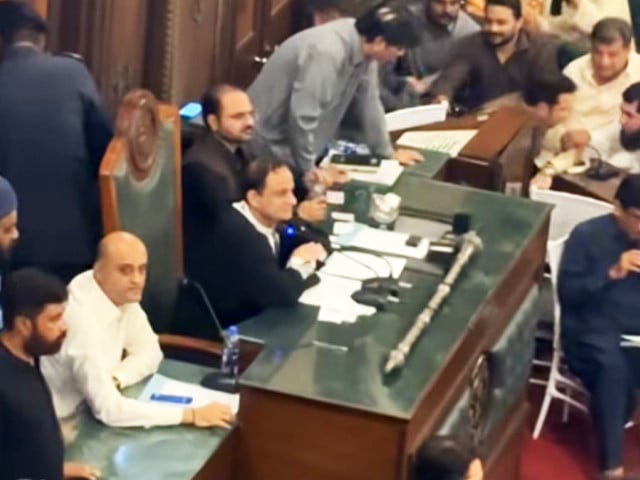
TMCs slam Sindh govt for bypassing local councils with Rs13bn KMC uplift deal
Several Karachi town administrations have questioned the Sindh government’s decision to let KMC execute Rs13 billion in local uplift works. Ministers say the move was agreed by consensus and involves no discrimination against any town.


KARACHI: The Sindh government’s decision to have the Karachi Metropolitan Corporation oversee Rs13 billion worth of road rehabilitation and other infrastructure works across the city’s 24 town municipal corporations has triggered concern among several town administrations, particularly those led by opposition parties, over whether the move runs counter to the principle of devolving powers and resources to the grassroots level.
The funding was approved at a recent meeting of the cabinet sub-committee on finance chaired by Sindh Local Government Minister Syed Nasir Hussain Shah. According to an official statement issued after the meeting, the committee cleared major financial initiatives aimed at addressing Karachi’s long-running urban problems, especially road rehabilitation, drainage and sewerage infrastructure, through allocations amounting to billions of rupees.
Officials and elected representatives in a number of towns have questioned why development funds intended for municipal works would be administered by the KMC instead of being placed directly under the control of the towns. They say the arrangement could weaken local councils and dilute the idea of empowering elected governments at the lowest tier.
Government defends arrangement
Sindh Minister for Labour, Human Resources and Social Protection Saeed Ghani, who also attended the meeting, said the decision was taken by consensus and was not meant to curtail the authority of the towns. "And if you look at the break up of these funding, you will find that most of the funds are allocated for towns in Central district of Karachi which is entirely governed by the opposition party [Jamaat-i-Islami]," he added.
He said the provincial government had allocated the money from its own resources for development schemes in towns and maintained that no town had been treated unfairly. "It is, in fact, a generous gesture on the part of the Sindh government that it decided to allocate funds from its own resources for development projects in towns. No discrimination has been made against any town in this regard. Moreover, it was not a new decision to hand over funds to the KMC; this understanding already existed when the towns were asked to submit proposals for their development projects," he informed.
Town representatives raise objections
Town administrations, many of them run by Jamaat-i-Islami, have rejected that reasoning and argued that meaningful decentralisation requires direct financial and administrative powers for local governments. They say towns are better positioned to identify the needs of their own areas and respond accordingly.
Gulshan-i-Iqbal Town Chairman Dr Fuad Ahmed said the Pakistan Peoples Party often cites the 18th Amendment as a major step towards devolution, but added that its spirit required powers and resources to move downward to the lowest levels of government rather than remain concentrated at higher tiers. He said the provincial government should act as a facilitator and mediator so that towns and local councils can function effectively.
"The genuine devolution requires direct financial empowerment of towns so they could develop institutional stability and public trust. The local governments should be provided funds and held accountable for how effectively they utilise them. The towns are in a much better position to understand needs and priorities of their own areas," Ahmed said.
Dr Ahmed also said such a model could politically benefit the ruling PPP because empowered towns could then be assessed transparently on their performance. "Then the political point-scoring begins when development work carried out by the KMC is highlighted while towns are denied direct financial control. It is unfair to withhold funds from towns and then criticise them for not delivering."
Saddar Town Chairman Mansoor Ahmed Shaikh of Pakistan Tehreek-i-Insaf said he did not object to the KMC being assigned certain projects in towns, but said town administrations should not be sidelined from the process and must remain involved in planning and implementation.
"At least towns should be given the mandate to monitoring and quality evaluation of these projects. Because at the end of the day, we will be the one held accountable for the work being done in our towns," Shaikh said.
Korangi Town Chairman Muhammad Naeem Shaikh of the PPP voiced similar concerns, saying development works should be subject to town approval before payments are released.
"Payment for any development work in a town should only be released after a proper verification of the completed work on the ground and with the formal consent of the elected town administration, so that transparency is ensured and the town representatives, who are directly accountable to the people, are fully satisfied that the work has been carried out according to the agreed specifications and standards," he said.
Comments
No comments yet. Be the first to join the discussion!