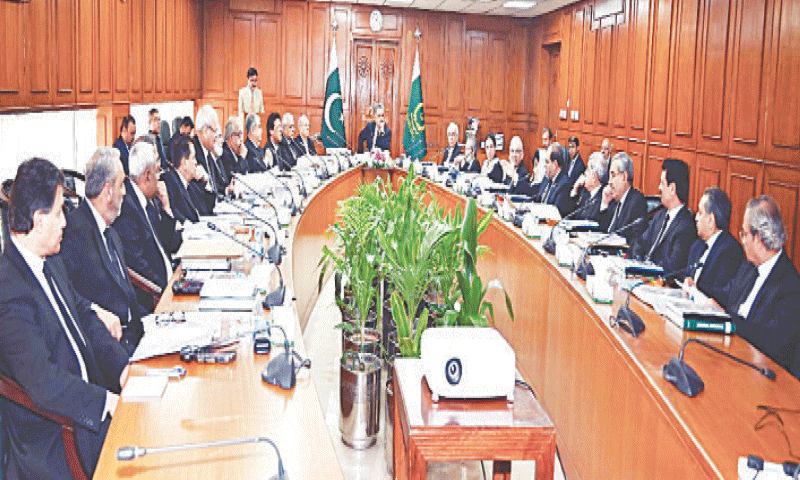
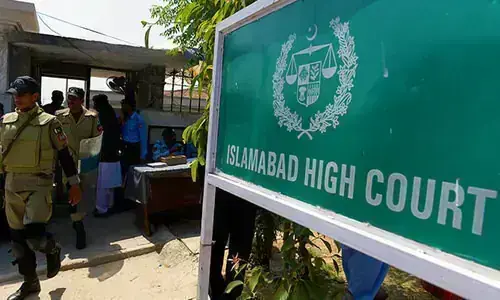
Islamabad legal fraternity dismayed by JCP decision on judicial elevations
Islamabad’s legal community has objected to the JCP’s decision not to treat IHC vacancies created by judges’ transfers as fresh openings. Lawyers say the move could further reduce representation for Islamabad-based practitioners in the high court.

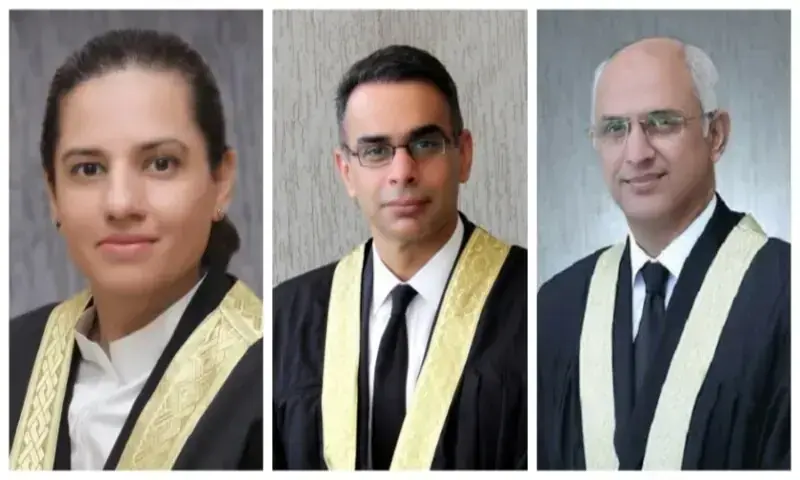
ISLAMABAD: The Judicial Commission of Pakistan’s decision not to treat vacancies created in the Islamabad High Court (IHC) after the transfer of three judges as fresh openings has drawn criticism from lawyers in the federal capital, while concerns have also surfaced within the judiciary over representation, seniority and prospects for elevation.
The issue arose after the JCP, in its April 28 meeting, approved the transfer of Justice Mohsin Akhtar Kayani to the Lahore High Court, Justice Babar Sattar to the Peshawar High Court and Justice Saman Rafat Imtiaz to the Sindh High Court. The commission also decided that the seats vacated by their transfers would not be counted as new vacancies.
The move was opposed by lawyers, including the Islamabad High Court Bar Association (IHCBA). In a declaration issued after a meeting of its executive body, the IHCBA underlined the need to fill vacant positions in the high court with qualified and deserving members of the legal fraternity.
Concerns over representation and balance
A member of the JCP told Dawn that the commission considered it necessary, in order to maintain balance among the high courts, that such posts should be filled through transfers from the relevant high courts rather than through fresh appointments. However, the same member said the situation in the IHC was different in view of the transfer of three judges from provincial high courts to the IHC in February 2025.
The reference was to the transfer of three judges, including IHC Chief Justice Sarfraz Dogar, to the Islamabad High Court. Since then, no judge from the IHC has been transferred to any provincial high court, a point that sections of the legal community are now citing as evidence of an imbalance.
Sources within the judiciary told Dawn that efforts were underway to persuade the JCP to revisit its latest decision in order to address this imbalance. They said some members may ask the commission to treat the recent transfers of IHC judges as reciprocal adjustments against the transfers made last year. "There is room for review because precedents do exist where the commission revisited its own observations," Dawn quoted a source familiar with the deliberations as saying.
The same source referred to the case of Justice Ali Baqir Najafi, now serving as a judge of the Federal Constitutional Court, whose elevation from the Lahore High Court had previously drawn adverse remarks from the JCP. Those remarks were later removed by the commission itself.
A JCP member also told Dawn that the commission may reconsider its recent decision in view of the existing composition of the IHC.
According to insiders cited in the report, the proposal was not discussed in an internal pre-meeting before the formal JCP session and was instead introduced during the proceedings. Such pre-meetings are usually held to build consensus among like-minded members of the commission.
Lawyers weigh legal challenge
The development has also unsettled judges in the IHC, who are concerned about seniority, as well as judges in the district judiciary, who are worried about their chances of elevation. Insiders said the existence of six vacancies in the high court had raised the possibility that at least two seats could go to judges serving in the sessions courts, but the JCP decision ended those expectations and also angered lawyers.
Islamabad Bar Council member Raja Aleem Abbasi said the IHC had been created for the federal capital territory and that vacancies should be filled from within Islamabad’s legal fraternity. "Justice Babar Sattar and Justice Mohsin Akhtar Kayani belonged to Islamabad. Therefore, the vacancies created after their transfer should be filled through lawyers from Islamabad, he said.
Abbasi said lawyers from all provinces were already practising before the IHC and could be considered against provincial quotas where necessary. He added that Islamabad lawyers had already suffered last year when three IHC seats were filled through transfers from other high courts, and said that another three appointments through transfers would further reduce the representation of lawyers based in the capital in the IHC.
Calling the move unacceptable, Abbasi said the lawyers’ community would resist the decision with full force.
Lawyers in Islamabad are already considering challenging the JCP decision before the IHC. Legal experts, however, pointed out that any ruling in such a case could eventually be appealed before the Federal Constitutional Court, where the issue may receive a final constitutional determination.
The report also noted that there is precedent for judicial review of the commission’s decisions. In 2012, IHC additional judge Azim Khan Afridi had challenged the JCP’s decision not to confirm him as a permanent judge of the high court.
1 Comment
No comments yet. Be the first to join the discussion!