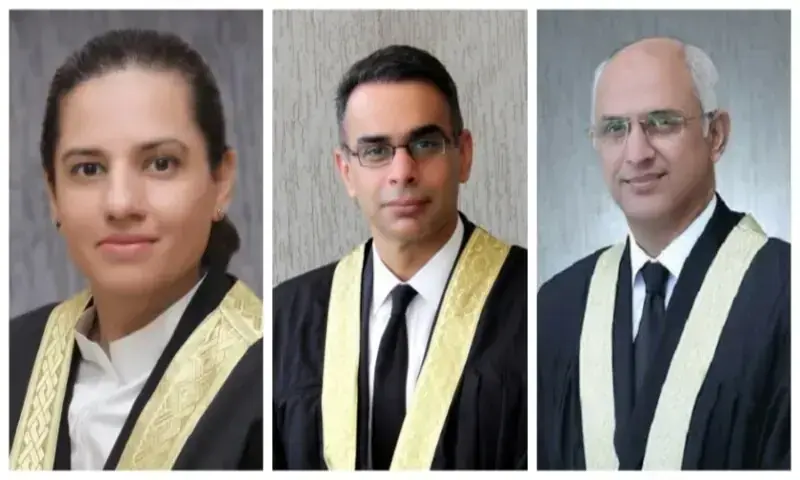
JCP greenlights high-profile judges' transfers amid legal tensions
The Judicial Commission of Pakistan approved transfers of three IHC judges to the LHC, PHC and SHC, reshaping placement rules amid constitutional and legal tensions.

ISLAMABAD: The Judicial Commission of Pakistan (JCP) on Tuesday approved the transfer of three judges from the Islamabad High Court (IHC) to other provincial high courts, in a move that comes against the backdrop of deepening institutional tensions and ongoing judicial reshuffles.
A meeting of the commission, chaired by Chief Justice of Pakistan Yahya Afridi at the Supreme Court, endorsed the relocation of Justice Mohsin Akhtar Kiani to the Lahore High Court (LHC), Justice Babar Sattar to the Peshawar High Court (PHC), and Justice Saman Rafat Imtiaz to the Sindh High Court (SHC). The decision was approved by a majority of members.
According to an official statement, the session was convened under Article 175A(22) of the Constitution after a requisition by one-third of JCP members, despite the chairman’s initial reluctance to call the meeting.
The commission also ruled that vacancies created by such transfers would be filled strictly through further transfers, not fresh appointments—effectively reshaping the mechanism of judicial placements.
Meanwhile, proposals to transfer Justice Arbab M. Tahir and Justice Khadim Hussain Soomro were withdrawn by the member who had originally moved them.
The development coincides with ongoing deliberations over new inductions to the IHC. Several prominent lawyers, including Ayyaz Shaukat, Usman G. Rashid Cheema, Umair Majeed Malik, and Sultan Mazhar Sher Khan, are under consideration, alongside serving district judges Shahrukh Arjumand and Humayun Dilawar.
Notably, Chief Justice Afridi had earlier expressed serious constitutional reservations about such transfers, warning they could undermine federal balance, create instability, and risk being perceived as punitive actions without due process. He stressed that the Constitution already provides a mechanism under Article 209 for addressing judicial misconduct.
The transfers follow a key amendment to Article 200, which now empowers the JCP to recommend transfers without requiring judges’ consent—a significant shift from previous rules. Judges refusing transfers may now face proceedings before the Supreme Judicial Council.
The move also comes amid lingering friction within the IHC. The transferred judges were among those who had previously raised allegations of interference by state agencies and had opposed earlier judicial appointments, including that of IHC Chief Justice Sardar Mohammad Sarfraz Dogar.
Their resistance had led to a visible rift within the court, followed by administrative restructuring that altered internal power dynamics and sidelined dissenting judges.
As the IHC navigates both internal discord and external scrutiny, the latest transfers mark another pivotal moment in Pakistan’s evolving judicial landscape.
Comments
No comments yet. Be the first to join the discussion!