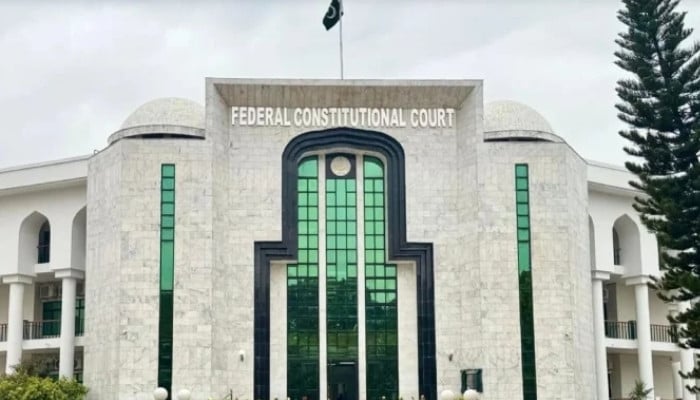
FCC upholds ban on import of books from India, Israel
The Federal Constitutional Court has upheld the federal government’s ban on importing books from India and Israel. The court ruled that the right to read is qualified and may be restricted by law on foreign policy and national security grounds.


ISLAMABAD: The Federal Constitutional Court (FCC) has upheld the federal government’s decision to bar the import of books from India and Israel, ruling that the right to read is not unrestricted and can be limited under the law, including on grounds linked to foreign policy.
In a 21-page judgement authored by Justice Aamer Farooq, the court upheld Statutory Regulatory Orders (SROs) Nos 927 and 928(I)/2019, which were issued by the federal government under what the judgement described as its constitutional and statutory authority. The ruling said the measures reflected considerations of foreign policy, national security and sovereign discretion.
"We have recognised the right to read as flowing from the right to life under Article 9 of the Constitution, this right is not absolute but qualified. Article 9 itself expressly provides that no person shall be deprived of life or liberty "save in accordance with law," it added.
The judgement said that in this case, the law had been applied through the federal government’s regulation of trade.
The court also held that the federal government’s foreign policy is not open to judicial review and that any review or reconsideration of such policy remains the executive’s exclusive domain.
According to the judgement, the executive authority of the federation rests with the federal government and is exercised by the prime minister and the cabinet in the name of the president. It further noted that Article 97 of the Constitution empowers the federation to exercise executive authority over matters that fall within parliament’s legislative competence.
The court said that in order to determine the extent of the federation’s executive power, it was necessary to examine the scope of parliament’s lawmaking authority. It then referred to the grounds cited by the petitioners for the contested ban, namely national security and foreign policy considerations. "To determine the extent of the Federation's executive power, it is therefore necessary to examine the scope of Parliament's lawmaking powers. At this stage, we take note of the ground relied upon by the Petitioners for imposing the impugned ban, namely considerations of national security and foreign policy. We refrain from examining the nature of Pakistan's relations with the said countries or the policy reasons underlying the adoption of such measures," it stated.
The judgement added that courts have consistently maintained over the years that they should not interfere in matters involving national security and foreign policy.
The ruling came after the Lahore High Court had also upheld the validity of the SROs and declared them intra vires the Constitution and the relevant statutory framework. However, despite endorsing the legality of the measures, the high court had issued certain directions to the federal government. Those directions were later challenged by the executive before the top court.
With the latest ruling, the FCC has affirmed the federal government’s authority to maintain the restrictions under the existing legal framework.
Comments
No comments yet. Be the first to join the discussion!