














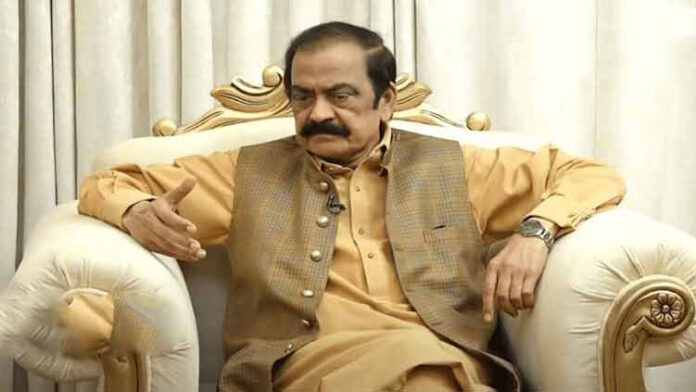
QUETTA: A heated exchange erupted at a discussion on Balochistan when PML-N leader Rana Sanaullah suggested that innocent people were likely to be affected in the aftermath of security operations following militant attacks, including those reported across the province on Jan 31, prompting several attendees to walk out of the event in protest.
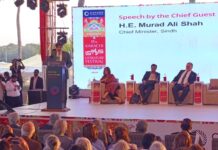
The remarks were made during a session titled Is There a Political Will to Solve the Crisis in Balochistan at the Asma Jahangir Conference in Lahore. Sanaullah, an aide to the prime minister, was speaking alongside BNP-Mengal chief Akhtar Mengal and National Party leader Dr Abdul Malik Baloch, with journalist Mujahid Barelvi moderating the discussion.
Tensions rose when Sanaullah responded to criticism over the treatment of Baloch citizens and demands for the removal of security checkpoints. He argued that such measures could not be eased unless militancy and violence were eliminated, adding that security operations after major incidents could result in innocent people being detained.
His comments drew an immediate and vocal reaction from the audience. Rights activist Sheema Kermani stood up and heckled the minister, prompting Sanaullah to accuse critics of refusing to listen. Kermani then walked out of the hall, with a number of participants following her, turning the disagreement into a visible protest against his remarks.
Speaking outside the venue, Kermani said that invoking Asma Jahangir’s name while providing a platform to voices that justified state violence was unacceptable. She added that Jahangir herself would have refused to remain part of such a discussion.
Earlier in the session, Dr Abdul Malik Baloch identified insurgency and enforced disappearances as the province’s most pressing and unresolved problems. He said complaints about missing persons were a daily occurrence in his constituency and urged the state and political leadership to address the issue through dialogue rather than force.
He warned that treating Balochistan solely as a security problem would further deteriorate conditions, while meaningful engagement with political parties could help stabilise the situation. He also expressed concern over the shrinking space for mainstream political parties and criticised what he described as the symbolic representation of elected leaders in parliament.
Recalling his involvement in the Pakistan Democratic Movement, Dr Malik said the alliance had agreed on several points, including ending enforced disappearances. He called for political reforms, greater provincial control over resources, and the protection of the 1972 Constitution, the 18th Amendment and the National Finance Commission Award.
Akhtar Mengal, speaking at the outset, described the Balochistan issue as fundamentally political but said successive governments had relied on military solutions, exacerbating tensions. He referred to historical agreements between the Khan of Kalat and Quaid-i-Azam that promised administrative autonomy, noting that these commitments were never honoured.
He cited past military operations, the killing of Nawab Akbar Bugti and the long-standing issue of enforced disappearances as sources of deep trauma for Baloch families, including his own. Mengal also criticised recent political and electoral developments, alleging that mainstream Baloch leadership had been marginalised amid restrictions on political activity, media freedom and civil liberties.
He further highlighted the imprisonment of human rights lawyers and activists Imaan Mazari-Hazir and her husband Hadi Ali Chattha, questioning why severe punishments were handed down for social media posts while those accused of corruption and damaging the country faced little accountability.
In response, Sanaullah said the past could not be undone and argued that Balochistan was facing two distinct crises. One, he said, was represented by political leaders like Mengal and Dr Malik, while the other involved militant groups led by figures such as Bashir Zaib of the banned BLA.
He maintained that these crises required separate solutions and accused critics of conflating political grievances with militancy. Sanaullah also claimed that enforced disappearances and violence in the province had emerged together and would only end together, describing the issue as a chicken-and-egg situation.





چطور در یک رابطه عاشقانه، به یکدیگر فضای آرامش بدهیم؟ وبسایت یادگیری نوآور