











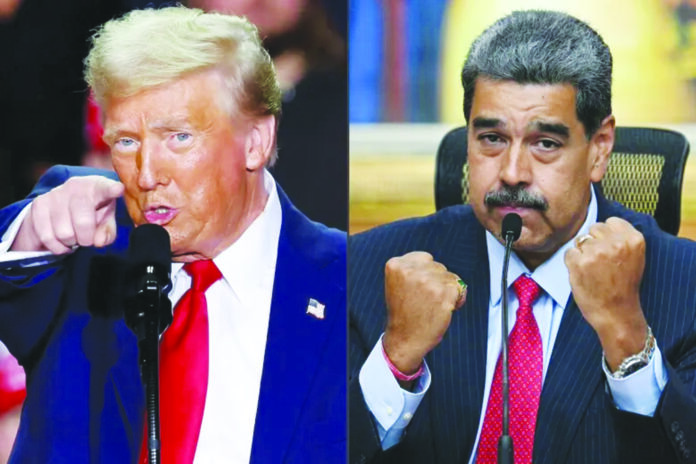
From Venezuela to Iran, the rules of international law appear to bend for some and break for others. The US capture of President Nicolás Maduro is the latest in a long line of interventions that treat sovereignty and norms as negotiable. This episode, as noted by Maleeha Lodhi in ‘Donroe doctrine’ in action’, fits squarely into a structural pattern: one in which might dictates legitimacy, law is selectively applied, and global norms are instruments of convenience rather than principle. While Lodhi highlights Venezuela’s immediate context, a broader analysis shows that these patterns extend across regions and decades, with consequences that demand deeper scrutiny.
Noam Chomsky, in works spanning decades— from Deterring Democracy (1991) to What Uncle Sam Really Wants (1992)— has meticulously documented this continuity. US foreign policy, Chomsky argues, prioritises dominance, economic access, and strategic compliance over morality or legality. This approach does not depend on ideology: whether during the Cold War, the unipolar moment after the Soviet collapse, or the present multipolar rhetoric, the logic remains consistent. Power, not principle, defines legitimacy. The Monroe Doctrine, repeatedly invoked and adapted, is not a defensive policy but a declaration of entitlement. Latin America has long been the testing ground for this entitlement— from Guatemala and Chile to Panama and now Venezuela. Each episode may differ in form or justification, but the underlying intent— regime change, coercion, and resource control— remains unbroken.
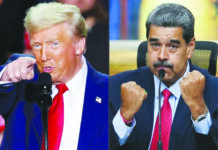
The Venezuelan operation illustrates this vividly. US authorities have justified Maduro’s capture as a law enforcement action to enforce criminal indictments, framing it domestically as a technical matter of justice. International law, however, tells a different story. The UN Charter prohibits the use of force against a sovereign state absent Security Council authorisation or self-defence justification. Experts have widely regarded the operation as a violation of sovereignty. Yet accountability remains elusive: the USA wields veto power on the Security Council, insulating itself from consequences, while the global system is left to witness the circumvention of norms.
What is particularly striking is the selective enforcement of law and morality. Powerful states are often exempt from standards imposed on others. Israel’s conduct in Gaza and the West Bank, widely cited by international legal scholars as violations of humanitarian law, receives muted criticism from the USA and its allies. Similarly, India’s treatment of minorities under the BJP government has drawn limited and inconsistent scrutiny. By contrast, the USA issues relentless threats against Iran’s government and ruling establishment— while Iranian citizens’ domestic protests against inflation and economic hardship remain internal matters, largely unthreatened. This glaring asymmetry demonstrates that law and rights are often instruments of power, applied strategically rather than universally. Global norms bend to the convenience of the powerful, while obedience is enforced selectively. This selective application is the modern embodiment of the Donroe doctrine: might determines legitimacy, and law is shaped by power.
Economic motives further underscore the structural logic. Access to natural resources, control over markets, and protection of strategic supply chains have consistently influenced US interventions. While security narratives often accompany these actions— framed as counter-narcotics, anti-terrorism, or humanitarian enforcement— the economic and geopolitical incentives are rarely incidental. Chomsky and other critics have long highlighted how interventions claiming moral or security justification frequently serve underlying strategic interests, often to the detriment of the populations purportedly protected.
The lesson is clear: from Maduro to Iran, from Gaza to other theaters of selective enforcement, these are not exceptions but the rule. The modern Donroe doctrine— might, law, and hypocrisy— continues to shape the international order. The challenge for policymakers, scholars, and civil society alike is to name it, confront it, and demand accountability, lest history continue to witness the repetition of the same cycles of power unchecked.
The implications of this structural imbalance are profound. Interventions rarely produce lasting stability, democracy, or prosperity. Instead, they deepen resentment, trigger humanitarian crises, and erode the legitimacy of international institutions. What appears as a temporary crisis— a single operation, a unilateral threat, a sanction regime— is, in fact, the predictable outcome of a global architecture in which one power can act with impunity. Each episode, whether Maduro’s capture, Iran’s targeted economic coercion, or selective toleration of allied violations, reinforces the rule that might, not law, defines legitimacy.
The contemporary “Donroe doctrine” is more than a historical echo. It is alive in the selective application of norms, in the calculated toleration of ally transgressions, and in the uncompromising coercion of adversaries. From Latin America to the Middle East, the same logic governs: sovereign rights are conditional, law is flexible for the strong, and interventionist power is routinely justified under the guise of principle. Unless this reality is named for what it is— a structural and enduring pattern— commentary risks underestimating its depth and consequences.
History teaches that unchecked power invites resistance and instability, not genuine order. The cycle repeats: interventions, selective enforcement, global condemnation, and eventual adjustment. Yet the underlying structural asymmetry remains, reproducing itself across administrations and global shifts. Recognition of this pattern is the first step toward confronting it. As Chomsky reminds us, understanding the systemic roots of interventionism— rather than treating each case as an anomaly— is essential if global norms are to mean more than rhetoric.
The lesson is clear: from Maduro to Iran, from Gaza to other theaters of selective enforcement, these are not exceptions but the rule. The modern Donroe doctrine— might, law, and hypocrisy— continues to shape the international order. The challenge for policymakers, scholars, and civil society alike is to name it, confront it, and demand accountability, lest history continue to witness the repetition of the same cycles of power unchecked.