




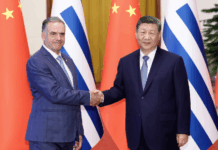





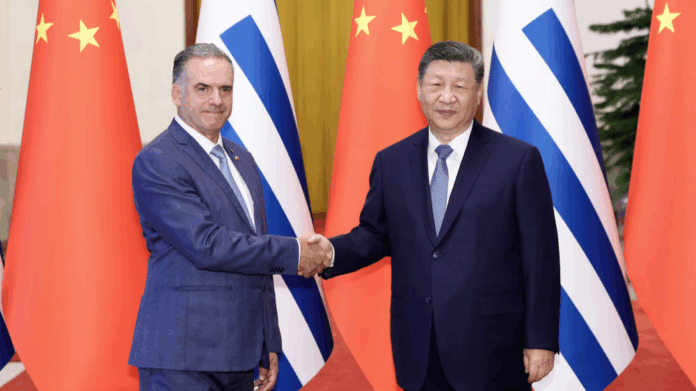
BEIJING: Chinese President Xi Jinping held talks with Uruguayan President Yamandú Orsi in Beijing on Tuesday, with both leaders pledging to deepen cooperation across multiple sectors and further align their development strategies under an expanding comprehensive strategic partnership.
President Orsi, who arrived in China on Sunday for a week-long state visit, is the first Latin American leader to visit the country in 2026. His trip follows recent visits by leaders from Ireland, the Republic of Korea, Canada, Finland and Britain.
Marking the 38th anniversary of diplomatic relations between the two countries, President Xi noted that China and Uruguay had consistently upheld mutual respect and win-win cooperation despite shifts in the international landscape. He called on both sides to build on this foundation and deepen their comprehensive strategic partnership “under the new circumstances” to ensure the relationship continues to grow stronger and more dynamic.
President Orsi said bilateral ties were at their strongest point in history, describing China as one of Uruguay’s most important cooperation partners. He stressed that strengthening relations with China was now a state policy in Uruguay, enjoying unanimous support across political parties and society.
Under the strategic guidance of the two leaders, China–Uruguay economic and trade cooperation has expanded rapidly. Bilateral trade surged from just $124 million at the establishment of diplomatic ties to $6.59 billion in 2024, a 24.4 per cent year-on-year increase, according to China’s General Administration of Customs. China has remained Uruguay’s largest trading partner for more than a decade and is the main destination for its soybean and wool exports.
Trade ties are also diversifying. Uruguay is increasingly becoming a hub for Chinese innovation, with Chinese new energy vehicles accounting for one in every three passenger vehicles sold in the country in 2025, according to industry data.
Referring to China’s upcoming 15th Five-Year Plan, adopted by the Communist Party of China’s 20th Central Committee, Xi said China’s development blueprint would create broad opportunities for countries worldwide, including Uruguay. He urged deeper cooperation in trade, finance, agriculture, infrastructure and information technology, while encouraging exploration of emerging areas such as green development, digital economy, artificial intelligence and clean energy.
Xi also highlighted the “natural affinity” between the peoples of China and Uruguay, calling for stronger exchanges in culture, education, sports, media and subnational cooperation, alongside greater facilitation of people-to-people contacts.
President Orsi echoed these sentiments, expressing Uruguay’s desire to elevate bilateral cooperation in trade, investment, science and technology, poverty alleviation, green growth and the digital economy. He also stressed the importance of expanding exchanges in education, tourism and sports to deliver greater benefits to both nations.
Following the talks, the two leaders witnessed the signing of more than 10 cooperation agreements covering investment, trade and other key sectors.
Backing Multilateralism and Global South Solidarity
Xi and Orsi also discussed multilateral cooperation, as Uruguay prepares to chair the Group of 77 and China, the Community of Latin American and Caribbean States (CELAC) and the Southern Common Market (Mercosur) in 2026.
Xi said China supports Uruguay’s leadership roles in these forums and stands ready to work with Montevideo to strengthen Global South solidarity, promote an equal and orderly multipolar world, and advance inclusive economic globalisation. He reaffirmed China’s support for Latin American and Caribbean countries in safeguarding sovereignty, security and development interests, and expressed readiness to deepen the China–LAC community with a shared future.
President Orsi praised Xi’s vision of building a community with a shared future for humanity and said Uruguay would work closely with China to uphold multilateralism, defend the international trading system, promote LAC–China relations and protect the shared interests of the Global South amid mounting global and regional challenges.