




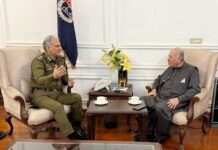









Federal minister for communications Abdul Aleem Khan, addressing his party workers in Kamoke the other day, said that for a sustainable solution to long neglected governance and service delivery to the masses in the far-flung areas of the country there was an imperative need for creation of more provinces. He suggested division of Punjab in four provinces and similar number units in the other existing provinces. He observed that new provinces will save people’s time and energy and ensure resolution of their problems at their doorstep.
The demand for creation of more provinces has been resonating in the country with fluctuating intensity for quite some time. We have heard demands for creation of a new province of South Punjab, restoration of the state of Bahawalpur, carving out of Hazara province from the present KPK and making Karachi a separate governing unit. The arguments in favour of the creation of more provinces usually have been poor governance, lack of development and distance factor from the provincial capitals. The question is do we really need more provinces for resolving the problems of the people?
An incisive look into the issue however reveals that the political parties have never shown required seriousness in the issue and have used this slogan sporadically to gain political mileage out of the prevailing political environment.
In the present scenario the demand for creation of more provinces is tantamount to the politicians and parties trying to exploit the prevailing political ambience for their narrow political ends.
It is interesting to note that those who defected from the PML(N) ranks before the 2018 elections and formed Janoobi Punjab Sooba Muhaz never raised the issue while they were part of the PTI government. These turncoats actually invented a justification for their betrayal at the fag-end of the PML(N) government to try their fortunes on another platform which in their estimation was likely to rule the roost after next elections. Their joining PTI removed all the haze about the game that has been played behind the scenes.
PTI welcomed the saleable horses and electables in the hope of getting more seats in the upcoming elections or even winning a majority with the help of its mentors at the time of merger of the Muhaz with PTI and pledged that it would make South Punjab a separate province within 100 days of coming into power. That surely was a political hoax to say the least in view of the fact that it involved a host of considerations and pre-requisites in creating a separate province including economic viability and the existence of necessary paraphernalia and administrative structures to run a province. In the absence of these ingredients any claim to create a new province amounted to blatant attempts to hoodwink the people for narrow political ends.
Probably the revolutionary who had cast off his cloak to become a traditional power grabber did not know that a new province could not be created through any administrative order or political ambition. It can only be done according to Article 239 (4) of the Constitution which says “A Bill to amend the Constitution which would have the effect of altering the limits of a Province shall not be presented to the President for assent unless it has been passed by the provincial assembly of the concerned province by two third majority of its total membership.” The first requirement therefore is support of the affected existing provinces.
As is evident from the foregoing, the people do not need more provinces on administrative or ethno-linguistic basis. They want their problems to be resolved at the local level which can be done only through strengthening the local government as per the Constitution and implementation of the 18th amendment in letter and spirit. It is therefore incumbent upon the political parties to shun their traditional politics of befooling the people and show honesty of purpose in resolving their problems through improved governance in consonance with the Constitution.
Creating provinces on linguistic or ethnic basis is fraught with great dangers. In an environment when Pakistan is confronted with internal and external dangers that pose an existential threat to the country, which requires strengthening of the state edifice and governing apparatus, any talk of dividing it further on linguistic or ethnic basis is absolutely unjustifiable.
Demands for more provinces largely represent populist slogans targeting Pakistani desires for instant short cuts to good governance. They confuse the functions of provincial and district governments. There is, therefore, a need to improve governance instead of adventuring with the idea of more provinces.
The real issue is about improving governance and regrettably the political parties, instead of resolving real problems through improvement in governance, have been focusing on serving their narrow and transient political interests. The constitution of Pakistan does provide the solution to the problems regarding governance and development of the deprived areas. There is a need to translate those constitutional provisions into reality.
After the 18th Amendment the provinces have been given the required autonomy and the right to own and use their resources for the benefit of the people. Improving governance depends on devising mechanisms to implement those constitutional provisions in letter and spirit. The solution to the problems indicated by the proponents of more provinces lies in strengthening the local bodies in conformity with Article 140A. Our constitution stipulates a three-tier system of governance, that is, local government, provincial government and the federal government. Local Bodies are meant to deliver to the people at the grass-root level and according to Article 140A are supposed to enjoy almost plenipotentiary powers in regards to running their respective territorial domains. The article reads “Each province shall, by law, establish a local government system and devolve political, administrative and financial responsibility and authority to the elected representatives of the local governments”
Under this Article the local administration and police are required to be under the supervision of the local bodies at the district level. The development at the local level is the responsibility of the local bodies. Bringing the district administration and police under the local bodies will also end the ‘Thana culture’.
A close look at the prevailing system of local bodies reveals that they are not functioning in accordance with the Constitution in all the four provinces and are still under the thumb of the bureaucracy which to a great extent scuttles their ability to deliver. The practice of giving development funds to the MNAS and MPAs needs to be scrapped as it has hardly paid any dividends. In fact development funds are like pocket money given to the lawmakers for winning elections. Unfortunately our law makers and bureaucracy are the major hurdles in empowering the local bodies according to the constitution.
As is evident from the foregoing, the people do not need more provinces on administrative or ethno-linguistic basis. They want their problems to be resolved at the local level which can be done only through strengthening the local government as per the Constitution and implementation of the 18th amendment in letter and spirit. It is therefore incumbent upon the political parties to shun their traditional politics of befooling the people and show honesty of purpose in resolving their problems through improved governance in consonance with the Constitution.